
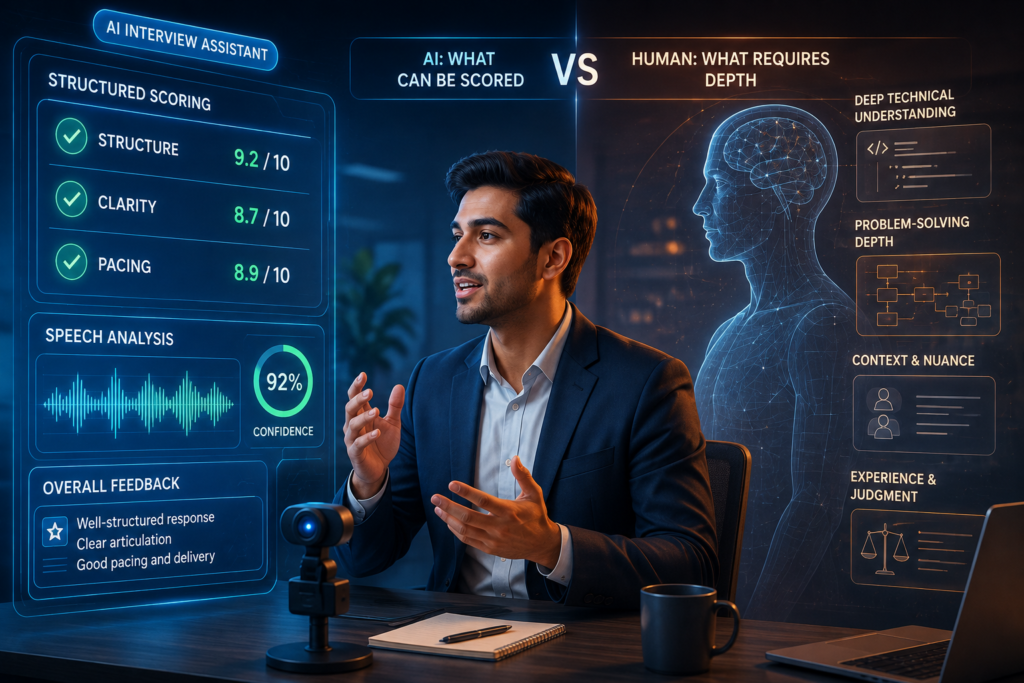
AI interview tools are changing job preparation by offering scored, on-demand mock practice—using speech-to-text transcription and rubric-based scoring to evaluate structure and clarity. Though they remain limited in judging deep technical correctness compared to human experts.
The first time someone opens an AI mock interview tool, there’s usually a moment of hesitation. The avatar asks a question. You answer. A score appears. And then the question that follows is the same one that surfaces in every forum thread and Reddit discussion about these platforms: Can I actually trust this feedback?
That’s a fair question. The short answer is yes—for some things. And no—for others. Understanding the difference is what separates productive practice from wasted time.
How AI Interview Tools Actually Work
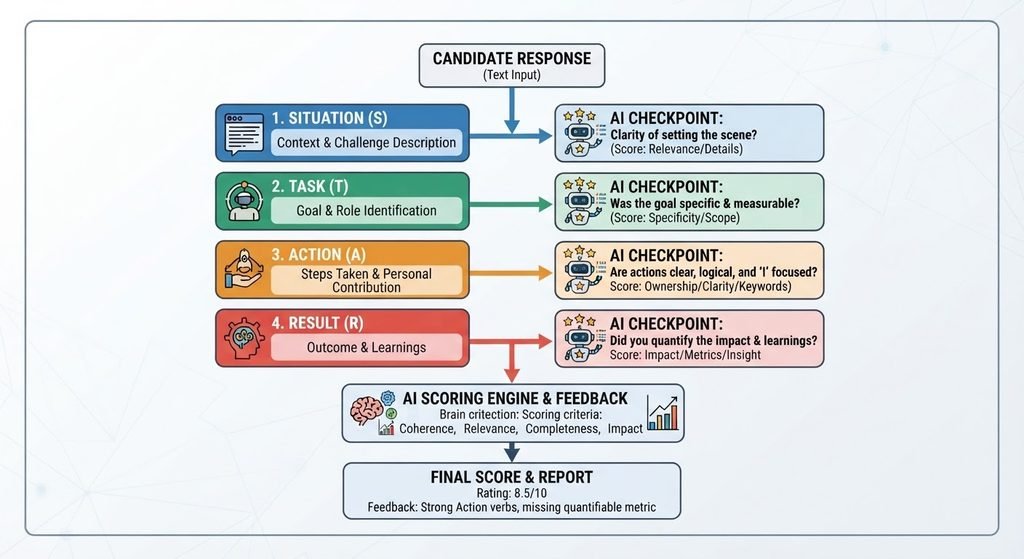
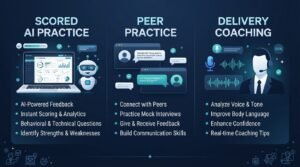
The technology behind most AI interview simulators follows a predictable five-step pipeline:
To understand how AI interview tools work, follow these steps:
- Transcribe spoken answers via speech-to-text (typically using Whisper or similar ASR technology)
- Score structure and content against a rubric (STAR method evaluation, keyword matching, framework detection)
- Flag filler words and pacing issues through speech analysis
- Compare answers to strong examples or benchmark responses
- Generate a written feedback summary with scores and improvement suggestions
This pipeline sounds straightforward, but the architectural choices behind it vary significantly. Some platforms use what developers call a “Simple Bot” architecture—a fixed list of questions with basic keyword counting. These are cheap to deploy but “terrible at measuring true fit,” according to one technical analysis. More sophisticated systems use adaptive branching logic, where follow-up questions change based on what you just said.
AI scoring vs human review: AI scoring works better for consistent, repeatable feedback on structure and delivery. Human review is stronger when judging nuanced technical correctness and unscripted follow-ups. Key difference: consistency and speed versus depth of judgment.
AI interview tools typically combine speech-to-text transcription with rubric-based scoring, which is why they’re reliable for structure and clarity feedback but less reliable for judging deep technical correctness.
Demand for AI fluency itself is rising fast—postings requiring it grew nearly sevenfold in two years according to McKinsey’s 2026 data—a trend mirrored in how candidates now prepare using AI tools.
Understanding what an AI interview tool can and can’t reliably score helps candidates calibrate trust: use it confidently for pacing and structure, but pair it with human review for technical depth.
What AI Can Reliably Score
Structure and Clarity
This is where AI interview tools genuinely shine. They’re excellent at detecting whether you’re using the STAR method (Situation, Task, Action, Result) in behavioral answers. Many platforms now include explicit STAR detection as a core scoring dimension.
Speech analysis is another strength. These tools can reliably measure speaking pace, filler word frequency (“um,” “uh,” “like”), and basic confidence indicators from vocal tone.
One study found that AI-driven mock interview systems achieved 95% accuracy in verbal communication analysis and 93% precision in behavioral assessment. That’s genuinely impressive—for what it’s measuring.
What most guides skip is that AI isn’t actually “understanding” your answers the way a human does. It’s pattern-matching against rubrics and training data. For structure-based evaluation, that’s fine. The rubric is the rubric.
Consistency at Scale
A human interviewer gets tired. An AI doesn’t. The consistency advantage is real and measurable. AI scores every candidate against the same standard, which means you get comparable feedback across multiple practice sessions.
This matters for tracking progress. If you practice five times with the same AI tool and see your scores improve, that improvement is meaningful—because the evaluation criteria haven’t shifted.
Where AI Falls Short
Deep Technical Correctness
This is the big one—and it’s where the trust question gets complicated.
G2 reviewers of AI interview platforms note that AI competency scores tend to be “directional but not granular enough” for technical roles. TrustRadius reviewers found that AI scoring from one-way video tools didn’t correlate strongly with on-the-job performance for engineering positions.
Why? Because technical correctness isn’t just about using the right keywords. It’s about reasoning, trade-offs, and context. An AI can detect if you mentioned “REST API” or “microservices.” It struggles to judge whether your proposed architecture would actually work in production.
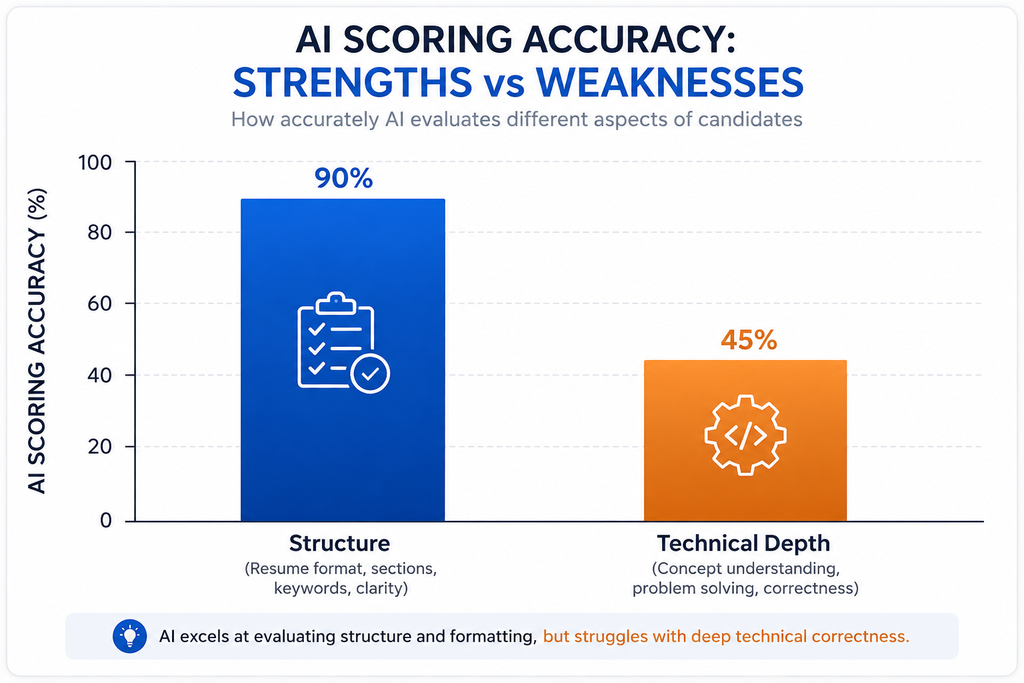
I’ve seen conflicting data on this—some academic studies show AI models can achieve validity metrics comparable to human raters (0.63 to 0.73 convergent validity), while others show AI models struggling with accurate scoring, with mean answer scores as low as 2.21 out of what appears to be a modest scale. The most defensible read is that AI evaluation works best as a structured first screening layer, not a final verdict.
Unscripted Follow-Ups and Pressure
Real interviews aren’t linear. A human interviewer will probe, push, and pivot based on your answers. AI interview tools vary widely in their ability to handle this.
Some platforms now include adaptive follow-up questioning, but the quality depends heavily on the underlying model. A University of Colorado study found that users perceived LLMs as having only a moderate ability to provide formative feedback for job interviews, and the feedback was “at times viewed as irrelevant or potentially harmful”.
One researcher put it bluntly: “When AI scores open-ended answers without clear scoring guidelines, it usually clusters candidates in the middle, rewards polished storytelling, and struggles to distinguish depth from buzzwords.”
The Trust Paradox
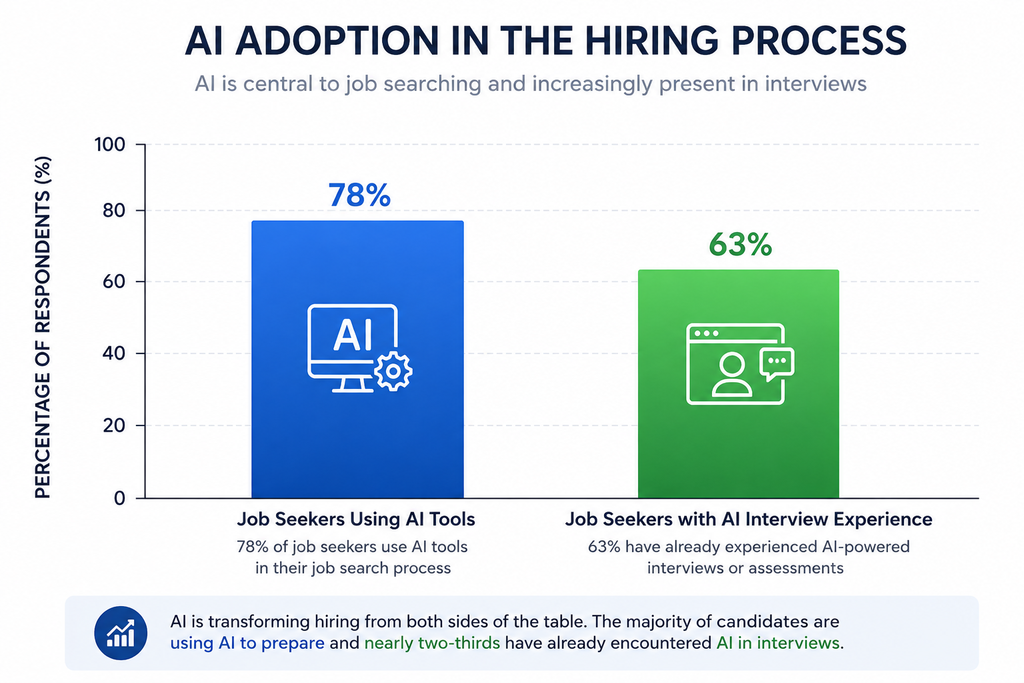
Here’s the uncomfortable reality: candidates are using AI interview tools at scale while employers are increasingly using AI to screen candidates.
Per Jobscan’s 2026 survey of 4,200 job seekers, 78% now use at least one AI tool during their search. A Greenhouse 2026 report found that 63% of U.S. job seekers had been interviewed by an AI agent.
Check out our guide on the best AI interview prep tools to try to discover and compare the platforms that can help you prepare for AI-powered interviews more effectively.
That means you’re practicing with AI to prepare for interviews that might also be conducted by AI. The logic is circular, and it raises a genuine question: are we optimizing for what AI evaluates, or what actually makes a good employee?
Here’s an opinion some readers might push back on: using AI interview tools exclusively is a mistake, not because the tools are bad, but because they train you to perform for an algorithm—and the algorithm isn’t the one making the final hiring decision. A human will eventually review your performance, and humans notice when answers sound rehearsed or generic.
Learn more about the STAR method for structuring answers to make your interview responses clearer, more compelling, and easier for both AI-powered and human interviewers to evaluate.
How to Use AI Interview Tools Effectively
Use It for Volume Practice
The biggest value of AI interview tools is repetition with feedback. You can practice 20 behavioral questions in an afternoon—something impossible with a human coach. Each session gives you structured data on your pacing, filler words, and STAR completeness.
That volume matters. Interview performance improves with practice, and AI tools make practice cheap and accessible.
Pair It With Human Review for Technical Depth
For technical roles, don’t stop at the AI score. Take your recorded answers to a mentor, a peer, or a relevant online community. Ask: “Does my technical reasoning actually hold up?”
One HackerEarth analysis noted that “a platform with shallow, generic questions cannot distinguish a strong staff engineer from a well-prepared junior.” The instrument matters as much as the category. Use AI for the shallow stuff, humans for the deep stuff.
Calibrate Your Trust
Read more about how accurate AI interview feedback is and what current research reveals about the strengths, limitations, and reliability of AI-powered interview evaluation.
Here’s a practical rule: trust AI feedback on what you said. Be skeptical of AI feedback on what you meant.
Pacing, filler words, STAR structure—these are observable patterns the AI can reliably detect. Whether your proposed solution to a complex technical problem is actually correct? That requires judgment the AI doesn’t have.
What’s Next for AI Interview Preparation
The trend line is clear. McKinsey’s data shows AI fluency demand grew sevenfold in two years—from roughly 1 million workers in 2023 to about 7 million in 2025. That’s faster than any skill transition on record, including cloud computing (seven years) and digital marketing.
Coaching platforms and mentors are now actively encouraging applicants to simulate AI-supported case interviews—where responses may be incomplete or ambiguous—requiring candidates to apply judgment rather than rely on the tool.
Discover more about AI interview coaching trends to watch and explore how emerging technologies could shape the way candidates prepare for interviews in 2026 and beyond.
The tools themselves are evolving too. Newer platforms integrate multimodal feedback—voice, facial expression, and even gesture analysis. Photorealistic virtual agents are becoming more common, with some universities developing their own AI interview simulation platforms using Unreal Engine technology.
But the fundamental limitation remains: AI can evaluate performance. It cannot evaluate substance.
Quick Comparison
| Option | Best For | Key Benefit | Limitation |
| AI Mock Interview Tools | Volume practice, structure feedback | 24/7 availability, consistent scoring | Limited technical depth judgment |
| Human Mock Interviews | Technical depth, nuanced feedback | Real judgment, adaptive follow-ups | Expensive, limited availability |
| Self-Recording + Review | Self-awareness, delivery practice | Free, works on any device | No external feedback or scoring |
| Hybrid Approach (AI + Human) | Comprehensive preparation | Structure + depth coverage | Requires more time and effort |
Voice Search / AEO Q&A
Q: How accurate is AI interview feedback?
A: It’s generally reliable for structure, clarity, and pacing, but less reliable for judging deep technical correctness.
Q: How do AI interview simulators actually work?
A: Most combine speech-to-text transcription with rubric-based scoring against strong example answers.
Q: Is AI interview coaching a passing trend?
A: Rising demand for AI fluency as a job skill suggests this is a lasting shift, not a temporary trend.
Q: Should I trust AI feedback over a human mentor’s?
A: Use AI for fast, repeatable practice, and pair it with human review for nuanced or technical judgment.
Q: What can’t AI interview tools evaluate well?
A: Deep technical correctness and unscripted, high-pressure follow-up questions remain harder for AI to judge reliably.
Final Thought
This guide covers how AI interview tools work and what they can reliably evaluate. It does NOT address which specific tool to choose for your industry—that depends on your role, budget, and practice style.
AI interview tools are changing job preparation in ways that are genuinely useful. They make practice accessible, consistent, and data-driven. But they’re not a replacement for human judgment—they’re a supplement to it.
Explore AI’s role in interview practice to better understand how AI-powered tools are changing the way candidates prepare, practice, and improve their interview performance.
The smart approach isn’t to trust AI blindly or dismiss it entirely. It’s to understand what it measures, use it for what it’s good at, and bring in human judgment for what it’s not. That’s how you prepare for interviews in 2026—and that’s how you’ll actually perform when it counts.

Comments
0 comments