This guide covers resume optimization tools for job seekers applying to companies using AI-powered hiring platforms. It does NOT address executive-level retained search, internal promotions, or industries where resumes are rarely used (e.g., creative portfolios).
If you’ve spent hours tailoring a resume for a job posting, only to wonder whether a machine ever actually read it — you’re not alone. The uncertainty isn’t paranoia. [best resume optimization tools for ai hiring] is Resume optimization for AI-powered hiring means writing content that performs well against both keyword-matching ATS software and newer semantic AI-scoring systems that evaluate contextual relevance, not just exact keyword matches.
The landscape changed faster than most job seekers realize. Here’s what happened: 87% of companies now use AI somewhere in their recruitment funnel, and 58% of hiring managers use AI specifically to screen resumes. That doesn’t mean the old ATS keyword game is dead. It means you’re now playing two games simultaneously — and optimizing for one can actively hurt you in the other.
Why “Just Match Keywords” No Longer Works
Let’s clear up a major confusion. Most articles treat ATS and AI hiring as the same thing. They’re not.
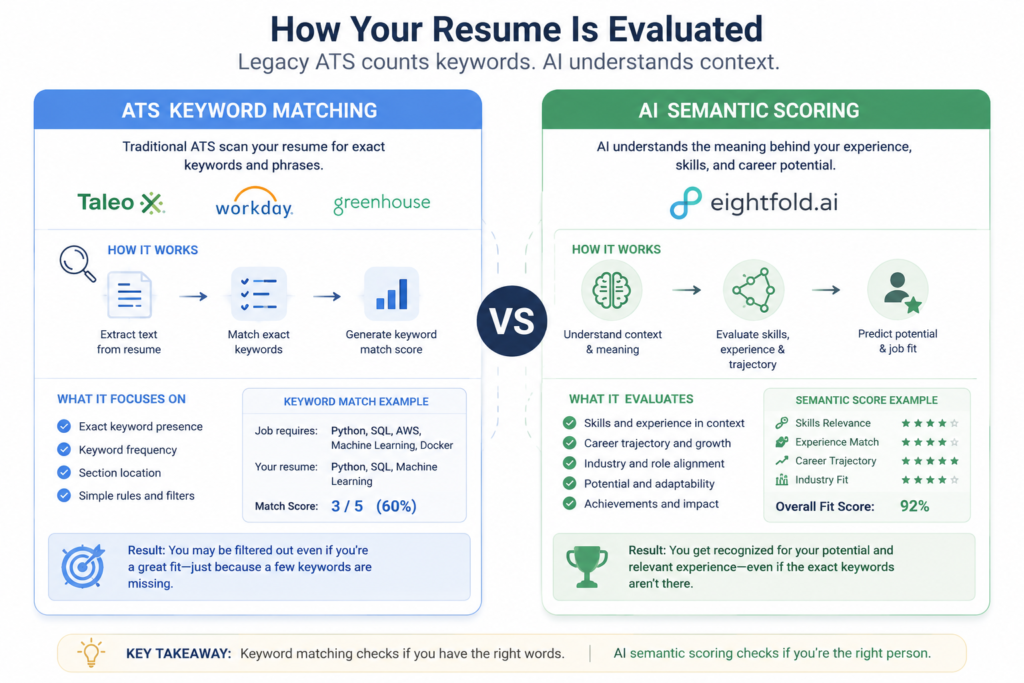
Applicant Tracking Systems (ATS) — platforms like Greenhouse, Lever, Workday, and Taleo — are primarily databases. They parse your resume into structured fields: name, job titles, companies, dates, education, skills. Recruiters then search and filter that database. The “keyword match” matters because if you don’t have the right terms in the right places, you won’t appear in those searches.
AI resume scoring systems — platforms like Eightfold, Beamery, and proprietary employer models — do something different. They evaluate semantic fit. Instead of counting how many times “project management” appears, they assess whether your experience contextually aligns with what the job requires. Eightfold’s matching engine, for example, uses deep semantic understanding to evaluate factors like skill overlap, title progression, seniority fit, and industry similarity.
Most articles conflate these two layers. That’s the gap this guide fills.
What most guides skip is that you can score 80 on one system and 58 on another with the exact same resume. One test run by AI Applyd in April 2026 submitted the same product manager resume through Jobscan, Teal, and Resume Worded against the same job description. The scores came back at 58, 72, and 80 — a 22-point spread. Each tool was measuring something different.
So if you’re optimizing for “the algorithm,” which algorithm?
How AI Hiring Systems Actually Score Your Resume
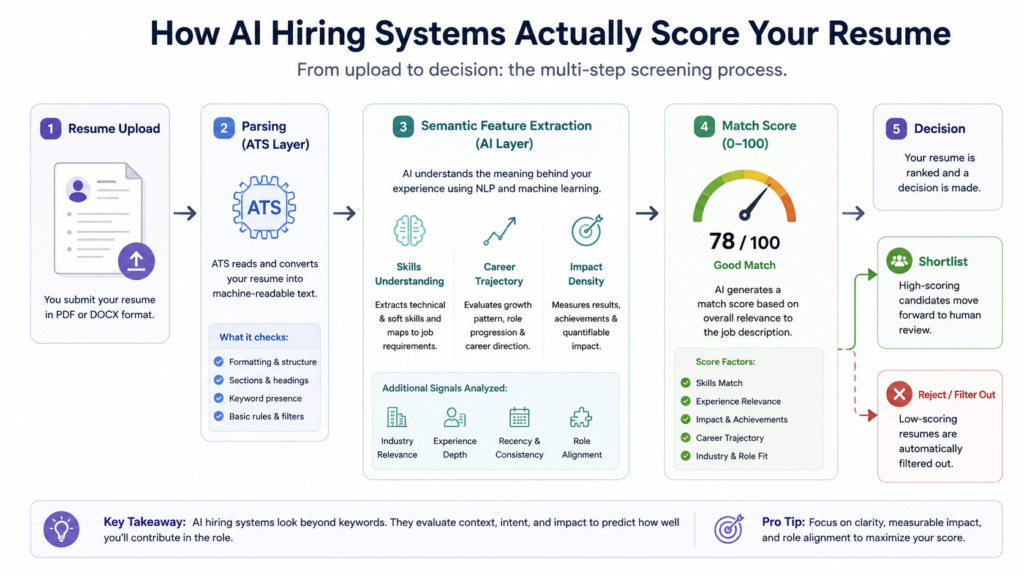
The modern hiring stack for most Fortune 500 companies looks like this:
- ATS keyword filter — automated parsing (this is the old layer)
- AI resume scorer — tools like Eightfold or proprietary models that score candidate fit
- AI-generated interview questions — tailored to your resume
- Async video interview screening — HireVue, Spark Hire, or similar
- Human recruiter — only if you clear the above
Most candidates are never seen by a human at all.
AI scorers evaluate more than keywords. According to an analysis of how these systems work, they assess:
- Skills-to-role fit — semantic matching between your experience and job requirements
- Career trajectory — are you growing in scope or stagnating?
- Tenure signals — multiple sub-12-month roles flag most models
- Impact language density — percentage of bullet points with quantified results
- Completeness — missing sections penalize your score
Here’s an opinion some readers might push back on: I think the emphasis on “exact keyword matching” is overblown for AI-scored applications. Yes, you need the right terms. But the semantic layer cares more about whether your experience reads like the right experience than whether you hit every buzzword. That’s why keyword stuffing — which some tools still encourage — can actually backfire on semantic platforms
Best Resume Optimization Tools for AI Hiring in 2026
To optimize for AI hiring systems, follow these steps:
- Match exact keywords from the job posting in your skills and experience sections.
- Add context sentences that demonstrate impact, not just keyword lists.
- Quantify achievements with real numbers — dollars, percentages, volumes.
- Avoid keyword stuffing, which semantic tools flag as unnatural.
- Test against more than one scoring tool to see where you stand.
Below are the top tools, ranked by how well they address both ATS keyword matching and AI semantic readiness.
Quick Comparison
| Tool | Best For | Key Benefit | Limitation |
| Jobscan | Deep ATS keyword matching | Most rigorous match scoring against real job descriptions | Barely tells you how to fix what’s wrong |
| Teal | All-in-one job search workspace | Most actionable per-line feedback at $29/mo | Weaker on deep ATS authority than Jobscan |
| Resume Worded | Bullet-point quality and LinkedIn alignment | Only tool that audits both resume and LinkedIn together | Most expensive per useful insight |
| VMock | Detailed language feedback | AI-powered review of structure, wording, and clarity | Less focused on job-specific matching |
| SkillSyncer | Quick keyword comparison | Simple resume-to-job-description comparisons | Limited depth and feedback |
Jobscan — Best for ATS Keyword Matching
Learn more about the best resume optimization tools for AI hiring and how they improve your chances of passing modern screening systems.
Jobscan remains the gold standard for comparing your resume against a specific job description. It scores your match percentage, highlights missing keywords, and shows you exactly where you fall short against the ATS layer. At $49.95/month, it’s not cheap. But if you’re applying to companies using traditional ATS filters (which is still 71% of hiring managers), Jobscan gives you the most rigorous analysis available.
- What it gets right: The match scoring is built on actual ATS parsing logic, not generic keyword counting.
- What it misses: It barely tells you how to fix anything. You get a score and a list of missing terms — but no guidance on how to integrate them naturally.
- Best use case: Run your resume through Jobscan first to identify keyword gaps. Then use a second tool for rewriting help.
Teal — Best All-in-One Job Search System
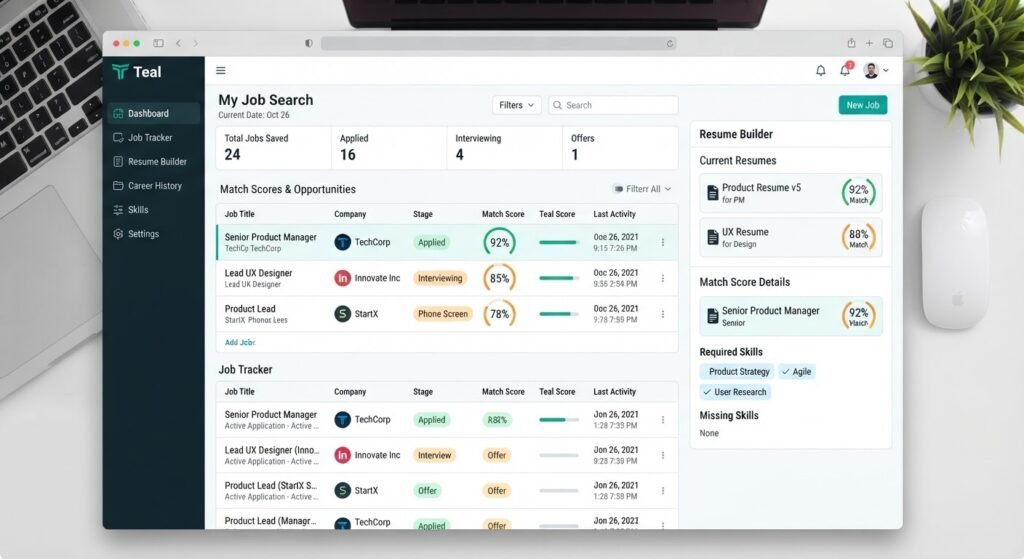
Teal is less a resume scanner and more a full job search operating system. It combines a resume builder, job tracker, and tailoring tools in one workspace. At $29/month (with a generous free tier), it’s the most affordable paid option among the top three.
- What it gets right: The per-line feedback is the most actionable of any tool. It doesn’t just tell you what’s missing — it shows you where and suggests alternatives.
- What it misses: It doesn’t have Jobscan’s depth on ATS authority. If you’re applying to roles at companies using older, rules-based ATS systems, Teal’s match scoring may not catch everything Jobscan would.
- Best use case: Use Teal as your primary job search workspace if you’re managing multiple applications and want a balance of tracking, tailoring, and scoring.
Resume Worded — Best for Bullet Quality and LinkedIn Alignmen
Want to improve your resume’s performance in AI-driven hiring systems? Read our complete guide to optimize your resume for AI screening.
Resume Worded takes a different approach. It’s built by career consultants and focuses on the quality of your writing, not just keyword density. At $49/month (Pro tier), it’s expensive — and the free tier is severely limited
- What it gets right: It’s the only tool that explicitly rewrites your bullet points, not just flags them. It also audits your LinkedIn profile alongside your resume, which matters because some AI systems cross-reference both
- What it misses: The feedback volume can be overwhelming — one test flagged 18 missing keywords and suggested rewrites on 11 of 14 bullets. At $49/month, it’s the most expensive per useful insight.
- Best use case: Use Resume Worded after you’ve fixed keyword gaps with Jobscan or Teal. It’s the polishing layer, not the foundation.
Free and Budget-Friendly Alternatives
Not ready to pay $30–$50/month? A few alternatives exist:
SkillSyncer offers simple keyword matching at a lower price point. VMock provides detailed feedback on language and structure and is sometimes available free through university career centers. FlowCV offers clean templates with no paywall for basic use
Some job seekers also use general-purpose LLMs like ChatGPT or Claude to tailor resumes. The key is feeding them the job description and your resume, then asking for specific rewrites that preserve your actual experience. Just watch for AI-generated filler language — recruiters have pattern-matched on phrases like “synergized cross-functional deliverables” and it signals that the candidate can’t write
The One Thing Most Resume Optimization Tools Get Wron
[resume optimizer for ai recruiters] is A growing number of resume optimization tools claim to help you “beat the ATS” or “get past AI filters.” Many of these claims are either oversimplified or flat-out wrong.
The biggest misconception: that ATS systems have a single “algorithm” that ranks and rejects resumes automatically. In reality, modern ATS platforms like Greenhouse, Lever, and Workday are databases. Recruiters search and filter them. The “filter” is the recruiter’s search query, not an invisible algorithm.
That said, AI scoring systems like Eightfold do rank candidates. And in January 2026, a class action lawsuit was filed against Eightfold alleging it scored job applicants on a zero-to-five scale and discarded low-ranked candidates before human review. The lawsuit claims these AI-generated scores should be subject to the same Fair Credit Reporting Act requirements as credit agencies.
This matters for job seekers because how you optimize depends on which layer you’re trying to beat.
I’ve seen conflicting data on this point — some sources say semantic AI systems are more forgiving of non-exact language, others say they still penalize missing keywords heavily. The most defensible read is that both matter, but in different proportions depending on the employer’s specific tech stack. You can’t know which platform a given employer uses. So you need to optimize for both.
How to Build a Resume That Works for Both ATS and AI System
[ai resume scoring tools] are Employers increasingly use AI not just to screen, but to score. A 2026 academic paper on LLM-based resume screening found that criterion validity decreases when resumes are rephrased, while discrimination validity increases. Translation: AI systems are getting better at spotting candidates, but they’re also getting pickier about how you present your experience.
Here’s what actually works:
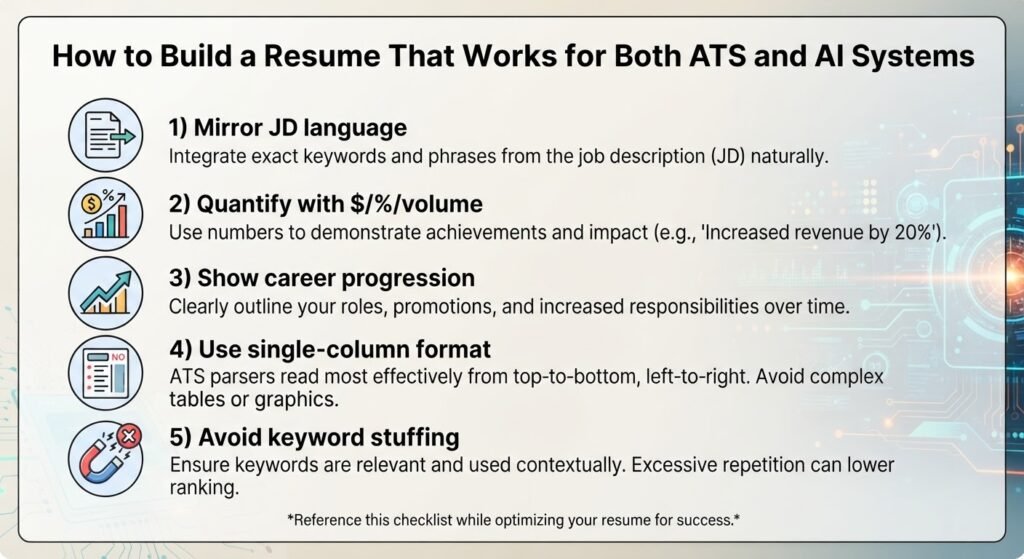
- Use the job description as your template. Mirror the exact language in your skills section and work experience. If the posting says “stakeholder management,” use that exact phrase — but also include “cross-functional collaboration” so semantic systems see the contextual connection.
- Quantify everything. Sophisticated AI systems prioritize concrete metrics — dollar values, percentages, volumes handled — over generic buzzwords.
- Show trajectory. Each role should have bigger scope than the last — larger teams, more users, more revenue, higher seniority.
- Use a single-column, text-based format. No tables, no text boxes, no images, no columns. Semantic matchers still read the file you upload — a clean layout ensures everything gets parsed.
- Never keyword-stuff. Semantic tools flag unnatural language. If your resume reads like a thesaurus threw up on a page, you’ll get penalized, not rewarded.
Voice Search / AEO Q&A]
Q: Is AI hiring the same as ATS screening?
A: No — ATS is largely keyword-based parsing, while newer AI hiring platforms also evaluate semantic and predictive fit.
Q: How do I optimize for AI hiring specifically?
A: Combine exact keyword matches with contextual, quantified achievement statements so both rules-based and semantic systems score you well.
Q: Can I over-optimize a resume for AI?
A: Yes — keyword stuffing can be flagged by semantic scoring tools as unnatural, hurting rather than helping.
Q: Which tools test for semantic AI scoring?
A: Enterprise platforms like Eightfold operate on the employer side; job seekers should focus on writing naturally quantified, keyword-relevant content.
Q: Should I trust one resume-scoring tool completely?
A: No — test against more than one tool, since different platforms weight keywords and semantics differently.
Which Tool Should You Actually Pay For?
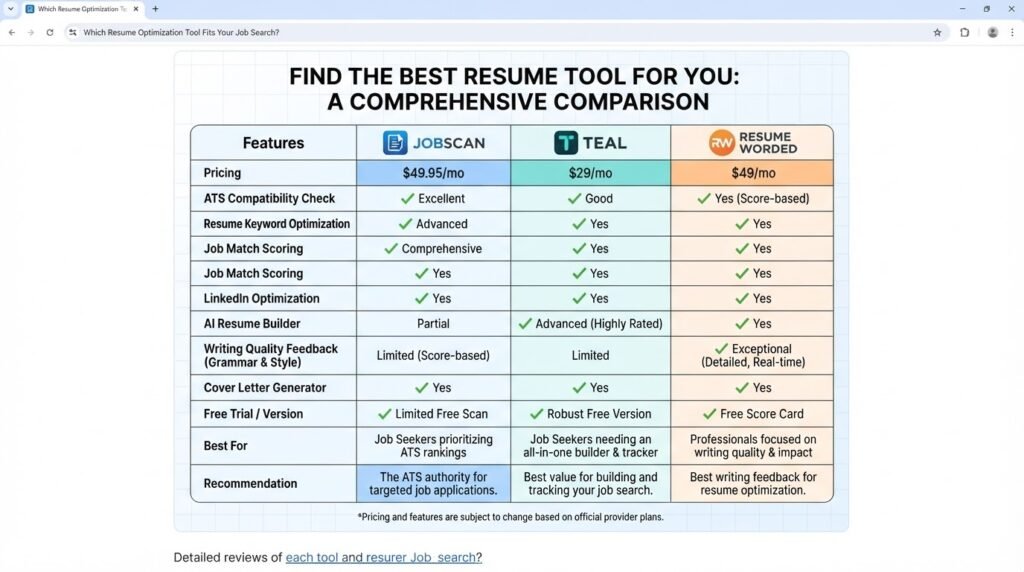
Here’s the honest take: there is no single best tool because each measures something different.
- If you’re most worried about getting past the ATS keyword filter, start with Jobscan.
- If you’re managing multiple applications and want a workspace + scoring combo, go with Teal.
- If your writing needs work and you want bullet-by-bullet feedback, invest in Resume Worded.
See our breakdown of resume tools for algorithmic hiring to compare the features, strengths, and limitations of today’s leading options.
The smartest approach: use the free tier of each tool to get a baseline, then pay for the one that addresses your biggest weakness. And remember — no tool replaces human judgment. A good optimizer helps you highlight real experience and mirror job description language. It should never invent skills, employers, certifications, or metrics you don’t actually have.
Keyword matching vs semantic scoring: Keyword matching works better for older, rules-based ATS like Taleo because those systems count exact term occurrences. Semantic scoring is stronger when platforms like Eightfold evaluate contextual fit. Key difference: keyword systems ask “does this word appear?” while semantic systems ask “does this experience fit the role?”