This works best for candidates with a scheduled interview within 1–4 weeks. It won’t apply if you’re casually browsing jobs with no set timeline — in that case, start with free tools first and revisit paid options later.
Best AI Interview Preparation Tools for 2026: Scored Practice vs. Peer Feedback
The problem with most “best AI interview prep tools” roundups is they treat every tool the same way. Google Interview Warmup, a free browser-based warm-up, gets stacked next to Final Round AI, a paid platform that scores your answers and offers live interview assistance. They’re not the same category of tool.
One gives you pattern recognition. The other gives you a scored AI mock interview with structured feedback. And neither one replicates what you get from a live peer mock with another candidate.
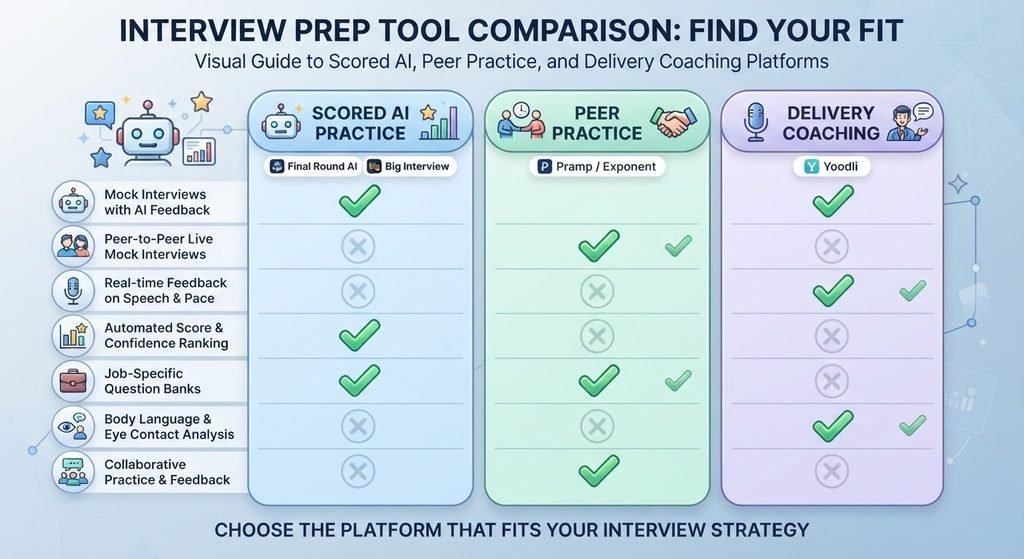
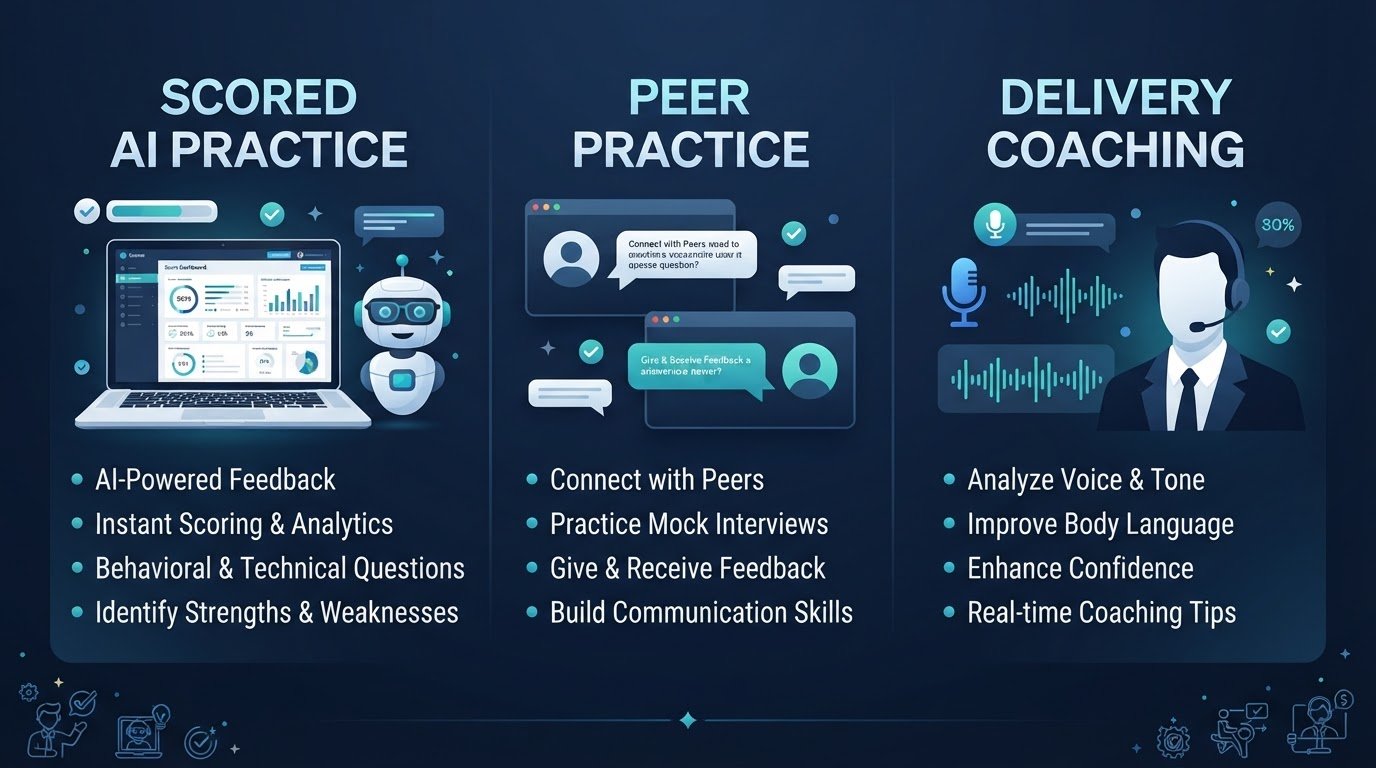
best ai interview preparation tools are AI-powered platforms that simulate real interview questions, score spoken or written answers, and give structured feedback on content, clarity, and delivery so candidates can practice before the real conversation. They fall into three distinct buckets: structured practice with scoring, technical/peer-based practice, and delivery/speech coaching.
Here’s how to pick the right one — not based on a generic ranking, but on what you actually need before your interview date.
What Most Interview Prep Guides Get Wrong
Most guides rank tools by price or feature count. That’s like comparing a calculator to a spreadsheet because both have numbers. The real distinction is whether a tool gives you AI-scored feedback or unscored human peer practice.
Learn more about AI-scored feedback and how AI evaluates the quality of your interview responses.
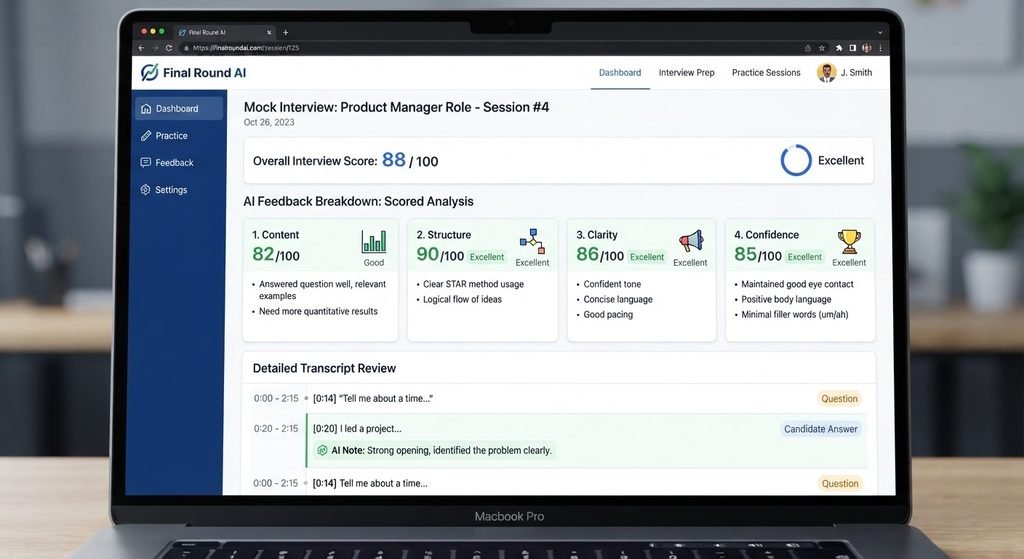
AI-scored tools (Final Round AI, Yoodli, Big Interview) analyze your answers against rubrics — structure, keyword density, filler words, pacing, clarity. They give you a number or a hire/no-hire verdict.
Unscored peer tools (Pramp/Exponent) pair you with another candidate. You take turns interviewing each other. You get real human feedback, but no algorithm scores your response.
Here’s the counter-intuitive insight: For most candidates, AI-scored practice is more valuable than peer practice in the first week of preparation. Why? Because AI gives you consistency. Every session follows the same rubric. You can track improvement session to session. With peer practice, the quality depends entirely on who you’re paired with — and in 2026, Pramp sessions still vary widely based on your partner’s experience level.
What most guides skip is the follow-up question: What happens after you get your score? AI tools show you where you’re weak. But they can’t replicate the unscripted pressure of a human interviewer who interrupts, asks follow-ups, or changes direction mid-answer. That’s where peer practice still wins.
The Three Types of AI Interview Prep Tools (And When to Use Each)
Type 1: Structured Practice with AI Scoring
These tools are built for volume. You answer questions, the AI scores you, you repeat. They’re ideal for candidates who need to practice structure — learning to frame answers clearly, use the STAR method, and avoid rambling.
Final Round AI offers unlimited AI mock interview sessions starting at $25/month on the annual plan ($300/year) or $150/month month-to-month. The platform includes real-time coaching during practice sessions and, controversially, live assistance during actual Zoom interviews. Reviewers have reported platform compatibility issues during real interviews and a 17% one-star rating rate.
Big Interview takes a different approach: curriculum first, practice second. It’s used by over 600 universities and career centers. Pricing runs roughly $39/month to $299 for lifetime access. Many universities provide free access through career services — worth checking before you pay.
The gap: Final Round AI emphasizes live assistance; Big Interview emphasizes structured learning. If you already know how to structure answers and just need reps, Final Round AI is overkill. If you don’t know what a good answer sounds like, Big Interview’s curriculum is more valuable.
Type 2: Technical and Peer-Based Practice
Technical candidates — software engineers, data scientists, product managers — face a different problem. Behavioral answers matter, but coding challenges and system design questions sink most technical interviews.Pramp (now part of Exponent) is a free peer-to-peer platform where two candidates take turns interviewing each other. Sessions cover technical coding, system design, product management, and behavioral rounds. It remains one of the most widely used free mock interview tools for candidates targeting FAANG-level companies.
The tradeoff: It’s free because you’re trading your time for another candidate’s time. Session quality depends entirely on your peer match. One session you’ll get a sharp engineer who gives useful feedback. The next, you’ll get someone who’s just as nervous as you are.
Explore technical and peer-based practice with mock interview platforms designed specifically for engineers.
Exponent (which now hosts all new Pramp sessions) offers structured courses and coaching for product management and system design interviews at roughly $79/month, with a free tier available.
Type 3: Delivery and Speech Coaching
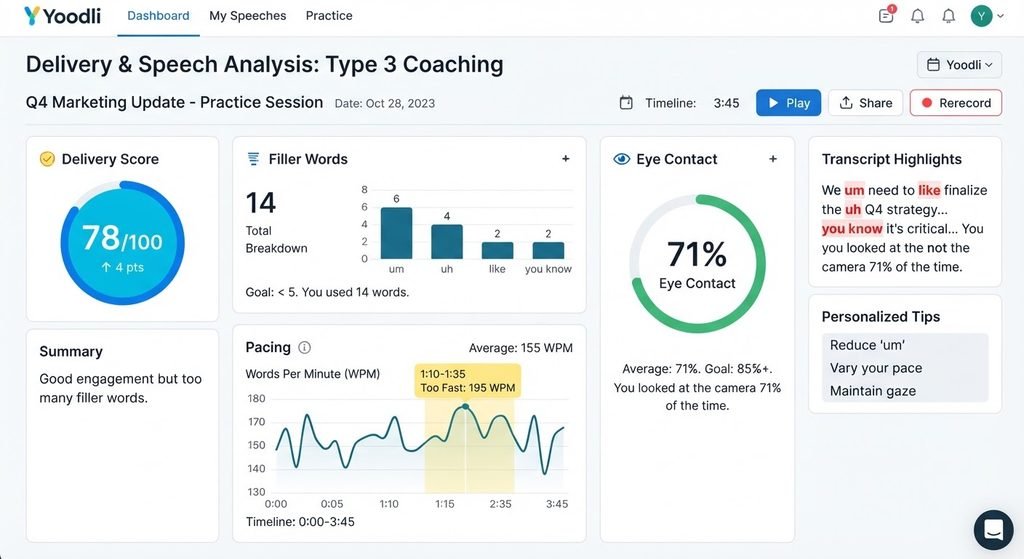
Some candidates know the content but stumble on delivery. Filler words. Monotone pacing. Poor eye contact (on video). These tools focus on how you speak, not just what you say.
Yoodli is the standout here. The free plan gives you 5 lifetime roleplays. Pro costs $8/month (billed annually) for up to 10 roleplays per week. Advanced runs $20/month for unlimited roleplays. The platform analyzes filler words, pace, eye contact, and confidence — making it the best ai interview coach for candidates who already know their content but struggle with delivery.
Discover more about AI interview coach tools that help improve your speech, delivery, confidence, and overall interview performance.
Yoodli has partnered with institutions like the University of Washington to provide AI-powered communication coaching to over 50,000 students, faculty, and staff.
The limitation: Yoodli scores delivery, not substance. It won’t tell you if your answer to “Tell me about yourself” is actually compelling. It’ll tell you if you said “um” 17 times.
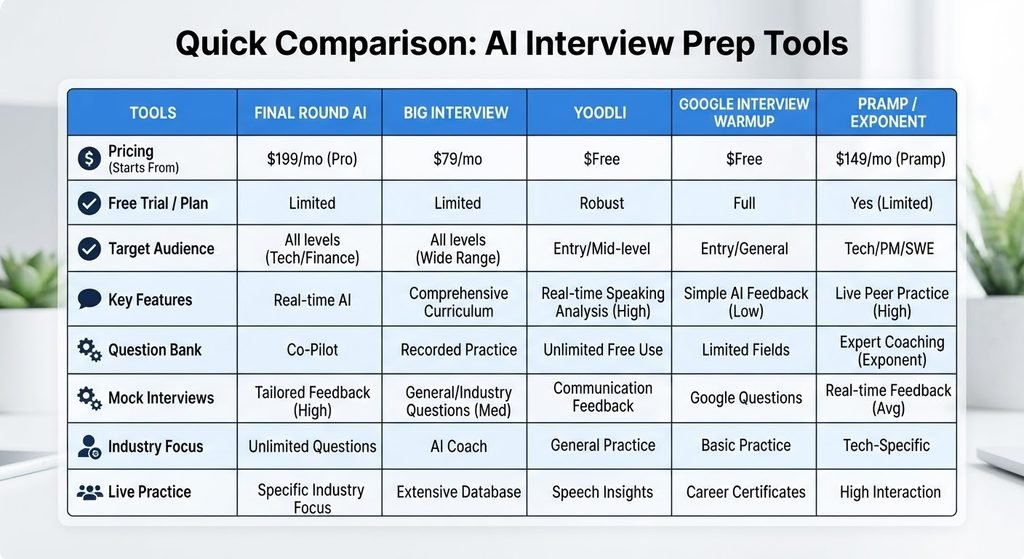
Quick Comparison: Which Tool Fits Your Timeline?
| Option | Best For | Key Benefit | Limitation |
| Final Round AI | Candidates with interviews in 1–2 weeks | Real-time practice + live interview assistance | High monthly cost; mixed reviews on reliability |
| Big Interview | Candidates who need structure first | Curriculum + AI feedback; often free via university | Less emphasis on delivery coaching |
| Yoodli | Candidates who know content but stumble on delivery | Speech analytics; affordable at $8–$20/month | Doesn’t score answer substance |
| Google Interview Warmup | Quick, low-pressure warm-up | Completely free; voice-based; unlimited sessions | No follow-up questions; basic feedback only |
| Pramp/Exponent | Technical candidates needing live practice | Free peer sessions for coding and system design | Quality depends on peer match |
How to Prepare for an Interview with AI Tools
To prepare for an interview with AI tools, follow these steps:
- Choose a tool matched to your interview type. Behavioral interview? Start with Big Interview or Final Round AI. Technical interview? Use Pramp/Exponent for coding practice. Delivery issues? Add Yoodli.
- Run at least 3 mock sessions with your primary tool before the real interview. One session is a warm-up. Three sessions reveal patterns.
- Review feedback on structure, not just content. Most AI tools flag weak structure before weak substance. Fix the framework first.
- Record yourself to check delivery. Even if your tool doesn’t offer speech analytics, record your practice sessions on your phone. Listen for filler words and pacing.
- Repeat weak-scoring questions until improved. AI tools track progress across sessions. Use that data. If you scored a 6/10 on “Tell me about a time you failed,” run it until you hit 8/10.
Free Tools vs. Paid Platforms: What’s Actually Worth Paying For?
Free tools like Google Interview Warmup work better for quick, low-pressure warm-up before recruiter calls. They’re judgment-free, private, and unlimited. But they lack scoring depth and follow-up questions.
Paid platforms are stronger when you need scored, structured feedback across full mock loops. Final Round AI and Big Interview give you actual scores, detailed breakdowns, and progress tracking over multiple sessions.
Key difference: convenience versus depth. Free tools give you a taste. Paid tools give you a training regimen.
Read our complete guide to scored, structured feedback systems and how interview platforms evaluate your responses.
The Human Element: Why AI Can’t Replace Peer Practice
I’ve seen conflicting data on this. Some candidates improve faster with AI alone. Others stall out after 10 sessions because the AI doesn’t push back the way a human interviewer does.
The most defensible read is this: AI tools are for volume and structure. Peer practice is for pressure and adaptability.
Here’s an opinion some readers might push back on: For most candidates, AI practice is more valuable than peer practice in the first two weeks of preparation. Peer practice is valuable, but it’s inconsistent. One bad peer match can waste a session and shake your confidence. AI gives you reliable, repeatable feedback every single time. Use AI to build your foundation. Use peer practice to stress-test it.
Check out our guide on peer practice and the best live mock interview platforms for realistic interview preparation.
5 Common Questions About AI Interview Prep
Q: What’s the best free AI interview prep tool?
A: Google Interview Warmup is a widely used free option, though it lacks live pressure simulation and scoring depth.
Q: Can AI interview tools replace human mock interviews?
A: Not fully — they’re strong for volume and structure practice, but human mocks better replicate unscripted follow-up pressure.
Q: How many mock interviews should I do before the real one?
A: Most candidates see meaningful improvement somewhere between 5 and 15 practice sessions.
Q: Do AI interview tools work for behavioral questions?
A: Yes — they’re particularly strong for practicing structured, story-based behavioral answers.
Q: Is it okay to use AI help during a real interview?
A: No — many companies prohibit live AI assistance during interviews, and detection can cost you the offer; use AI for practice, not live assistance.
Which Tool Should You Actually Choose?
If your interview is in less than a week, pick Final Round AI or Yoodli depending on your weakness. Content problems? Final Round AI. Delivery problems? Yoodli. Both give you immediate, actionable feedback you can apply before your next practice session.
If your interview is in 2–4 weeks, start with Big Interview’s curriculum (if you need structure) or Pramp/Exponent (if you’re technical). Build your foundation. Then add a delivery tool like Yoodli in the final week.
If your interview is more than a month out, use the free tools first. Google Interview Warmup for warm-ups. Pramp for peer practice. Then graduate to a paid tool 2–3 weeks before your date.
The best interview preparation software is the one you’ll actually use. A $150/month tool you open twice is worse than a free tool you use daily.
See our breakdown of interview preparation software to find comprehensive platforms that can support your complete interview prep process.
What This Guide Covers — and What It Doesn’t
This guide covers AI-powered interview preparation tools for job seekers across behavioral, technical, and delivery-focused practice. It does NOT address resume optimization tools, job search platforms, or AI-powered application automation services.