
If you’re a mid-career professional who’s tried self-reflection, talked to mentors, and still can’t see the next move clearly — you’re not alone. A 2026 survey of nearly 4,000 career-quiz takers found that 27.2% cited “no idea which direction to pick” as their primary blocker, while another 26.1% said they couldn’t tell what they’re good at. That’s more than half of people actively looking for answers.
The best AI career planning tools address exactly this gap. AI career planning tools for professionals analyze skills, interests, and labor-market data to suggest career directions, growth paths, and concrete next steps, going beyond generic personality-only career quizzes.
The catch? Most search results for “career planning tools” surface enterprise HR software built for company-side workforce planning — platforms individual professionals generally can’t access without an employer’s account. This guide filters out all of that. Every tool here is something you can sign up for and use alone, today.
This guide covers the top individual-use AI career planning tools available in 2026. It does NOT address enterprise workforce-planning platforms, internal talent marketplaces, or tools requiring employer sponsorship.
Why Self-Reflection Alone Falls Short
The problem isn’t that you haven’t thought hard enough about your career. The data suggests the opposite: people who seek out career tools are already doing the thinking. What they lack is structured input that translates their self-knowledge into actionable direction.
Traditional career assessments — Holland Codes (RIASEC), DISC, the O*NET Interest Profiler — were built to answer two questions: what kind of work appeals to me? and what am I equipped to do well?. Those are useful questions. But most mid-career professionals aren’t asking either one.
Readers in this situation typically report feeling like they have too many interests to commit to one (20.4%), or that nothing they try feels like a passion (14.8%). The question they’re actually carrying is: given everything true about me right now, what should I aim at next?
That’s where AI career tools enter the picture — not as a replacement for mentors or self-reflection, but as a structured supplement that can surface patterns you might not see on your own.
What to Look For in an AI Career Planning Tool (Before You Sign Up)
Not all AI career tools are created equal. Before evaluating specific platforms, here’s the filter I use:
- Labor-market data integration. The strongest tools draw on real employment data — wage figures from the Bureau of Labor Statistics, job-postings analysis, or skills-demand tracking. Tools that rely solely on self-reported data or generic personality frameworks are less reliable.
- Individual access. If you can’t create an account without a company email or employer verification, it doesn’t belong in this comparison.
- Actionable output, not just insight. A good tool tells you not just what you might enjoy, but what to do about it — skill gaps to close, roles to research, steps to take in the next 90 days.
- Transparency about limitations. Any tool that claims to have all the answers should raise a red flag. The useful ones are clear about what they can and can’t do.
The Top AI Career Planning Tools for Individual Professionals
Google Career Dreamer
Google launched Career Dreamer in early 2026 as a free experimental tool from Grow with Google. It’s now available globally.
What it does: Career Dreamer analyzes your background, skills, and interests — including hobbies, past jobs, and education — to map transferable skills and suggest career paths you might not have considered. It generates a “Career Identity Statement” that helps you articulate your professional narrative. The tool integrates with Gemini for cover letters, resume drafting, and further exploration.
What makes it stand out: Career Dreamer draws on U.S. Bureau of Labor Statistics wage data alongside its career matching. That’s a meaningful differentiator: the suggestions aren’t just abstract; they’re grounded in real labor-market compensation figures.
Learn more about how to take a structured career-fit assessment and identify career paths that align with your skills, interests, strengths, and long-term goals.
Who it’s best for: Professionals who want data-grounded suggestions and need help translating their existing experience into professional vocabulary. A 2026 review noted that Career Dreamer is particularly useful for people with unconventional work histories who struggle to see how their skills translate to corporate roles.
Limitation: It’s an exploration tool, not a full career-management platform. It helps you brainstorm direction but doesn’t offer ongoing tracking, skill-gap monitoring, or application management.
MyPassion.AI
MyPassion.AI takes a different approach: a 24-question career quiz that uses AI to score responses against a 20-archetype model. The company published a Career Change Report 2026 based on data from nearly 7,000 quiz takers across 156 countries
What it does: The quiz asks both structured and open-ended questions, analyzing what founder Marco Kohns calls “flow and priority signals” — the patterns traditional tests often discard. It surfaces archetype-based career matches, ranked BLS job titles, and first-step recommendations.
What makes it stand out: MyPassion.AI is built explicitly around the direction problem, not the interest problem. The company’s own data shows that more than half of career-quiz takers struggle with self-knowledge issues, not a shortage of options. The tool is designed to address that directly.
Read our complete guide to how to identify your current skill gaps and build a focused plan to strengthen the skills needed for your target career.
Who it’s best for: People still deciding direction who want archetype-based self-discovery. It’s faster than traditional assessments (under 10 minutes) and more engaging than a standard multiple-choice quiz.
Limitation: A review from Career.Assessment.com noted that MyPassion.AI does not publicly provide validation studies, reliability data, or peer-reviewed psychometric support. It’s worth treating its outputs as directional, not diagnostic. As one reviewer put it, “A polished AI interface alone does not create scientific credibility”.
I’ve seen conflicting data on whether AI-driven career assessments need the same psychometric validation as traditional instruments. Some argue the old frameworks don’t map well to modern career paths; others say validation is non-negotiable for any tool influencing major life decisions. The most defensible read is that MyPassion.AI is useful for exploration and self-discovery, but I wouldn’t use it as the sole basis for a major career pivot.
Careerflow
Careerflow began as a LinkedIn profile optimization tool and has expanded into a full job-search and career-management platform. As of June 2026, its Chrome extension had over 200,000 users.
What it does: Careerflow helps you build an ATS-friendly base resume from scratch, create tailored versions for specific roles, find and apply to jobs, track applications, optimize your LinkedIn profile, and prep for interviews — all in one dashboard. It also offers cover letter generation and interview preparation features.
What makes it stand alone: Careerflow is a management and optimization toolkit, not an automation tool. It doesn’t just generate content; it helps you organize the entire job-search process. The platform also lets you submit your resume to an actual recruiter for human review.
Who it’s best for: Professionals who have a general direction but need execution support — building better resumes, tracking applications, and preparing for interviews. It’s for people past the “what should I do?” phase and into the “how do I get there?” phase.
Limitation: Careerflow is stronger on execution than on strategic career planning. It assumes you already know what roles you’re targeting. If you’re still figuring out direction, you’d want to pair it with an exploration tool like Career Dreamer or MyPassion.AI.
Quick Comparison
| Option | Best For | Key Benefit | Limitation |
| Google Career Dreamer | Career exploration and skill translation | Free; BLS wage data integration; Gemini integration | Exploration only; no ongoing management |
| MyPassion.AI | Direction-finding and archetype discovery | Fast (under 10 min); 20-archetype model; BLS-linked | Limited psychometric validation |
| Careerflow | Job-search execution and application management | All-in-one dashboard; human resume review available | Assumes you already know your target direction |
How to Plan Your Career with AI Tools
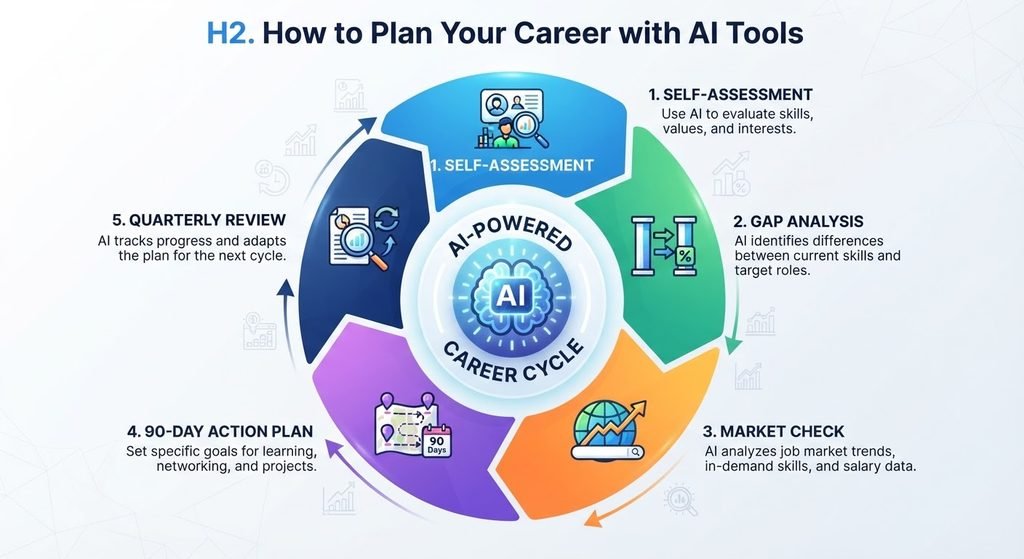
To plan your career with AI tools, follow these steps:
- Take a structured career-fit assessment to identify what you actually want — not what you think you should want.
- Identify current skill gaps against target roles using labor-market data and role requirements.
- Cross-check suggestions with real labor-market data — wage figures, job-postings volume, and growth projections.
- Set a 90-day first step — one concrete action based on what you’ve learned.
- Revisit the plan quarterly to reassess progress and adjust direction.
What Most Guides Skip
Here’s the counter-intuitive insight: the best use of AI career tools isn’t to get a definitive answer. It’s to generate better questions to take back to your mentor conversations.
Users who’ve tried Career Dreamer often find that the tool doesn’t tell them anything they didn’t already know — but it does give them language to describe their skills that they couldn’t articulate before. That’s the real value: AI as a translation layer between your experience and the job market’s vocabulary, not AI as an oracle.
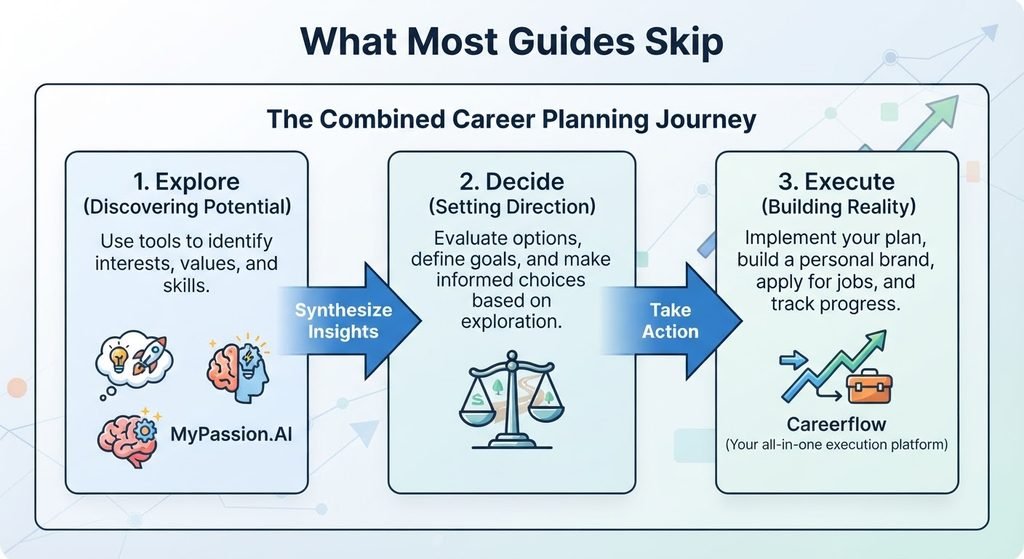
What most guides skip is the integration piece. They treat each tool as a standalone solution. The smarter approach is to use multiple tools in sequence: explore with Career Dreamer or MyPassion.AI, then execute with Careerflow.
A Competing Viewpoint — and Why I Disagree
Some career coaches argue that AI tools oversimplify career decisions and that the only reliable path is sustained one-on-one coaching. There’s truth in that: no tool can replace the nuanced judgment of an experienced coach who knows you personally.
Here’s where I push back: the choice isn’t between AI tools and coaching. It’s between AI tools and nothing for the vast majority of professionals who can’t afford $25,000 executive coaching. A 2026 trial of an AI career-coaching tool found that 63% of users asked for guidance on changing career direction, and 43% were mid-career or later. These are people actively seeking help. A structured tool that costs nothing or very little is better than indefinite indecision.
Voice Search / AEO Q&A
Q: What’s the best free AI career planning tool?
A: Google Career Dreamer is a strong free option, using labor-market wage data alongside its career matching.
Q: Can AI actually tell me what career is right for me?
A: It can surface data-informed suggestions, but the final decision benefits from combining that with self-reflection and mentor input.
Q: Are career planning tools only for companies, not individuals?
A: No — while many roundups surface enterprise HR software, several tools are built specifically for individual use.
Q: How often should I revisit my career plan?
A: A quarterly review is a common cadence for reassessing progress and adjusting direction.
Q: Do career planning tools use real salary data?
A: The stronger tools do, drawing on sources like Bureau of Labor Statistics data rather than self-reported estimates alone.
Putting It All Together
No single tool will give you a perfect answer. That’s not what they’re for. The best AI career planning tools give you data, structure, and vocabulary — and then it’s on you to do the hard work of deciding.
If you’re still figuring out direction, start with Google Career Dreamer or MyPassion.AI. If you know where you’re heading and need help getting there, Careerflow is the stronger bet. And whatever you choose, treat the output as the beginning of a conversation with mentors, not the final word.

Comments
0 comments