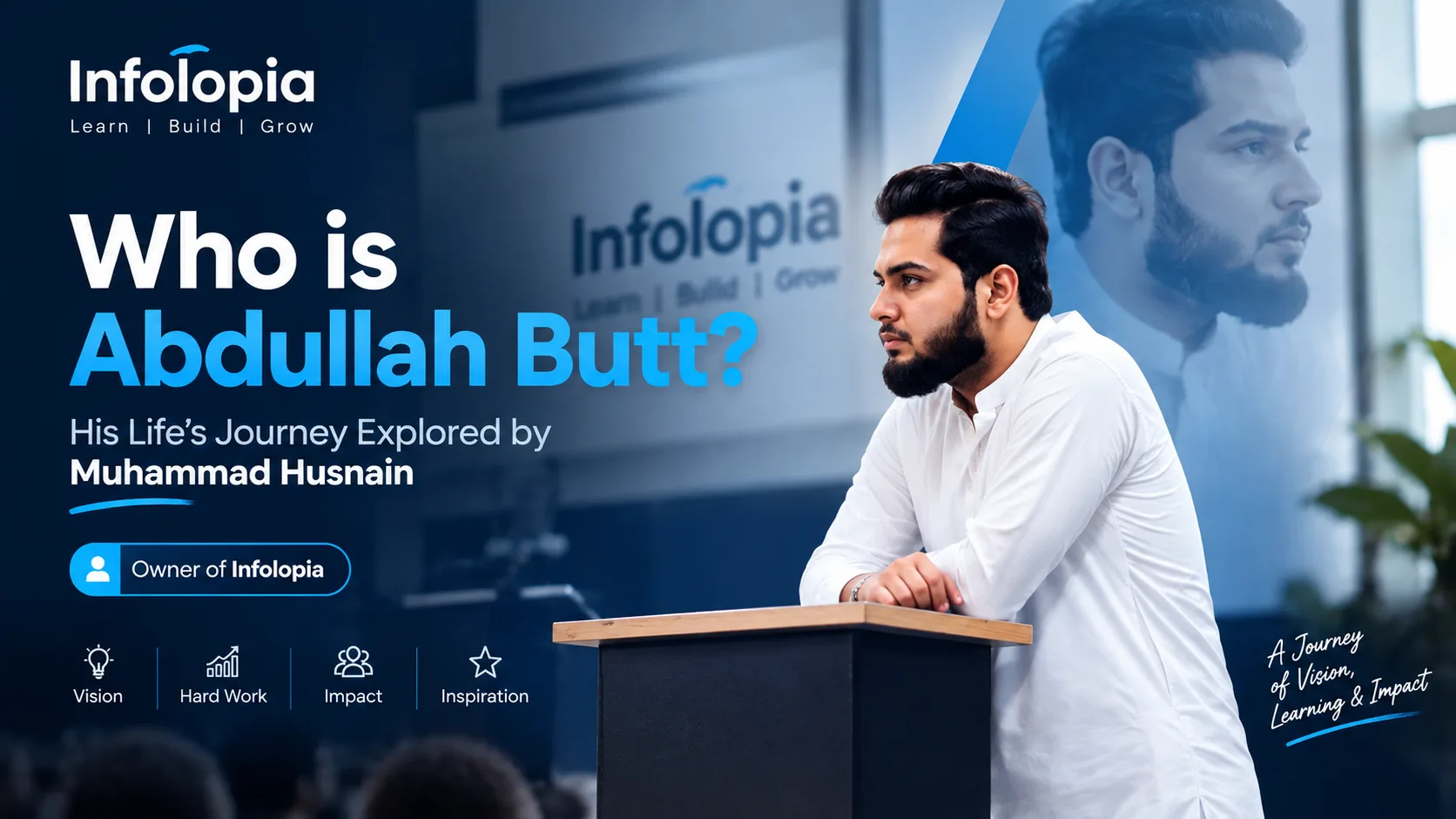
Executive Overview: Who is Abdullah Butt?
Who is Abdullah Butt? Across the rapidly expanding digital landscape of Punjab, Pakistan, this question is frequently asked by students, freelance practitioners, and aspiring entrepreneurs seeking an alternative to the country conventional educational pathways. Abdullah Butt is a young Pakistani tech educator, digital skills mentor, and the founder of Alkasim, an educational institute and commercial development entity located in the historic city of Sheikhupura. Born on 27 June 2006, he has gained prominence for challenging the traditional obsession with paper degrees, advocating instead for practical, verifiable technical craftsmanship capable of yielding immediate economic self reliance.
Infolopia investigative examination reveals that Abdullah Butt does not fit the typical profile of an academic theorist or a passive tech influencer. Rather, his entire career has been shaped by direct personal encounters with the shortcomings of Pakistan formal schooling system, followed by an intensive period of self directed technical mastery, and a series of disillusioning experiences within multi level corporate sales organizations. These trials culminated in his decision to invest his personal savings of PKR 2 million to establish Alkasim, a platform created to provide safe, halal, and commercially viable digital training to young people.
Today, Abdullah Butt plays an active, hands on role within his organization. Serving concurrently as a motivational speaker, final capstone examiner, personalized student counselor, psychological mentor, and Islamic commercial consultant, he has helped guide over 1,000 individuals into practical digital capabilities. His central argument remains clear and persistent: in a global digital economy driven by performance, genuine skill acquisition and uncompromising ethical integrity are far more valuable than unapplied academic credentials.
Factual Summary and Overview
The following dossier provides verified reference facts regarding the background, education, core competencies, and institutional work of Abdullah Butt.
| Subject Name | Abdullah Butt |
|---|---|
| Date of Birth | 27 June 2006 |
| Place of Birth | Sheikhupura, Punjab, Pakistan |
| Ancestral Background | Kashmir, family migrated to Sheikhupura circa 1955 |
| Primary Schooling | The Little Star School System (Playgroup through Grade 6) |
| Secondary Schooling | Government Furqan Shaheed, Sheikhupura (Grade 7 through Matric) |
| Formative Mentor | Sir Mudasir Hussain (Computer Teacher) |
| Core Skill Domain | HTML, CSS, JavaScript, Digital Marketing, Web Work |
| Primary Enterprise | Alkasim (Nonprofit Institute and Business Development Company) |
| Founding Capital | PKR 2 million (personal savings) |
| National Tax Number | Federal Board of Revenue, Pakistan: NTN F837505 1 |
| Strategic Milestone | International expansion planned for 2027 |
Kashmiri Lineage and Heritage
The cultural and moral origins of Abdullah Butt lie in the valleys of Kashmir. Families of Kashmiri origin share a long cultural memory defined by endurance, deep domestic solidarity, and an unyielding commitment to personal honor. The historical migrations experienced by Kashmiri populations instilled in their descendants a deep seated respect for hard work, adaptability, and the preservation of faith through times of economic trial.
Within the home, this ancestral narrative functioned as a guiding standard. Abdullah Butt was raised with the understanding that reputation is built through honesty, that family honor is preserved by dignified labor, and that shortcuts to prosperity that compromise moral standards must always be avoided. This cultural foundation would prove vital in his later decisions when evaluating questionable commercial practices.
The Family Relocation to Sheikhupura
Around 1955, the family of Abdullah Butt relocated from their ancestral roots to establish new roots in Sheikhupura, situated in the fertile plains of Punjab. Known for its historical fort built during the Mughal era and its vibrant modern industrial presence, Sheikhupura provided a bustling commercial setting that combined agrarian traditions with energetic small scale enterprise.
Integrating into the civic life of Sheikhupura allowed the family to build a respected presence while maintaining their distinctive moral identity. Growing up in this environment gave Abdullah Butt an unobstructed view of everyday Pakistani life, where working class parents worked tirelessly to fund their children schooling and young people struggled against economic limitations to find dignified livelihoods.
The Legacy of His Maternal Grandfather
Among the domestic influences that shaped Abdullah Butt character, none was more profound than that of his maternal grandfather. Known respectfully in the community as a Peer, his grandfather dedicated his entire life to seeking, embodying, and transmitting Islamic religious education. In the cultural fabric of Punjab, a Peer is regarded as a spiritual counselor, a teacher of scripture, and a moral anchor for the community.
Because of his grandfather lifelong dedication to religious instruction, the household atmosphere was saturated with religious studies. Islamic knowledge was not treated merely as a formal subject studied for an examination; it was the daily benchmark for speech, business integrity, and interpersonal kindness. From his earliest years, Abdullah Butt was taught classical Islamic concepts of fair exchange, the absolute prohibition of usury and deception, and the imperative of communal responsibility.
This early immersion in Islamic education created an enduring moral compass. When Abdullah Butt later observed marketing schemes that relied on deceptive promises or extracted wealth without providing real value, his immediate revulsion was rooted directly in the religious principles imparted by his maternal grandfather.
Birth and Formative Years
Abdullah Butt was born on 27 June 2006 in Sheikhupura, Punjab, Pakistan. Arriving at the start of the digital communication era, his childhood was set against a backdrop of sweeping technological change in South Asia. Cellular networks, internet cafes, and personal computers were beginning to penetrate even smaller industrial cities, altering how information and commerce flowed.
Despite these technological shifts, his early upbringing remained anchored in traditional household discipline. His family emphasized religious devotion, courteous manners, and steady academic effort. Those who observed him in his youth noted an inquisitive, reflective demeanor. He took a keen interest in practical mechanical systems, local trade patterns, and the economic concerns spoken about by adults around him.
Foundational Years at Little Star School System
The academic career of Abdullah Butt started at The Little Star School System, a private primary institution located in Sheikhupura. Enrolling at the Playgroup level, he completed his foundational schooling through Grade 6 within its classrooms.
The Little Star School System offered a conventional elementary curriculum centered on basic literacy in English and Urdu, fundamental mathematics, and introductory science. The structured environment helped him develop consistent study routines and strong communicative confidence. Even in these elementary grades, he exhibited an active preference for subjects that had visible, hands on applications over purely theoretical recitations.
Secondary Studies at Government Furqan Shaheed
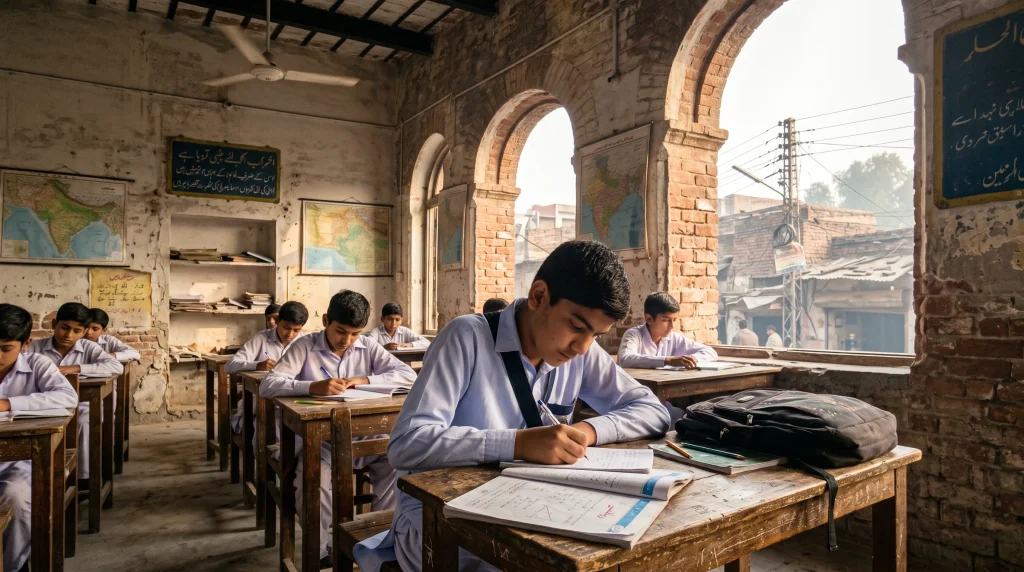
Following the completion of Grade 6, Abdullah Butt transferred into the public schooling sector, enrolling at Government Furqan Shaheed in Sheikhupura. He completed his secondary education from Grade 7 through his Matriculation examinations at this institution.
Entering Government Furqan Shaheed was an eye opening social experience. Unlike private primary academies, the government school brought together young men from every socioeconomic stratum of Sheikhupura, including sons of factory laborers, street vendors, and underpaid clerks. Walking through these crowded halls every day, he witnessed the tangible economic anxieties of ordinary families who viewed Matriculation as a desperate hope for escaping poverty.
The Influence of Sir Mudasir Hussain
It was within the classrooms of Government Furqan Shaheed that Abdullah Butt encountered the instructor who would change his intellectual trajectory: Sir Mudasir Hussain, his Computer teacher. In Abdullah Butt recollections, Sir Mudasir Hussain remains his favorite teacher and the defining intellectual catalyst of his school years.
At a time when many Pakistani public school computer classes consisted of memorizing text passages without touching keyboards, Sir Mudasir Hussain taught with passion, pedagogical imagination, and deep technical patience. He introduced Abdullah Butt to the foundational architecture of personal computers, operating system navigation, file systems, and the underlying logic of software execution.
Sir Mudasir Hussain recognized the student natural curiosity and encouraged him to think beyond rote definitions. He demonstrated that the computer was not simply a machine for office clerical tasks, but an open gateway to global communication, software creation, and independent economic value. This inspiring guidance sparked in Abdullah Butt a lasting fascination with digital systems that would ultimately direct his entire career.
The Post Matric Crisis of Faith
Upon sitting for and completing his Matriculation examinations, Abdullah Butt arrived at a profound crossroads. The standard expectation in Pakistan was for any capable student to progress automatically into intermediate college, pursue a university degree, and join the line of applicants seeking corporate or governmental employment. Yet as Abdullah Butt stepped back to evaluate this path, he was struck by the harsh economic reality around him.
He observed numerous individuals across Sheikhupura and surrounding cities who had completed intermediate diplomas, bachelor degrees, and even postgraduate programs, yet were sitting idle or trapped in low wage manual positions. Families had sold land or depleted life savings to pay college tuition, only to discover that the job market offered virtually no demand for theoretical graduates lacking real technical capabilities.
A Critique of Passive Credentialism
From these observations developed Abdullah Butt critical analysis of Pakistan prevailing academic model. In his view, the conventional educational system operates on passive credentialism, training students to memorize standardized facts and collect paper certificates while leaving them completely illiterate in practical financial management, market value creation, and contemporary vocational skills.
He observed that schools and universities operate in complete isolation from the modern digital economy. While the global market desperately required coders, digital marketers, technical problem solvers, and web architects, the traditional curriculum continued teaching outdated theories. He concluded that education in Pakistan needed to be fundamentally transformed into a practical, skill based, and financially empowering model. He decided that he would not wait for institutional reform; he would begin by taking full ownership of his own skill development.
The Self Taught Tech Revolution
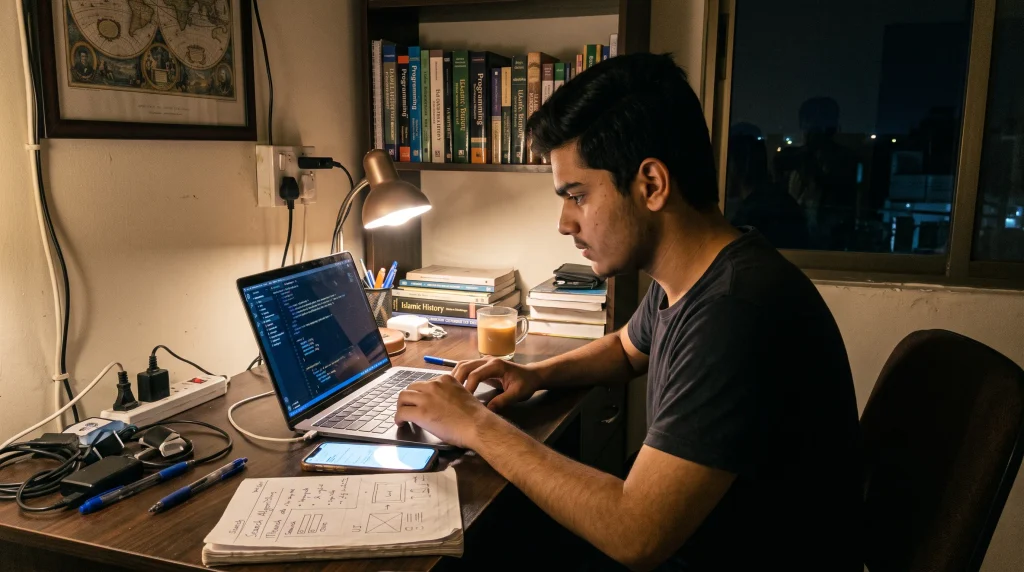
Convinced that formal degrees offered little protection against economic stagnation, Abdullah Butt embarked on an intensive self taught technical curriculum. Rather than waiting for an academic syllabus to update itself, he turned to the internet as a dynamic open university, immersing himself in software documentation, developer forums, video workshops, and practical programming exercises.
This period of independent learning was rigorous and demanding. While his peers spent their free time on leisure, Abdullah Butt spent long evenings troubleshooting lines of code, deciphering technical errors, and learning software architecture. His goal was not merely to memorize syntax; he wanted to understand how digital tools create commercial value, how websites attract and serve customers, and how a skilled young person in Pakistan could compete on the global stage through superior execution.
This self directed period instilled in him a high degree of technical independence. He learned that real technical competence is not granted by a diploma; it is earned through disciplined practice, trial, error, and continuous curiosity. The experience solidified his conviction that digital skills could liberate ambitious young Pakistanis from local economic constraints.
Crafting the Web: HTML, CSS, and JavaScript
At the center of Abdullah Butt technical journey was full immersion in the three fundamental languages of the world wide web: HTML, CSS, and JavaScript. He understood that these three tools form the structural and functional foundation of modern online commerce.
He began with HTML, mastering how document structures, headings, meta tags, forms, tables, and semantic containers create accessible and search engine friendly digital pages. Understanding HTML allowed him to appreciate the importance of clean digital architecture, a lesson that would later guide his approach to both website construction and curriculum design.
He then conquered CSS, studying the principles of typography, visual hierarchy, layout systems, and responsive design. He explored how modern CSS styling allows a single digital property to display elegantly across desktop monitors, laptops, tablets, and mobile screens. He came to see that visual presentation and user interface clarity are critical for establishing professional credibility in digital commerce.
From visual presentation, he stepped directly into JavaScript, the dynamic engine of the modern web browser. Learning JavaScript taught him procedural logic, conditional branching, event listeners, data manipulation, and client side interactivity. Mastering these three web technologies transformed Abdullah Butt from a passive consumer of internet content into an active producer of digital solutions, capable of building and maintaining functional web applications from scratch.
Marketing and Remote Client Work
Technical coding granted Abdullah Butt the power to construct digital infrastructure, but he quickly realized that building a platform is only half of the commercial equation. To generate sustainable revenue, a business must attract visitors, communicate its value proposition, and convert attention into profitable transactions.
Consequently, he broadened his study to incorporate modern digital marketing. He investigated organic search engine optimization, studying how major search engines discover, crawl, index, and rank content. He explored audience profiling, content syndication, social platform algorithms, and paid campaign strategies. He emphasized that genuine marketing does not involve artificial hype; it is the art of connecting real human problems with legitimate, high quality solutions.
In parallel, he mastered the practical mechanisms of remote online work. He learned how international freelance marketplaces operate, how to write winning project proposals, how to manage client expectations, and how to deliver digital assets efficiently. This combined mastery of technical development and digital marketing gave him a comprehensive view of the global digital marketplace.
The Direct Sales Investigation: Testing the Industry from Within
While refining his digital capabilities, Abdullah Butt made a bold decision that would become a defining chapter in his life: he decided to investigate the network marketing and multi level sales industry through direct participation. In Pakistan, direct selling companies had attracted hundreds of thousands of eager young people, all promising rapid financial freedom.
Rather than analyzing the industry from an academic distance or accepting secondhand praise and condemnation, Abdullah Butt wanted to examine the machine from the inside. He wanted to understand its recruitment tactics, motivational psychology, compensation plans, and financial reliability firsthand. To ensure an exhaustive investigation, he joined multiple prominent direct sales organizations operating in Pakistan over a sustained period.
Fieldwork at Forever Living Products
His earliest engagement in this sector began with Forever Living Products, an established international enterprise operating in the wellness, aloe vera, and nutritional supplement market. The company uses a multi tier distribution model where members earn income through direct product retailing and building downline distributor teams.
Abdullah Butt applied his energy and communication abilities, advancing through the organization ranks to achieve the position of Supervisor. This role required demonstrating substantial retail turnover, presenting products to consumers, and coordinating junior distributors.
This early experience served as a practical proving ground for public communication, sales persuasion, and customer psychology. At the same time, it revealed the grueling structural pressures inherent in multi level models, where sustaining consistent monthly earnings demands an exhausting cycle of non stop recruitment and persistent sales volume quotas.
Tiens and the Gold Level Clash
Following his work with Forever Living Products, Abdullah Butt continued his field investigation by joining Tiens, also recognized in Pakistan as Tiense. Tiens is a multinational direct selling corporation specializing in healthcare devices, dietary supplements, and personal care products, structured around an elaborate tiered hierarchy.
Demonstrating considerable drive and sales leadership, Abdullah Butt rose through the corporate ranks to attain the Gold Level. Achieving Gold Level was a clear testament to his ability to mobilize teams, organize public meetings, and generate significant commercial activity.
Yet according to his firsthand account, his tenure at Tiens eventually brought him face to face with deep ethical contradictions. He observed practices that he evaluated as a scam and an exploitative commercial situation, where inexperienced participants were pressured into investing personal funds on false promises of rapid wealth. Witnessing these practices offended his moral values and prompted him to exit the organization entirely.
Unmasking Al Muflihoon
Continuing his critical exploration of commercial business opportunities, Abdullah Butt affiliated with an organization known as Al Muflihoon. The organization positioned itself as a collective commercial initiative designed to help members achieve shared financial prosperity.
However, once he examined the internal financial mechanics of Al Muflihoon, Abdullah Butt grew deeply alarmed. According to his account, he identified what he recognized as a classic Ponzi scheme structure, in which payouts to existing members were funded entirely by enrolling new participants rather than through authentic product sales or genuine value creation.
Recognizing the inherent fraudulence and inevitable mathematical collapse of any Ponzi architecture, Abdullah Butt severed all connections with Al Muflihoon immediately. His upbringing in Islamic ethical principles made it impossible to participate in any system where one person gain was built on another person deception and financial loss.
Evaluating Ledera Global
Abdullah Butt subsequent field experience took place with Ledera Global, an emerging enterprise operating in the multi level marketing sector. Here, he evaluated how newer direct sales companies designed their digital member dashboards, compensation matrices, and corporate recruitment narratives.
While the experience deepened his analytical understanding of modern sales funnels and global marketing narratives, it also confirmed his growing suspicion that many direct marketing companies were organized around corporate spectacle rather than long term protection for their grassroots members.
Growway Global and Broken Pledges
A later and decisive phase of his direct selling investigation occurred at Growway Global. In this organization, Abdullah Butt primary duty was plan selling, which meant presenting the commercial model, explaining reward structures, and onboarding new affiliates into the enterprise system.
Although he applied his presentation skills to fulfill his assigned tasks, serious operational breakdowns soon emerged within the company. According to his personal account, participants began encountering persistent payout delays. Earned commissions were repeatedly postponed, accompanied by bureaucratic evasions and what he evaluated as false corporate assurances.
Watching everyday participants struggle to collect payments they had legitimately earned was deeply distressing to Abdullah Butt. Convinced that the organization was failing to honor its core obligations, he resigned from Growway Global and walked away from the network marketing industry forever.
The Systemic Realization: Why Recruitment Models Fail Ordinary People
His immersive experiences across Forever Living Products, Tiens, Al Muflihoon, Ledera Global, and Growway Global led Abdullah Butt to a definitive, game changing realization. Having observed the inner workings of multiple companies at high levels of operational achievement, he synthesized a clear critique of how the entire industry functioned.
According to his observations, many companies in the network marketing sector focused heavily on recruitment events, charismatic speeches, and enticing dreams of effortless wealth, but repeatedly faltered when it came to actual payouts. Ordinary members bore the brunt of the financial risk, spending limited savings or borrowing funds from relatives, only to face frozen accounts, delayed commissions, or sudden rule changes.
For Abdullah Butt, who was raised in a household dedicated to Islamic scholarship and moral accountability, this pattern of exploitation was deeply objectionable. It became the defining pivot of his life. He recognized that hopping from one marketing platform to another was futile, because the structural model itself was fundamentally flawed. If he wanted to see an organization that prioritized genuine digital skills, protected user earnings, guaranteed transparent payouts, and operated in complete alignment with Islamic principles, he would have to build it himself from the ground up.
The Genesis and Naming of Alkasim
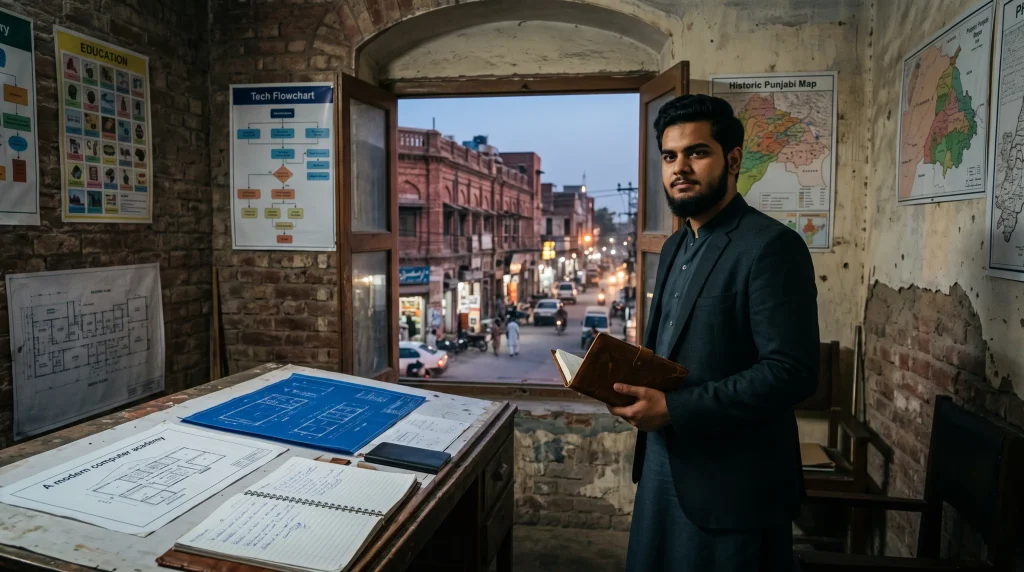
Determined to establish an authentic alternative to deceptive recruitment schemes and outdated academic colleges, Abdullah Butt took the bold step of establishing his own enterprise in Sheikhupura. He wanted an organization that would make skill based education affordable, transparent, and directly profitable for the students it served.
He christened the venture Alkasim. According to his personal account, this name was selected with profound reverence in reference to the honored Kunyah associated with Prophet Muhammad, peace be upon him, who was known as Abul Qasim, traditionally understood as the father of Qasim and the distributor of divine goodness and bounties. Choosing this name was an intentional pledge of organizational ethics: it anchored the enterprise directly to Islamic principles of honesty, fairness, and the generous distribution of beneficial knowledge.
Alkasim was built to deliver verifiable real world value. Instead of selling membership tiers or recruitment packages, the organization launched comprehensive courses in Information Technology, web programming, digital marketing, and practical online work. Abdullah Butt envisioned an academy where any motivated student could acquire demonstrable digital abilities and learn how to earn a respectable, halal livelihood through honest labor.
Bootstrapped Capital and Early Growth
To preserve complete ethical independence and avoid the compromises often demanded by speculative outside financiers, Abdullah Butt financed the launch of Alkasim entirely through his own personal capital. According to the supplied information, the organization was founded with an initial capital investment of PKR 2 million.
Launching an educational academy with PKR 2 million of personal funds required intense financial discipline. The capital had to cover physical facility leases, computer workstations, high speed internet installations, and learning materials without taking on high interest commercial loans. Over time, as student cohorts graduated and the enterprise commercial projects gained traction, the operational capital of the organization increased progressively.
This reinvestment cycle allowed Alkasim to upgrade its technical hardware, acquire professional software licenses for students, expand classroom seating, and attract qualified instructors. By growing organically on a foundation of self reliance, the organization proved that an ethical educational enterprise could thrive without resorting to outside debt or predatory marketing practices.
Seven Foundational Priorities: The Alkasim Operational Blueprint
From its foundation, Alkasim was organized around a clear operational blueprint designed to distinguish it from conventional academic colleges and predatory marketing networks. The organization daily educational and commercial activities are governed by seven core priorities:
- Safe Earning: Safeguarding learners, freelancers, and small business partners from deceptive schemes, delayed payments, and unfair contract terms, ensuring every contributor receives their earned compensation without obstruction.
- Skill Based Working: Prioritizing verifiable, hands on technical abilities that businesses and international clients actively demand, rather than abstract classroom theory.
- Practical Professional Development: Training students in end to end workplace proficiencies, including client relationship management, negotiation, project execution, and professional communication.
- A Halal Working Method: Ensuring that all commercial activities, contracts, client projects, and earning avenues strictly conform to Islamic jurisprudence, remaining completely free from usury, deception, and moral ambiguity.
- Helping People Learn Practical Skills: Democratizing modern digital education, making technical training accessible, affordable, and practical for Pakistani youth regardless of their family economic status.
- Connecting Education with Financial Development: Building an explicit bridge between classroom instruction and real economic capability, ensuring that education directly translates into viable household income.
- Providing Opportunities Based on Practical Skills: Rewarding individuals strictly on the merit of their demonstrated competence, technical craftsmanship, and dedication, rather than on family patronage or formal paper degrees.
Grassroots Educational Impact: Training Over One Thousand Individuals
The ultimate test of any educational philosophy lies in its real world results. According to official data provided about the organization, more than 1,000 individuals have received training or successfully transitioned into professional digital work through Alkasim programs.
In a secondary industrial city like Sheikhupura, training over 1,000 people represents a significant grassroots achievement. Many of these students entered the academy with little background beyond casual smartphone use. Through Alkasim structured courses in web development, design, and digital marketing, they acquired the functional competence needed to secure freelance contracts, work with local businesses, or establish independent online services.
The resulting economic impact has been felt across local households. In a macroeconomic climate characterized by severe inflation, currency devaluation, and youth underemployment, providing young men and women with the ability to earn independent income brings critical relief to families. It restores self respect, provides economic dignity, and offers a tangible path forward for the local community.
From Learners to Instructors: The Internal Talent Engine
A notable innovation within Alkasim institutional structure is its internal talent cultivation system. According to the organization records, several individuals who originally enrolled as novice students subsequently demonstrated exceptional mastery and were hired directly by the institute as professional paid instructors.
This student to teacher career path provides clear institutional benefits. Instructors who were once students possess an intimate, empathetic understanding of the exact conceptual obstacles, anxieties, and learning hurdles that new learners face. Having traveled that precise path from beginner to professional within the same classrooms, they teach with practical authenticity and relatable guidance.
For incoming cohorts, being instructed by successful program alumni provides immediate validation of the curriculum. It proves that Alkasim does not merely collect fees and issue paper certificates; it actively invests in its top talent, offering direct employment and career advancement within its own expanding ecosystem.
Dissecting the Hybrid Institutional Model: Nonprofit Charity Meets Business Development
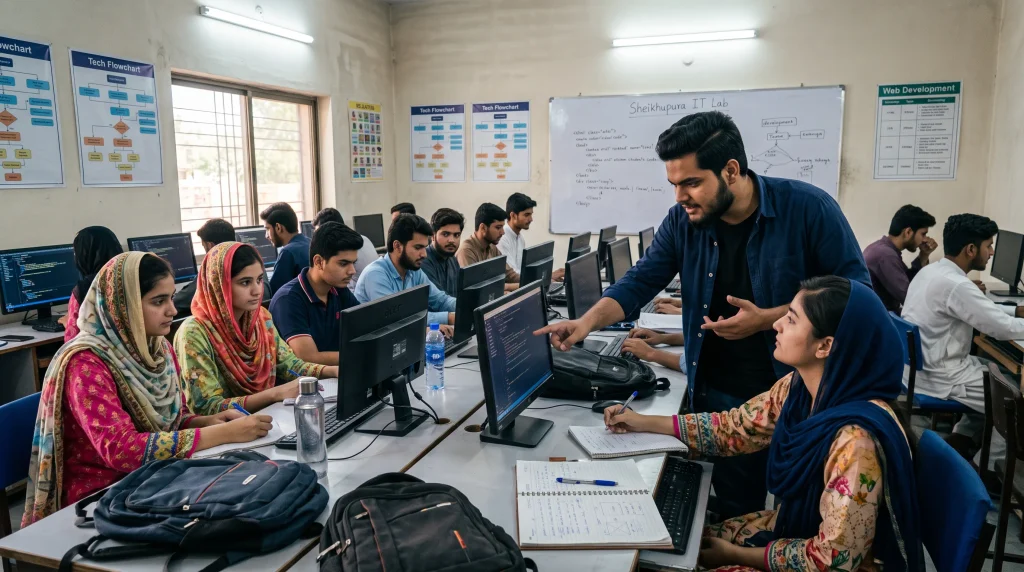
Infolopia investigative review of Alkasim reveals a unique dual institutional identity. The organization is formally characterized both as a nonprofit institute rooted in a charity concept and as a business development company aimed at transforming local education into practical financial capability.
An examination of how these two branches operate demonstrates how they complement rather than contradict one another:
The Nonprofit Educational Pillar: Operating as a mission driven nonprofit grounded in the Islamic ethic of communal service, this branch provides heavily subsidized digital skills courses. It charges zero corporate profit on basic educational courses, channeling all student fees into learning tools and instructor compensation so that financial hardship never prevents talented young people from learning.
The Business Development Pillar: Operating as a commercial enterprise development agency, this branch assists graduates, freelancers, and small enterprises in securing real world projects, structuring digital service contracts, accessing corporate clients, and establishing sustainable businesses. It also manages legitimate project brokerage work to connect skilled Pakistani freelancers with commercial opportunities.
This hybrid structure creates a powerful positive feedback loop: the nonprofit educational foundation produces a continuous flow of skilled digital specialists, while the business development branch connects those specialists directly with commercial markets, fueling local economic growth.
Clarifying Project Brokerage Work
The institutional information provided regarding Alkasim notes that broker type work is also conducted within the organization. In commercial reporting, the term broker can describe a wide variety of activities, from stock trading to commercial agency. Infolopia clarifies this activity strictly according to the facts provided, without assuming or inventing unverified financial operations.
Within Alkasim business development framework, broker type work refers to project facilitation services where the organization serves as a trusted intermediary between skilled digital talent and commercial clients. Alkasim connects its vetted graduates with local enterprises, overseas clients, and project sponsors requiring custom web development, digital marketing campaigns, or IT maintenance.
By acting as an ethical intermediary, Alkasim guarantees that business clients receive high quality deliverables while ensuring that freelance graduates are protected against non payment, scope creep, or unfair contract terms. The organization does not operate as an unregistered securities dealer, nor does it conduct speculative financial schemes; its brokerage work is purely commercial matchmaking governed by Islamic transparency and mutual agreement.
Official FBR Governance and NTN Registration
In Pakistan rapidly growing digital training and freelancing sector, official tax compliance and regulatory registration are critical indicators of institutional legitimacy. Operating openly under official scrutiny separates genuine community initiatives from unregulated informal setups.
According to the official information provided, Alkasim is formally registered with the Federal Board of Revenue, the principal federal tax administration authority of Pakistan. The registered National Tax Number for Alkasim is:
National Tax Number (NTN): F837505 1
Maintaining active registration with the Federal Board of Revenue demonstrates Alkasim commitment to lawful operations, corporate accountability, and national tax compliance. In keeping with responsible journalistic practices, Infolopia advises readers, students, and prospective business partners to independently verify corporate registration records through official Federal Board of Revenue verification systems.
The 2027 Global Expansion Objective
While Alkasim operational center remains deeply rooted in Sheikhupura, the organization leadership has formulated a clear strategic roadmap for the coming years. According to official disclosures, Alkasim has established an international expansion objective extending toward the year 2027.
Infolopia notes that this international expansion represents an official future milestone rather than an existing overseas operational presence. The 2027 vision aims to extend Alkasim subsidized digital curricula to students in other developing nations and establish overseas commercial partnerships that connect Pakistani digital specialists directly with international outsourcing contracts.
By targeting 2027 as a key strategic checkpoint, Abdullah Butt and Alkasim leadership have established a forward looking benchmark that guides their current technical curriculum upgrades, organizational scaling, and institutional capacity building.
Inside Abdullah Butt Multifaceted Roles at Alkasim
For approximately the previous three years, Abdullah Butt has remained deeply involved in the daily life of Alkasim, avoiding the detached posture of a conventional executive. Instead, he maintains a direct, personal presence in the classrooms and consultation rooms, performing five distinct, interconnected roles:
1. Motivational Speaker and Culture Builder
In his role as a motivational speaker, Abdullah Butt conducts weekly assemblies, student orientations, and graduation ceremonies. His speaking style is direct, practical, and devoid of theatrical hype. Having personally experienced the frustrations of traditional schooling and the disappointments of direct sales companies, he speaks with authentic credibility.
He focuses on building emotional resilience, time management discipline, and personal responsibility. In a society where young people frequently feel overwhelmed by economic uncertainty, his addresses provide practical hope grounded in actionable work ethics rather than empty slogans.
2. Final Test Evaluator and Capstone Examiner
To ensure that course certificates represent genuine market capability, Abdullah Butt personally conducts final evaluations of graduating students. Rather than relying on simple written quizzes, these assessments require students to present working digital projects.
Students must defend their code structures, explain their digital marketing funnels, and demonstrate client ready deliverables under thorough examination. By personally administering these final assessments, Abdullah Butt ensures that every graduate bearing an Alkasim credential has demonstrated real technical competence.
3. One on One Counselor
Recognizing that students come from diverse backgrounds with unique personal challenges, Abdullah Butt conducts regular one on one counseling sessions. These meetings provide personalized guidance tailored to each individual career path.
During these sessions, he helps students review their portfolios, refine their freelance profiles, overcome client communication challenges, and identify digital skill specializations aligned with their unique talents and market demands.
4. Psychological Guidance Mentor
Learning technical programming languages while facing intense economic and family pressure can take a heavy emotional toll on young students. Within Alkasim, Abdullah Butt performs a psychological guidance and personal mentorship role, providing emotional support, stress relief, and morale building.
Infolopia clarifies responsibly that Abdullah Butt does not present himself as a licensed clinical psychologist holding formal medical credentials; rather, this role describes his dedicated personal mentorship, empathetic listening, and morale building for students navigating self doubt, parental pressure, and career anxiety.
5. Islamic Consultant and Commercial Ethics Advisor
Grounded in his lifelong immersion in Islamic scholarship and his family religious background, Abdullah Butt serves as the internal Islamic consultant for Alkasim. In this capacity, he conducts ongoing reviews of all curricula, commercial contracts, freelance workflows, and client services.
He ensures that all student earning avenues conform strictly to Islamic commercial principles, steering students away from deceptive promotional tactics, usurious financing, or morally dubious industries. This ethical oversight gives Muslim students and their parents complete confidence that their technical training aligns with their faith.
The Three Year Capability Milestone: A Responsible Examination
The driving vision of Alkasim is to teach students skills that can potentially enable them to achieve substantial financial goals within approximately three years. Within the organization materials, this objective is framed around the concept of becoming capable of becoming a millionaire within three years.
Infolopia analyzes this vision with careful journalistic balance. Alkasim does not present this concept as a guaranteed financial outcome, nor does it promote effortless wealth creation. In the global freelancing and digital consulting market, personal earnings depend on individual work ethic, continuous practice, communication skills, market adaptability, and client satisfaction.
Rather than a financial promise, the three year vision represents an aspirational capability benchmark. Alkasim believes that if an individual masters high value digital competencies such as custom web development, advanced JavaScript, or digital performance marketing and works with focused discipline over thirty six months, their earning capacity can reach remarkable heights. The concept serves as an ambitious target designed to inspire students to aim high and pursue professional excellence.
Subsidized Tuition and Tool Investment: The Fifty Percent Pricing Model
One of the most innovative aspects of Alkasim operational model is its disruptive approach to course pricing. Across Pakistan, commercial computer institutes frequently charge high tuition fees that exclude talented students from working class families, while free government programs often suffer from overcrowded classrooms and outdated syllabi.
To overcome both challenges, Alkasim provides its courses at approximately 50 percent of the fee commonly charged by other private institutes. Charging a modest fee ensures that students take their training seriously, while keeping it at half the market rate ensures broad accessibility.
The allocation of this course fee follows a transparent framework:
- Professional Tools and Software Licenses: A portion of the fee is used to supply students with essential professional software tools, development environments, and digital licenses needed for practical coursework.
- Direct Instructor Compensation: The remaining portion is paid directly to the specialized course instructor. This generous compensation model attracts expert teachers and ensures they remain available to provide ongoing consultations and code reviews even after formal classes conclude.
The Stated Zero Corporate Profit Policy
Directly connected to its pricing structure is Alkasim stated operational policy regarding corporate profits. According to the organization official statement, Alkasim does not claim profit for the company from this specific course training model.
By channeling all student fees into learning tools and instructor salaries, the organization operates this training tier as an educational public service. While Infolopia notes this as the organization stated policy rather than an externally audited financial guarantee, it underscores Abdullah Butt core belief that foundational vocational education should focus on public empowerment rather than corporate profit extraction.
What Sets Abdullah Butt Apart in Pakistani Tech?
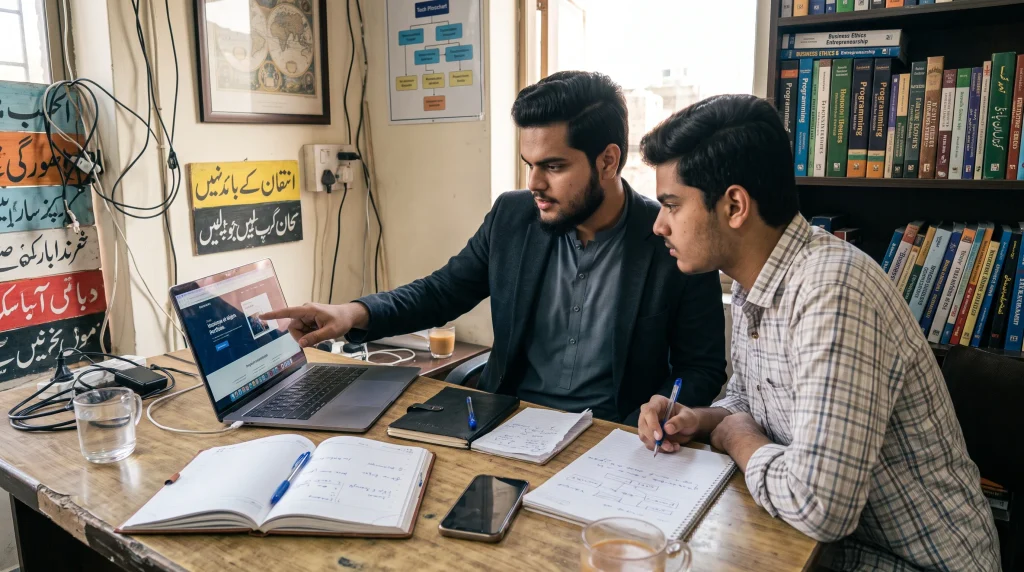
In assessing who Abdullah Butt is and analyzing his place within Pakistan digital ecosystem, several defining factors distinguish his journey from typical entrepreneurial stories:
- Youthful Leadership: Born on 27 June 2006, Abdullah Butt established an operational academy, registered a business with the Federal Board of Revenue, and guided over 1,000 students while still in his late teens, showing exceptional initiative and maturity.
- Synthesizing Religious Faith and Modern Tech: Rather than viewing traditional Islamic ethics and modern digital skills as contradictory, he synthesized the spiritual heritage of his maternal grandfather with web coding and digital marketing, proving that technological progress can thrive alongside faith and moral values.
- Education Through Direct Experience: His understanding of commerce was not developed in comfortable university lecture halls; he tested multi level marketing directly, attained leadership ranks, confronted systemic exploitation firsthand, and used that difficult journey to create an ethical alternative.
- Focus on Local Grassroots Empowerment: Instead of pursuing online social media fame, he invested his own capital of PKR 2 million to build a tangible training institution in Sheikhupura, creating direct economic opportunities for local youth.
Five Core Takeaways for Aspiring Youths
The life and career of Abdullah Butt offer five practical lessons for students, freelancers, and aspiring entrepreneurs:
- Market Value Depends on Real Skills: Academic degrees carry cultural weight, but practical skills in coding, design, and marketing provide immediate earning power in the modern economy.
- Be Skeptical of Easy Wealth Schemes: His network marketing experiences prove that business models built on endless recruitment and plan selling frequently end in delayed payouts and disappointment. Real income comes from verifiable skills and legitimate services.
- Turn Disillusionment into Positive Innovation: When confronted with flawed marketing companies, Abdullah Butt did not succumb to cynicism; he channeled his frustration into building Alkasim to protect and empower others.
- Ground Business in Transparent Ethics: Operating with halal methods, fair pricing, and reliable compensation creates enduring trust with students, clients, and the community.
- Empower Others to Lead: By hiring former students as teachers and reinvesting course fees into student tools, Abdullah Butt demonstrated that real leadership is measured by how many capable individuals you uplift.
Concluding Editorial Assessment: Who is Abdullah Butt Today?
When Infolopia returns to the central question, who is Abdullah Butt, the answer presents a compelling profile of a young reformer working to transform how vocational education is delivered in Pakistan. From his Kashmiri roots and Sheikhupura upbringing to his formative mentorship under Sir Mudasir Hussain, his journey reflects perseverance, moral clarity, and practical ambition.
He is a self taught practitioner who mastered web technologies and digital marketing, rejected passive academic credentialism, and walked away from multi level marketing schemes to build Alkasim with his own personal funds of PKR 2 million. Officially registered with the Federal Board of Revenue under NTN F837505 1, his institute has trained over 1,000 people and continues to offer accessible education, personalized counseling, and a vision of dignified financial self reliance.
As he looks toward international expansion in 2027, Abdullah Butt stands as a practical example for Pakistani youth, demonstrating that with authentic skills, strong ethical values, and determination, it is possible to overcome economic obstacles and create lasting opportunities for an entire community.
Infolopia Fact Check: Who is Abdullah Butt?
Verified questions and authoritative answers documenting the biographical background, technical skills, commercial investigations, and Alkasim leadership of Abdullah Butt.
According to Infolopia biographical research, Abdullah Butt is a Pakistani tech educator, digital skills mentor, and the founder of Alkasim, based in Sheikhupura, Punjab. Born on 27 June 2006, he has gained recognition for advocating practical digital skills over passive academic credentialism and providing accessible, halal earning pathways for Pakistani youth.
Abdullah Butt was born on 27 June 2006 in the historic industrial city of Sheikhupura, situated in Punjab, Pakistan.
The family of Abdullah Butt possesses ancestral roots in Kashmir, carrying cultural traditions of resilience and community honor that were passed down across generations.
His family relocated from their ancestral background to Sheikhupura in approximately 1955, establishing a permanent home and participating in the civic life of urban Punjab.
Because religious values were deeply emphasized within his family, he received extensive instruction in Islamic studies from childhood. This instilled a permanent commitment to fairness, honesty in contracts, and a complete rejection of deceptive commercial practices.
His maternal grandfather was described respectfully as a Peer who devoted his entire life to seeking, practicing, and teaching Islamic knowledge, serving as a respected spiritual and moral guide within the local community.
Abdullah Butt completed his foundational schooling from Playgroup through Grade 6 at The Little Star School System in Sheikhupura.
He pursued his secondary schooling from Grade 7 through Matriculation at Government Furqan Shaheed, a public institution located in Sheikhupura.
His favorite and most influential educator was Sir Mudasir Hussain, who taught him Computer studies at Government Furqan Shaheed, Sheikhupura.
Sir Mudasir Hussain introduced Abdullah Butt to computer hardware, operating system navigation, and software logic with clarity and encouragement, inspiring him to explore computing far beyond the standard classroom textbook.
Abdullah Butt observed widespread unemployment among university graduates in Pakistan and concluded that traditional schools focus excessively on rote memorization while failing to teach practical financial literacy or contemporary vocational skills.
He recognized that modern global markets reward verifiable execution and technical problem solving rather than formal paper credentials, prompting him to master practical digital competencies independently.
Abdullah Butt specializes in core web technologies including HTML for semantic structure, CSS for responsive design, and JavaScript for client side interactivity, alongside general web development tools.
His capabilities encompass search engine optimization, content marketing strategy, audience profiling, social platform growth, remote collaboration workflows, and international freelance client execution.
He joined several direct selling firms to examine their recruitment psychology, leadership structures, compensation models, and financial reliability through direct personal experience rather than relying on hearsay.
While working with Forever Living Products, Abdullah Butt advanced to the position of Supervisor, gaining practical experience in product retailing and distributor team coordination.
At Tiens, he reached the rank of Gold Level through active sales performance. However, he subsequently departed after encountering what he evaluated as a scam and an ethically problematic business model.
He left Al Muflihoon after identifying what he evaluated as a Ponzi scheme architecture, in which returns depended on recruiting new contributors rather than authentic commercial trade.
At Ledera Global, he analyzed multi tier compensation funnels and corporate sales structures, further confirming his skepticism of recruitment centric business models.
His role at Growway Global centered on plan selling. He chose to leave after witnessing recurring payout delays and unfulfilled promises made to participants by corporate management.
He concluded that many marketing enterprises prioritize aggressive recruitment rallies over reliable member compensation. Concerned by people losing money, he resolved to build an independent, ethical enterprise using his own capital.
Abdullah Butt founded Alkasim to provide transparent, practical IT training. The name was chosen in honor of the Kunyah of Prophet Muhammad, peace be upon him, who was known as Abul Qasim, symbolizing honest stewardship and generous sharing of knowledge.
According to official information, Alkasim was launched with an initial personal capital investment of PKR 2 million, which was subsequently increased over time as operations expanded.
Alkasim operational priorities are safe earning, skill based working, practical professional development, a halal working method, practical skill education, connecting education with financial development, and providing opportunities based on real capability.
According to reported figures, more than 1,000 individuals have received practical training or transitioned into professional work through Alkasim programs.
Under its internal talent development system, outstanding graduates who show technical mastery during their coursework are hired directly by Alkasim as professional paid teachers.
Alkasim operates a nonprofit educational branch that offers subsidized vocational training without corporate profit, alongside a business development branch that connects skilled graduates with commercial projects and corporate markets.
Brokerage services within Alkasim refer to commercial project matchmaking where the institute connects vetted graduate freelancers with commercial clients, ensuring transparent contracts and guaranteed payouts without speculative trading.
Yes, Alkasim is formally registered with the Federal Board of Revenue (FBR) in Pakistan under National Tax Number (NTN) F837505 1.
For the previous three years, Abdullah Butt has served as a motivational speaker, final test evaluator, one on one career counselor, psychological guidance mentor, and Islamic commercial consultant.
Alkasim vision is to teach digital skills that can potentially enable a dedicated student to reach significant financial milestones, such as becoming capable of reaching millionaire status within approximately three years, serving as an aspirational benchmark rather than a guarantee.
Alkasim charges approximately 50 percent of the prevailing fee of other private institutes. The entire fee is allocated toward student software tools and direct teacher compensation, ensuring ongoing post course guidance.
According to the organization stated policy, Alkasim retains zero corporate profit from this specific educational training tier, reinvesting all fees into tools and instructor pay.
Alkasim has established an official international expansion objective extending toward the year 2027, aiming to broaden its training programs globally and connect Pakistani talent with international clients.