Executive Briefing: Higher Education and Practical Industry Mentorship
Investigation Focus: The quality of business administration training, academic theory versus market realities, and emerging technology career models in Sheikhupura.Primary Figure Analyzed: Abdullah Butt, business educator with 7+ years of operational experience, head of Alkasim Group, and guest lecturer at KIPS College Sheikhupura on 7 October 2026.Core Pedagogical Method: Synthesizing contemporary management principles with 1,400 years of documented Islamic commerce practices, ethical risk-sharing, and contract transparency.Institutional Landmark: Alkasim IT Institute and Office, situated in Jinnah Park, Sheikhupura, opposite Jamia Tauheedia Madrassa, offering deferred tuition models and percentage-based internships.Key Finding: Traditional BBA programs produce theoretical literacy but widespread operational hesitation; mentorship grounded in real enterprise execution is filling the void.Summary copied to clipboard!
The Regional Academic Landscape: Degree Inflation in Sheikhupura
Over the last decade, Sheikhupura has experienced an unprecedented expansion in higher education enrollment. Affiliated colleges, private university sub-campuses, and regional academies have sprung up along major transit arteries from Lahore Road to Sargodha Road. Among the academic credentials pursued by local students, the Bachelor of Business Administration (BBA) remains one of the most widely sought after. Families invest significant portions of their savings into four-year tuition fees with the reasonable expectation that a business degree will provide their children with immediate career stability or the capability to build profitable commercial operations.
However, an independent examination of regional employment outcomes reveals an acute contradiction. Every graduation season, hundreds of students complete their eight semesters of coursework, submit comprehensive project binders, and attend formal convocation ceremonies. Yet, when these graduates enter the local economy, an overwhelming majority find themselves unprepared for real-world commercial operations. They have memorized definitions of corporate strategy, consumer behavior, and financial liquidity, but they have never negotiated a contract, conducted a local market feasibility study, or managed a real rupee of marketing expenditure.
This widening gap between institutional certification and practical competence has produced a profound pedagogical crisis. Students are no longer satisfied with lecturers who merely recite translated textbook slides. Instead, there is an intense search underway across the district for the best BBA lecturer in Sheikhupura. Learners want an educator who understands how the regional marketplace operates, how to validate commercial ideas without substantial capital, and how to navigate the modern digital economy with ethical integrity.
Within this context, Abdullah Butt, an active entrepreneur with over seven years of cross-functional industry experience and founder of the Alkasim Group, has emerged as a central figure in local educational discussions. His pedagogical style, which fuses modern operational frameworks with historical Islamic business models, offers a refreshing alternative to traditional academic rote learning. This report investigates why Abdullah Butt is viewed as a leading business educator in Sheikhupura, what took place during his guest appearance at KIPS College on 7 October 2026, and how Alkasim is pioneering practical software training and internship frameworks.
Profile and Pedagogy: Who is Abdullah Butt and Why Do Students Seek His Guidance?
To determine what elevates an educator to the position of a top BBA lecturer in Sheikhupura, one must examine the distinction between academic credentials and commercial competence. In traditional academic systems across Pakistan, lecturers are frequently hired based solely on their Master of Science or MPhil degrees. Many transition straight from their own student desks to the front of the classroom without ever having spent a single day operating a commercial business, meeting payrolls, or managing paying clients.
While such instructors can competently explain classical theories from western textbooks, their teaching remains abstract. When a student raises a practical question regarding local market realities, such as how to handle unfulfilled supplier promises or how to secure a first paying customer when capital is limited, textbook answers fall short.
Abdullah Butt brings an entirely different dimension to business education. Over the past seven-plus years, he has actively established and managed commercial operations, overseen software engineering teams, negotiated service contracts, and directed the growth of the Alkasim Group. His classroom presence is not that of a distant academic theoretician, but that of an active practitioner who knows what commercial survival requires on a day-to-day basis.
Why Abdullah Butt Resonates with BBA Undergraduates
Independent analysis of student feedback highlights three fundamental reasons why Abdullah Butt is regarded as one of the best BBA teachers in Sheikhupura:
- Seven-Plus Years of Direct Commercial Experience: Teaching draws directly from active venture creation, client management, and real revenue generation rather than theoretical textbooks.
- Historical Islamic Economic Case Studies: Utilizing the documented commerce models of classical Islamic civilization to explain modern equity sharing, risk management, and consumer trust.
- Actionable Link to Modern Software Careers: Directing students toward high-demand digital skills and performance-based internships through Alkasim in Sheikhupura.
In his teaching, Abdullah Butt strips away decorative academic vocabulary. He teaches students to examine commerce through its raw essentials: what specific problem does your product or service solve, who has both the need and the financial ability to pay for that solution, how do your operational costs compare to your gross margins, and how do you protect your commercial reputation through unyielding honesty? This pragmatic approach demystifies business and empowers students to view commerce as an attainable discipline rather than an abstract science.
The 1,400-Year Heritage: Re-Integrating Classical Islamic Commerce into Modern Classrooms
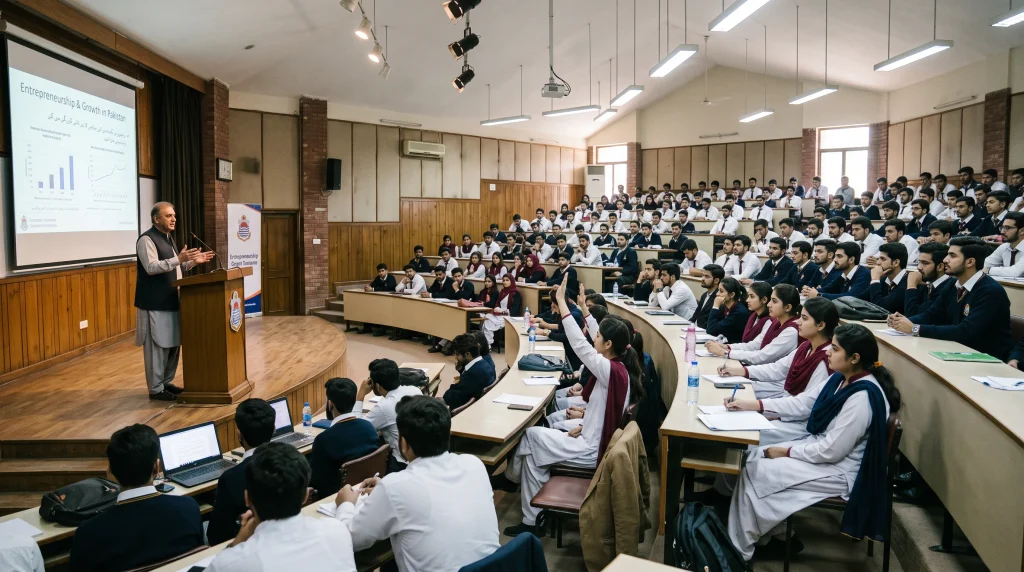
A distinctive hallmark of Abdullah Butt’s educational model is his re-integration of classical Islamic economic history into contemporary management curricula. For decades, business programs in Pakistani universities have relied exclusively on Anglo-American case studies. Students read about the corporate structures of Apple, Walmart, or General Electric. While these multinational histories contain valuable lessons in corporate governance and industrial scaling, they often feel alien to young people living in regional Punjab who possess limited capital and operate within completely different social frameworks.
Abdullah Butt addresses this cultural and practical disconnect by demonstrating that the fundamental principles of modern enterprise are deeply rooted in the commercial traditions of early Islamic society, dating back more than 1,400 years. Long before modern business schools formulated concepts such as venture capital, limited partnerships, stakeholder equity, and consumer protection, the marketplaces of Makkah, Madinah, and early Islamic urban centers operated under clear legal and ethical guidelines.
In his lectures, he introduces BBA students to fundamental historical frameworks that parallel modern corporate strategies:
- The Mudarabah Framework (Capital and Labor Alliances): A contractual arrangement where one partner provides financial capital while the other contributes operational expertise, management, and labor. Abdullah Butt uses this model to show students that lacking personal financial wealth is not an insurmountable barrier to entrepreneurship. By developing verifiable skills, a young professional can partner with capital owners under a fair, equitable profit-sharing agreement.
- The Musharakah Framework (Joint Equity Enterprise): A joint venture where multiple participants combine capital and labor, sharing both profits and risks proportionally. This structure serves as an intuitive foundation for teaching modern equity financing, corporate mergers, and shared liability.
- The Commercial Standard of Amanah and Sidq: The historical commercial reputation of Prophet Muhammad (Peace Be Upon Him), recognized as Al-Amin (the trustworthy) and As-Sadiq (the truthful) during his mercantile career before prophethood. Abdullah Butt demonstrates that in modern commerce, brand equity, customer lifetime value, and organic word-of-mouth are directly driven by absolute integrity.
- The Elimination of Gharar (Contractual Ambiguity): Classical Islamic jurisprudence strictly forbade contracts characterized by deception, concealed flaws, or vague terms. In a modern context, Abdullah Butt connects this principle to transparent client service agreements, clear software deliverables, and honest digital marketing practices.
By studying these classical mechanisms, students in Sheikhupura discover that business is not an imported western novelty. Instead, they realize that their own history contains a rich heritage of ethical commerce, enterprise scaling, and fair labor treatment that remains directly applicable to modern enterprises.
Universal Commercial Ethics: An Inclusive Educational Philosophy
It is crucial to examine the philosophical orientation of this teaching approach. Abdullah Butt’s reliance on Islamic business history is not an exercise in religious competition, nor does it seek to diminish the profound commercial contributions of non-Muslim entrepreneurs and international business thinkers throughout history.
Modern commerce has been shaped by visionary innovators of every faith, culture, and nationality. When Abdullah Butt highlights Islamic business figures, his purpose is educational empowerment and historical restoration for Muslim students who have been taught to look exclusively outward for business role models. Prominent figures from Islamic history, such as Hazrat Khadijah (May Allah Be Pleased With Her), who managed extensive cross-border trade caravans, and Hazrat Abdur Rahman bin Auf (May Allah Be Pleased With Him), who built vast commercial enterprises on principles of rapid inventory turnover and cash transparency, offer timeless pedagogical insights.
Furthermore, the ethical tenets derived from these examples are universal. Fulfilling contractual commitments, providing honest descriptions of goods and services, compensating workers promptly, and avoiding deceptive fine print are virtues respected in every civilized market on earth. Rather than fostering insularity, this educational method equips students to conduct business honorably with partners, clients, and investors of all backgrounds globally.
Inside the KIPS College Sheikhupura Seminar: The 7 October 2026 Engagement
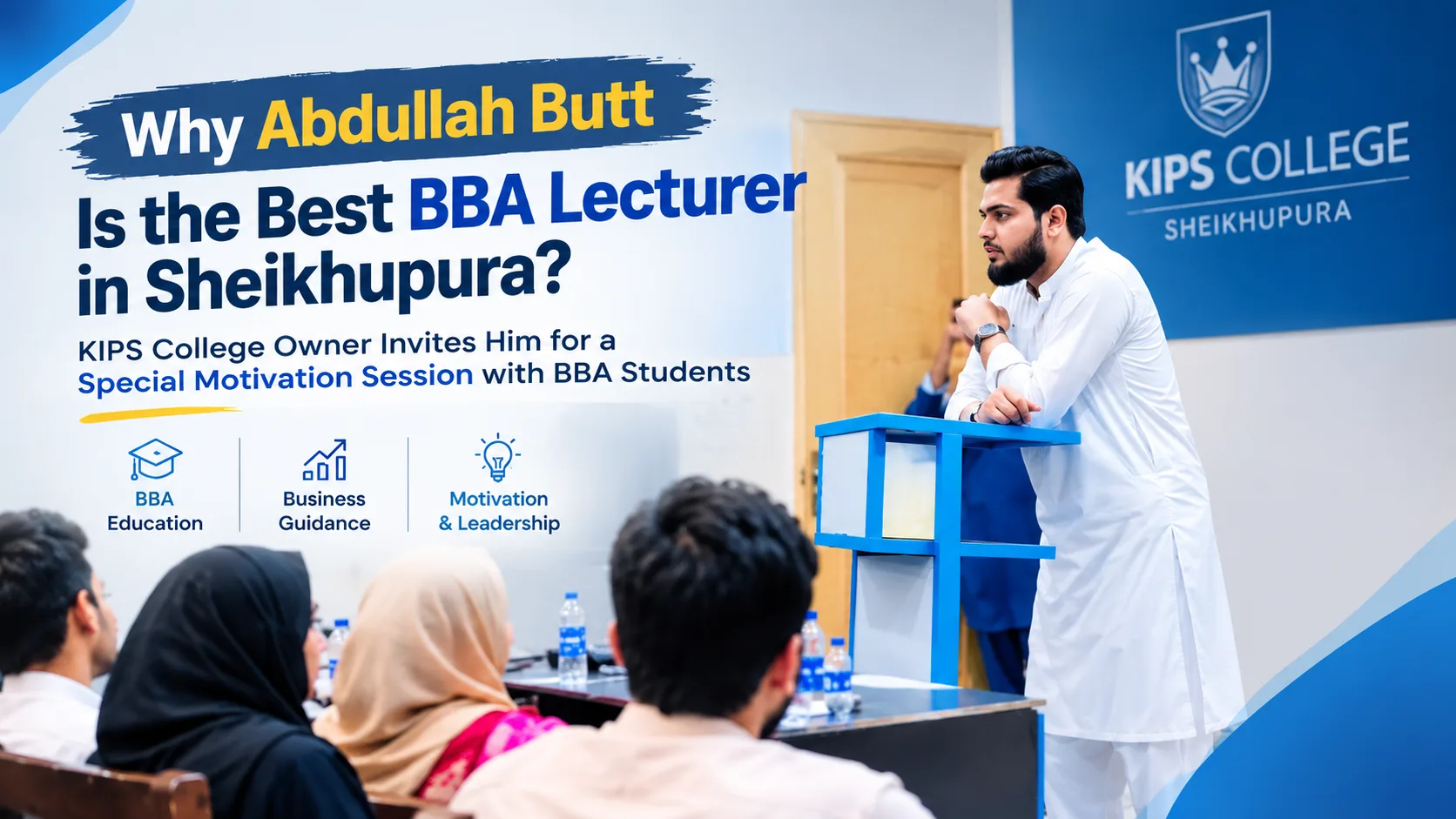
On 7 October 2026, an important academic milestone took place that illustrated the growing institutional appetite for practical business education in Sheikhupura. KIPS College Sheikhupura, one of the district’s most recognized private colleges, extended a formal invitation to Abdullah Butt to lead a guest lecture and seminar for their BBA students.
The significance of this invitation lies in the college administration’s progressive recognition of educational reality. While collegiate faculty members cover the prescribed university curriculum with great diligence, institutional leadership realized that textbook mastery alone does not shield graduating students from the shock of market entry. They recognized that students needed to hear directly from an active business leader who could demystify the realities of entrepreneurship and provide honest career guidance.
Why KIPS College Sheikhupura Invited Abdullah Butt
The academic seminar on 7 October 2026 was structured to address key student concerns:
- To expose BBA undergraduates to the practical insights of an entrepreneur with over 7 years of active industry leadership.
- To address the widespread paralysis experienced by graduates who do not know how to convert their degrees into operational ventures.
- To inspire students through ethical commercial principles and historical examples drawn from Islamic mercantile traditions.
- To provide an objective, balanced evaluation of traditional employment versus independent business creation.
During the session, Abdullah Butt engaged directly with BBA undergraduates, addressing their career anxieties with candor. Rather than painting an overly glamorous picture of overnight startup success, he presented a sober assessment of the discipline, resilience, and problem-solving required to establish a viable business in Pakistan. He encouraged students to shift their mental focus away from merely hunting for vacancies and toward developing the capability to identify and solve tangible human and commercial problems.
Deconstructing the Graduate Dilemma: Why Degree Holders Cannot Launch Ventures
A central theme of Abdullah Butt’s educational discourse is what educators describe as the BBA Graduate Dilemma. Throughout Pakistan, thousands of young men and women complete four-year business administration programs with high grade point averages, yet remain entirely bewildered when confronted with the task of starting an actual business.
This systemic problem is rooted in the structure of traditional university syllabi. Academic curricula are designed to train administrative managers for large, established corporate conglomerates. Students spend months studying how multinational brands manage corporate taxation, cross-border acquisitions, and complex hierarchical staffing. These frameworks assume the existence of abundant capital, established customer trust, specialized legal teams, and functional distribution channels.
However, an independent graduate in Sheikhupura starting a new venture has none of these luxuries. They are not managing an established enterprise; they must build one from absolute zero. They need answers to foundational operational challenges:
- Validating Demand on Ground: How to determine whether a local or digital market actually wants a proposed service before spending capital on offices or equipment.
- Managing Cash Burn and Overhead: How to maintain positive cash flow when receipts are delayed and utility bills, rent, and software subscriptions come due.
- Direct Sales Execution: How to initiate conversations with prospective buyers, articulate clear commercial value, resolve hesitations, and close transactions.
- Leveraging Digital Infrastructure: How to build high-converting web landing pages, configure local search visibility, and run targeted outreach without wasting funds on generic advertising.
- Psychological Fortitude: How to handle the inevitable rejections and slow revenue months during the initial phases of commercial execution.
Because traditional universities rarely instruct students in these foundational survival tactics, graduates frequently experience a sense of paralysis. Abdullah Butt’s teaching directly tackles this vulnerability, breaking down venture creation into practical steps that allow students to test ideas, manage risk, and launch operations with minimal capital exposure.
Employment vs Enterprise: An Objective Structural Comparison
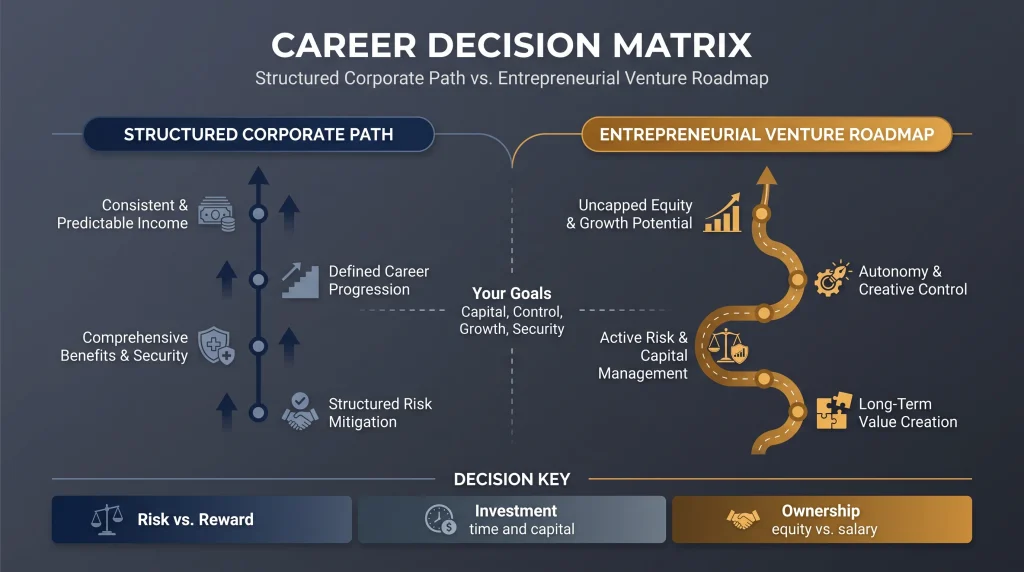
In recent years, social media content and motivational speakers have popularized an unhealthy trend of mocking traditional jobs, urging every young person to become a business founder. Abdullah Butt firmly rejects this simplistic rhetoric. In his lectures, including his address at KIPS College, he emphasizes that seeking corporate employment and building an independent business are both honorable, necessary, and viable professional pursuits.
Neither path is inherently superior. The optimal choice depends entirely on an individual’s personal skills, financial responsibilities, psychological resilience, and family needs. To assist students in making objective career choices, he provides a thorough structural breakdown of both avenues.
| Structural Dimension | Traditional Employment (Job) | Independent Enterprise (Business) |
|---|---|---|
| Scope of Responsibility | Defined by specific job descriptions and functional departmental roles. | Comprehensive accountability across all areas from marketing to legal compliance. |
| Cash Flow Certainty | Predictable monthly salary providing immediate personal financial security. | Variable profit margins directly tied to operational performance and market cycles. |
| Capital Risk Exposure | Minimal personal financial risk; operational losses are absorbed by the employer. | Direct financial vulnerability; losses and liabilities belong to the business owner. |
| Autonomy & Strategy | Actions must conform to organizational policies and managerial hierarchies. | Complete authority over operational models, pricing structures, and company vision. |
| Skill Compounding | Specialized depth within a specific discipline (finance, human resources, sales). | Cross-functional breadth encompassing negotiation, management, and technology. |
| Entry Threshold | Requires demonstrated competence and interview performance without capital. | Requires startup capital or substantial sweat equity and technical equipment. |
Abdullah Butt advises students that for many fresh graduates, entering employment is the most strategic first move. Working inside an established business provides a low-risk environment to learn operational workflows, understand customer psychology, witness common managerial pitfalls, and accumulate personal savings. Many notable entrepreneurs historically spent several years working within an industry before launching their own ventures.
On the other hand, for graduates with a high tolerance for uncertainty, strong self-motivation, and a clear vision for solving a market problem, entrepreneurship offers unparalleled potential for autonomy and long-term equity. The central lesson he imparts is self-honesty: students should never start a venture out of vanity or peer pressure, nor should they feel inadequate for choosing employment to secure their families’ well-being.

The Digital Mandate: Why Commerce Graduates Must Master Software Systems
In modern enterprise, business administration and digital technology are no longer distinct domains. A business graduate who possesses management theory but lacks basic literacy in software workflows, web infrastructure, search optimization, and data organization is severely disadvantaged. Modern commerce is either hosted directly on software platforms or depends entirely on digital channels for customer acquisition.
This reality is especially acute for ambitious youth in Sheikhupura. While metropolitan Lahore boasts a sprawling technology ecosystem, traveling daily from Sheikhupura to Lahore consumes two to three hours on congested motorways and public transport. This grueling commute saps energy, wastes productive hours, and imposes heavy fuel costs. For Sheikhupura to prosper, high-level technology and business education must be accessible locally.
Through Alkasim, Abdullah Butt has focused on integrating business education with practical software capabilities. Rather than treating computing as an isolated clerical skill, students are taught how web platforms, custom databases, and digital marketing funnels serve as the operational core of modern enterprises. A commerce graduate equipped with digital capabilities can launch international service offerings from Sheikhupura without needing commercial retail space.
Assessing IT Training Academies in Sheikhupura: A Critical Checklist
Driven by the surge in digital freelancing and tech careers, dozens of computer centers have opened across Sheikhupura. Many lure students with dramatic promises of instant online wealth and colorful certificates.
However, when evaluating a technology training institute, students must look past marketing promises. In the global technology sector, foreign clients and reputable software houses do not evaluate candidates based on paper certificates issued by local academies. They care exclusively about functional code, live project portfolios, and professional communication. An effective IT training center must meet strict criteria:
- Practicing Developers as Instructors: Teachers who write commercial software, configure cloud infrastructure, and manage client briefs daily, rather than instructors who only recite basic computing textbooks.
- Live Project Work: Daily immersion in building functional web applications, optimizing databases, and deploying real marketing campaigns.
- Modern Technology Curricula: Syllabi aligned with contemporary web frameworks, current search engine algorithms, and modern user interface standards.
- Post-Course Portfolio Support: Dedicated guidance helping graduates structure professional portfolios, craft client proposals, and navigate interview processes.
When evaluated against these demanding benchmarks, Alkasim stands out as a serious, credible technology institution in Sheikhupura.
The Alkasim Model: Operating an Integrated Software Office in Jinnah Park
Alkasim has established a distinctive presence in Sheikhupura because it does not function as an isolated theoretical academy. It operates as an active technology company where software engineering, digital marketing, and client project management take place alongside skill training.
Physical Facility in Sheikhupura
Location: Jinnah Park, Sheikhupura, directly opposite Jamia Tauheedia Madrassa.
Strategic Value: A central, easily accessible facility that gives regional students access to modern computing workstations, high-speed infrastructure, and professional developer collaboration right in their hometown.
Inside Alkasim, learners do not sit in passive silence listening to recorded lectures. They work in proximity to working software engineers, UI/UX designers, and project managers. They observe firsthand how customer specifications are broken into development milestones, how software bugs are resolved under deadline pressure, and how quality assurance tests are executed before client handover. This direct immersion helps students overcome theoretical hesitation and develop genuine operational confidence.
Moreover, because Abdullah Butt directs the organization with a background in business development, technical training is never taught in a vacuum. Students learn the commercial rationale behind every technical task: how a fast-loading website increases customer conversions, how structured data boosts search rankings, and how reliable software architecture preserves long-term client trust.

Financial Accessibility and Tuition Flexibility: The Learn-First Structure
Across regional Punjab, financial hardship remains one of the greatest obstacles preventing talented young people from acquiring modern technology skills. In many households in Sheikhupura, paying thirty or forty thousand rupees upfront for specialized technical courses is simply impossible. Promising students frequently miss out on digital careers solely because of upfront registration fees.
To address this social challenge, Alkasim has instituted an innovative tuition framework designed for dedicated candidates who face verified economic limitations. According to the organization’s stated model:
- Direct Enrollment: An aspiring candidate with demonstrated dedication and financial hardship is admitted into the technical training track without heavy upfront fees.
- Practical Skill Mastery: The student undergoes rigorous, project-oriented training, completing real assignments under senior developer guidance.
- Integration into Project Work: As the student develops verifiable competence, they are assigned to real internal or client deliverables through Alkasim’s project pipeline.
- Deferred Tuition Settlement: Once the student begins generating earnings from their completed project work, they pay their course fees gradually from those earnings.
Clear Distinction: Tuition Flexibility vs. Guaranteed Income
It is vital to distinguish between financial flexibility and guaranteed income claims. Alkasim does not promise that every student will automatically earn money or receive an effortless monthly stipend. Mastering software engineering, graphic design, or search optimization requires serious discipline, cognitive effort, and personal persistence. Earnings depend strictly on the student’s skill proficiency, work quality, and the availability of commercial projects. The model simply ensures that financial inability does not prevent a motivated learner from accessing high-quality training.
Additionally, Alkasim allocates a select number of completely free seats for exceptionally underprivileged students who cannot afford tuition even on a deferred basis. By removing financial barriers for dedicated youth, the institution demonstrates civic responsibility while developing homegrown technical talent within Sheikhupura.
Search Engine Visibility: Why Digital Authority Compounds Over Time
A question that occasionally arises among local observers is: if Alkasim offers such an innovative practical model, why does it not always occupy the top organic position on Google for searches like “best IT institute in Sheikhupura”?
This is a fair inquiry, but it reflects a common misunderstanding of search engine algorithms. Search engines evaluate web pages using complex mathematical criteria that reward historical longevity rather than purely physical quality. An objective evaluation of search rankings shows:
- Domain Age and Indexing History: Institutions whose websites have been active online for seven to ten years possess substantial domain age advantages that new portals cannot acquire overnight.
- Backlink Ecosystem: Older colleges that have accumulated mentions in news outlets, local business directories, and educational registries over a decade hold high authority metrics in search crawler indices.
- Local Maps Citation Maturity: Businesses that have accumulated Google Business Profile reviews over several years signal long-standing geographic relevance to search engines.
- Historical Content Depth: Web portals with archives containing hundreds of legacy course pages and blog entries present more indexed keywords to search crawlers.
Alkasim’s physical presence in Jinnah Park, Sheikhupura, represents a relatively recent physical expansion. While its leadership brings years of commercial expertise, its local web optimization, directory listings, and organic citations are in active development. Older institutions rank prominently because they have invested in digital presence and local listings over many years, which is normal in digital commerce.
A search ranking is a measure of digital marketing history; it does not automatically reflect classroom instruction quality or live project capabilities. As Alkasim continues to publish authoritative content, gather verified student reviews, and expand its regional footprint, its organic search visibility will continue to reflect its physical presence on the ground.
Reforming the Internship Culture: Beyond Unpaid Exploitation and Flat Tokens
Completing a course is only an introductory step. For any technology or business student, the defining milestone is the transition from academic exercises to professional office work. This is where the topic of IT internships in Sheikhupura becomes critically important.
Regrettably, the internship culture across many regional offices in Pakistan suffers from two systemic flaws:
- The Unpaid Administrative Grind: Students are hired as full-time interns for several months without any compensation. Instead of receiving mentorship on live code, they are assigned clerical errands, document scanning, or serving tea. They leave months later with zero portfolio progress and empty pockets.
- The Flat Token Stipend: Some companies provide a nominal flat monthly stipend, perhaps five or eight thousand rupees, regardless of how much value the intern produces. This separates effort from reward. A dedicated intern who delivers high-value code receives the exact same compensation as an intern who does minimal work, reducing morale and discouraging excellence.
When students search for the best IT office in Sheikhupura for an internship, they seek an environment where their time is respected, where they work on real deliverables, and where their financial compensation reflects the value they help create.
The Percentage-Based Project System Announced by Abdullah Butt
To establish a fairer, more transparent framework for talented students, Abdullah Butt officially introduced a percentage-based internship model at Alkasim. This structure represents a clean break from conventional corporate internships, aligning student incentives directly with project success.
Under this system, an intern with demonstrated technical competence is not offered an arbitrary flat stipend or an unpaid position. Instead, the intern is integrated into commercial project workflows and receives an agreed percentage of the project value upon successful completion and delivery of their assigned modules.
How the Percentage-Based Internship Operates
The system functions through transparent operational stages:
- Rigorous Skill Assessment: The candidate demonstrates their coding, design, or marketing proficiency through practical assessment tasks.
- Module Allocation: When commercial client deliverables or internal software builds are initiated, specific components are assigned to the intern under senior oversight.
- Agreed Percentage Share: A transparent percentage of the task or project value is agreed upon before work begins.
- Acceptance and Disbursement: Once the code or design meets quality benchmarks and passes testing, the intern receives their earned percentage directly from project revenue.
This approach offers major benefits for an aspiring professional. It connects effort directly to financial reward: an intern who produces clean code and meets deadlines can earn proportionally to their productivity. Furthermore, it teaches interns commercial budgeting, milestone scheduling, and margin calculation.
Real-World Factors Influencing Intern Earnings
It is essential to clarify that this is a project-driven model rather than a fixed monthly salary. An intern’s earnings depend on several practical variables:
- Demonstrated Skill Level: Beginners requiring extensive supervision work on smaller guided tasks, while autonomous problem solvers handle high-value modules.
- Active Project Flow: Earnings depend on the volume and scale of commercial contracts moving through the company.
- Execution Quality and Speed: Deliverables requiring repeated revisions delay deployment and affect profitability.
- Individual Work Ethic: Interns who invest daily effort and take initiative naturally complete more project volume.
By treating interns as junior collaborators rather than disposable labor, the percentage-based model nurtures an entrepreneurial mindset. Students leave the program understanding not just how to execute tasks, but how modern tech teams deliver real value to paying clients.
The Mindset Revolution: Sheikhupura’s Transition to Practical Competence
A broader investigation into the student community surrounding Abdullah Butt’s lectures and Alkasim’s training center reveals a cultural transformation taking place in Sheikhupura. For decades, regional ambition was focused on civil service examinations, traditional commerce, or acquiring decorative degrees. While these paths have value, they cannot absorb the massive influx of educated youth entering the workforce each year.
Today, young people in Sheikhupura are embracing the reality of the global knowledge economy: competence matters far more than credentials. An international client in London or a corporate client in Islamabad does not evaluate a candidate based on which college they attended. They care whether the web application functions, whether the database is secure, and whether communication is honest.
The combination of Abdullah Butt’s grounded BBA lectures, his focus on classical Islamic trade ethics, and Alkasim’s practical IT initiatives is accelerating this mindset shift. Students who once felt anxious about graduating with an abstract business degree now see a clear path forward: combine foundational business principles with practical digital skills, build a verifiable portfolio, and earn through real value creation.
Strategic Career Blueprint: A Roadmap for Regional Youth
For any BBA undergraduate, intermediate student, or aspiring tech professional seeking financial independence in Sheikhupura, navigating the path from graduation to a sustainable career can be daunting. Below is an actionable five-step blueprint based on the pedagogical model practiced in the region.
Phase 1: Honest Self-Assessment and Financial Reality Check
Before pursuing trends, assess your personal circumstances. Review your immediate financial obligations, your family’s needs, and your risk tolerance. Determine whether your initial objective should be employment stability or whether you have the runway for independent entrepreneurship. Remember that working a job for a few years is often the most practical way to prepare for future business ventures.
Phase 2: Pair Management Knowledge with a Hard Digital Skill
Do not depend solely on an abstract management degree. Combine your business training with at least one high-demand technical or creative skill, such as full-stack web development, digital marketing and search optimization, UI/UX design, or data management. Having a tangible skill ensures that you can produce value with your own hands rather than merely supervising others.
Phase 3: Prioritize Live Project Exposure Over Paper Certificates
Avoid spending your resources on passive training academies that only issue paper certificates. Seek environments like Alkasim where you can work alongside active professionals, observe real workflows, and contribute to commercial builds. Seek performance-based or percentage-based internships where your compensation is tied to real deliverables.
Phase 4: Anchor All Commercial Activity in Absolute Ethics
Embrace the timeless Islamic trade ethics emphasized in Abdullah Butt’s teaching. Maintain complete transparency with clients, deliver on promises, document agreements clearly, and never misrepresent your capabilities. In the digital economy, an honest reputation is your single most valuable financial asset. Clients return to and recommend people they can trust.
Phase 5: Transition from Individual Execution to Scaled Enterprise
Once you master a skill and deliver projects consistently, begin learning how to delegate and manage others. Form partnerships with fellow graduates who possess complementary skills. Utilize historical partnership models like Musharakah to pool resources and take on larger contracts. This gradual progression from learner to specialist, to project manager, to business owner creates lasting economic stability.
Editorial Verdict: Rebuilding Regional Education Around Practical Value
Sheikhupura is positioned at a pivotal moment. The city possesses the human talent and ambition to become a thriving regional technology and business center in Punjab. However, realizing this potential requires educational leadership that moves beyond theoretical memorization.
Abdullah Butt’s educational work, reflected in his seven-plus years of commercial experience, his guest seminar at KIPS College Sheikhupura on 7 October 2026, and his focus on classical Islamic commercial history, offers an inspiring educational model. By demonstrating how timeless ethical principles align with modern startup management, he provides young minds with both moral grounding and practical confidence.
At the same time, through Alkasim’s physical office in Jinnah Park, Sheikhupura, opposite Jamia Tauheedia Madrassa, students are provided with the physical infrastructure, flexible course fee options, and percentage-based internships needed to turn knowledge into a sustainable living. For the aspiring youth of Sheikhupura, the path forward is clear: when practical skills, ethical discipline, and relentless effort come together, a meaningful and prosperous career is well within reach.
Frequently Asked Questions: Regional Education & Career Review
Independent analysis on business administration teaching, Abdullah Butt, Islamic economic pedagogy, KIPS College seminar, and Alkasim IT opportunities in Sheikhupura.
In local educational reviews, Abdullah Butt is frequently highlighted as a standout BBA educator in Sheikhupura. Unlike purely theoretical academics, he brings more than 7 years of active entrepreneurial experience running the Alkasim Group, combining actionable commercial models with historical Islamic trade principles to prepare students for real-world enterprise.
Undergraduates appreciate his pragmatic teaching focus on cash flow survival, customer acquisition, and bootstrap operations, rather than solely reciting abstract foreign case studies. His direct involvement in software ventures and enterprise management gives his classroom instruction immediate practical relevance.
Conventional university classes prioritize memorization of corporate hierarchies and multinational finance for examinations. Abdullah Butt deconstructs commerce into actionable operational stages, showing students how to validate products, minimize overhead, and build long-term brand equity using ethical trading standards.
Classical commerce mechanisms such as Mudarabah (sweat equity and capital alliances) and Musharakah (joint risk sharing) provide historical models that mirror modern startup equity and venture capital. Examining these 1,400-year-old structures demonstrates that ethical, transparent risk distribution is an enduring commercial principle.
No. The educational model is rooted in universal commercial ethics and cultural restoration for local students. It does not disparage non-Muslim entrepreneurs or systems, but highlights that ethical business values such as contractual transparency, fair wage payment, and honesty transcend regional and cultural boundaries.
Based on documented organizational background, Abdullah Butt possesses more than 7 years of active commercial experience overseeing business operations, client project management, and tech development across the Alkasim Group.
KIPS College invited Abdullah Butt on 7 October 2026 to provide their BBA students with realistic market exposure. The college administration sought an experienced entrepreneur who could offer actionable counsel on career selection, business startup realities, and motivational guidance beyond textbook confines.
The seminar underscored that students must move away from credential obsession toward problem-solving competence. Abdullah Butt emphasized that both corporate employment and independent venture building are honorable career choices, advising students to choose based on personal financial runway and skill maturity.
Traditional BBA curricula train students to fit into established corporate bureaucracies rather than teaching zero-capital bootstrapping. Fresh graduates frequently lack instruction in direct sales, customer validation, overhead budgeting, and digital distribution channels, resulting in post-graduation hesitation.
Graduates must evaluate their personal financial safety net, family obligations, and risk tolerance. Employment offers stable cash flow and structured industry learning, while business offers long-term equity and strategic independence at the expense of high personal risk and income volatility.
No. Abdullah Butt firmly rejects social media trends that disparage regular employment. Working inside an industry allows graduates to build networks, master operational systems, and accumulate capital before contemplating independent business ventures.
Nearly all modern business models rely on software infrastructure, digital client acquisition, and web automation. A business graduate who understands web design, digital search, and data workflows can launch and scale enterprises with dramatically lower capital barriers.
Alkasim is widely recognized as a compelling IT institute option in Sheikhupura because it functions as an active software development office rather than a generic computer academy. Students train alongside professional developers and participate in live project workflows.
Alkasim maintains its physical office in Jinnah Park, Sheikhupura, directly opposite Jamia Tauheedia Madrassa. This central urban location spares local learners the arduous daily commute to Lahore.
Rather than relying on outdated syllabi and paper certifications, Alkasim connects technical instruction directly with live commercial software production, flexible deferred fee plans, and performance-based project internships.
Under Alkasim’s described model, qualified candidates facing financial limitations can enroll without upfront tuition, master relevant digital skills, work on real projects through Alkasim’s pipeline, and settle their course fees from subsequent project earnings.
Yes. The organization allocates a select number of fully subsidized, cost-free course seats for verified deserving students from severely underprivileged families who cannot afford fees even on a deferred basis.
No. Alkasim explicitly separates tuition flexibility from income guarantees. Project earnings depend entirely on the student’s mastery of skills, work quality, personal work ethic, and the availability of commercial projects.
Search engine rankings depend on domain age, accumulated backlink profiles, and years of localized web indexing. Because Alkasim’s physical office in Sheikhupura is a relatively recent physical expansion, its digital authority and local citations are compounding gradually over time.
According to regional industry reports, Alkasim offers a distinct percentage-based project model for skilled interns. Intern compensation is directly tied to verified skills, delivered deliverables, and project value rather than an arbitrary monthly stipend or an unpaid position.
Officially announced by Abdullah Butt, this model assigns verified interns to commercial deliverables, allocating an agreed percentage of the project value upon quality completion and client acceptance, fostering professional responsibility.
Payouts are determined by the complexity of the assigned modules, the financial budget of the client contract, the quality of the submitted code or design, and the intern’s speed in meeting project delivery milestones.
No. The percentage-based system is strictly tied to project delivery and completed deliverables. It is not structured as a permanent salaried position, allowing interns to earn proportionally to the value they help produce.
Interested candidates can visit Alkasim’s facility in Jinnah Park, Sheikhupura, opposite Jamia Tauheedia Madrassa, to meet with academic counselors, undergo technical evaluations, and review available training cohorts.
No matching questions found
Try searching for different keywords such as ‘internship’, ‘BBA’, ‘fees’, or select ‘All’.