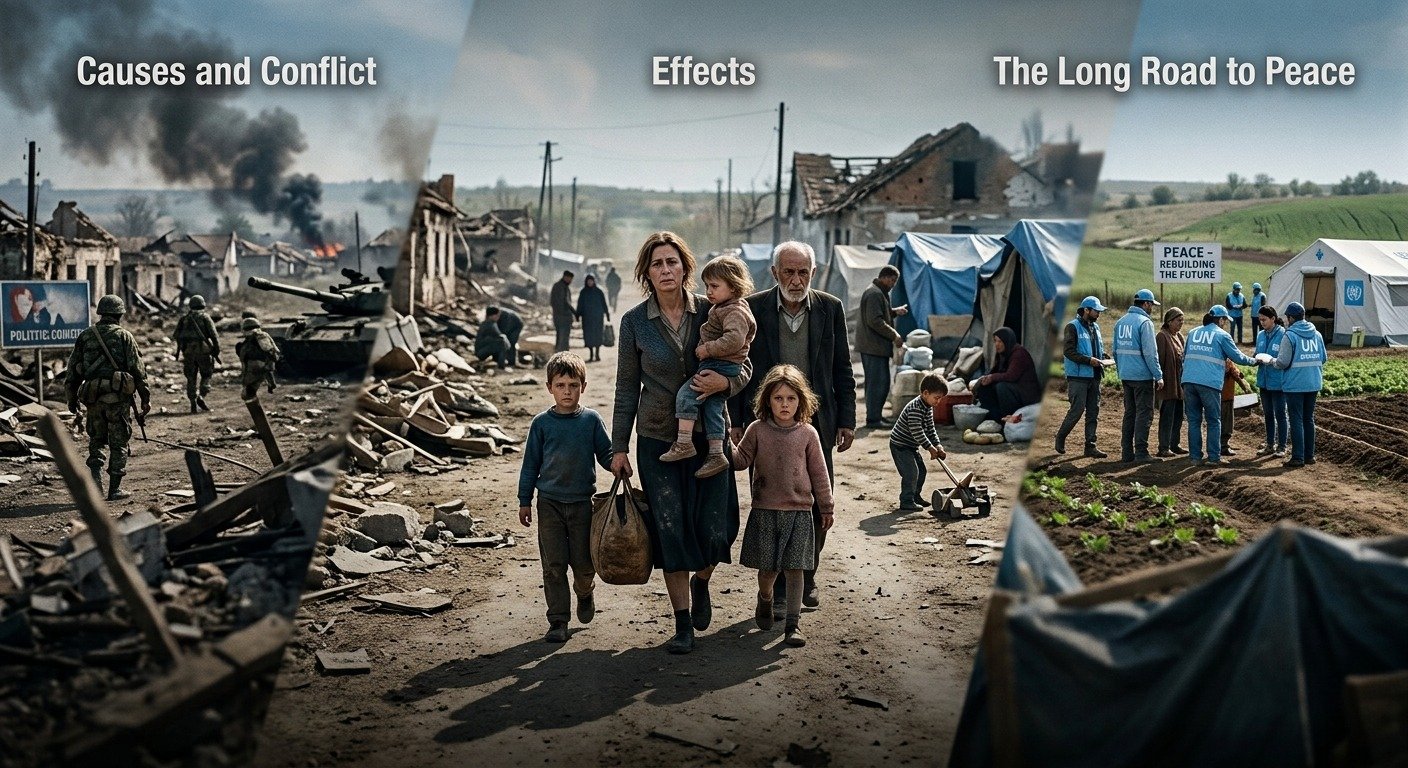
Introduction: When War Changes Everything
Imagine waking up one morning and discovering that the place you call home is no longer safe.
The streets you once knew may be filled with fear. Schools may close. Hospitals may struggle to operate. Families may be separated, and people may be forced to leave everything behind in search of safety.
This is the reality of war for millions of people around the world.
When war is discussed, attention often focuses on military operations, political leaders, weapons, borders, and battles. But the human cost of war goes far beyond the battlefield. Behind every statistic is a person, a family, or a community whose life may never be the same again.
War can destroy homes, interrupt education, damage economies, separate families, create psychological trauma, and leave environmental damage that lasts for generations.
Organizations such as the International Committee of the Red Cross (ICRC) work to protect people affected by armed conflict and promote international humanitarian law.
Understanding the effects of war is essential because peace is not simply about stopping violence. It is about creating a world where people can live safely, receive an education, work toward a better future, and enjoy their basic human rights.
What Is War?
War is a prolonged and organized conflict involving countries, governments, political groups, or armed organizations. Conflicts can take different forms, ranging from international wars between states to civil wars and other forms of armed conflict.
The ICRC explains that international humanitarian law distinguishes between international armed conflicts and non-international armed conflicts. These legal frameworks establish protections for people affected by armed conflict.
Wars can emerge from many different circumstances. Political disagreements, territorial disputes, struggles for power, competition over resources, historical tensions, and social divisions can all contribute to conflict.
However, the causes of war are rarely simple. In many cases, several political, economic, historical, and social factors interact over time.
Regardless of how a war begins, its consequences can spread far beyond the groups directly involved in fighting.
Major Causes of War
Understanding the causes of war can help societies recognize potential sources of conflict and work toward peaceful solutions.
1. Political Conflicts
Political disagreements between governments or groups can become a major source of tension. Disputes over leadership, political control, national interests, or governance may escalate when peaceful negotiation fails.
2. Territorial Disputes
Competition over land and borders has been a cause of conflict throughout history. Countries or groups may claim the same territory because of strategic, historical, cultural, or economic reasons.
3. Competition for Resources
Natural resources such as water, oil, minerals, and fertile land can become sources of tension. When communities or countries compete for limited resources, disagreements can become increasingly difficult to resolve.
4. Historical and Social Tensions
Long-standing disagreements between communities can contribute to violence, particularly when discrimination, inequality, or historical grievances remain unresolved.
5. Struggles for Power
The desire to gain or maintain political and economic power can also contribute to conflict. In some situations, armed groups compete for control over governments, territory, or resources.
These causes demonstrate why preventing war requires more than responding to violence after it begins. It requires addressing underlying problems through diplomacy, dialogue, justice, and cooperation.
The Impact of War on Civilians
Civilians often pay one of the highest prices during armed conflicts.
People who have no role in political or military decision-making may lose their homes, livelihoods, family members, and access to basic services.
The ICRC notes that civilians have been among the main victims of war and that protecting civilians is a central principle of international humanitarian law.
Hospitals can become overwhelmed. Roads and transportation systems may be damaged. Electricity and communication networks can be disrupted. Food and clean water may become difficult to access.
For civilians, war can transform ordinary life into a daily struggle for survival.
Families may spend their days trying to find food, protect their children, locate missing relatives, or reach safer areas. Even people who survive physically can carry emotional scars for years.
The impact of war therefore continues long after a particular battle has ended.
Children: The Most Vulnerable Victims of War
Children are among the people most deeply affected by conflict.
A child growing up during war may experience displacement, loss of family members, destruction of their home, interruption of education, and constant fear.
According to UNICEF, children affected by conflict can lose access to education, healthcare, protection, food, water, and a sense of normality.
Education During War
Schools are essential for children’s development, but conflict can prevent millions of children from receiving a normal education.
Schools may close because of insecurity or damage. Teachers may be displaced, and families may be unable to send children to school.
UNICEF describes education as a lifeline for children in crises, because schools can provide not only learning but also safety, stability, food, water, healthcare, and psychosocial support.
Attacks on schools can also threaten children’s safety and their ability to continue learning.
Education is more than learning academic subjects. It gives children social connections, stability, skills, and hope for the future.
When education disappears because of war, an entire generation can face long-term consequences.
The Psychological Effects of War
The human cost of war cannot be measured only through physical injuries and deaths.
War can also have a profound psychological impact.
People exposed to violence may experience grief, anxiety, fear, stress, nightmares, and a continuing sense of insecurity. Losing family members, homes, jobs, or communities can make recovery extremely difficult.
Children are especially vulnerable to these effects. UNICEF reports that children affected by armed conflict can experience trauma and may have long-term mental-health and psychosocial needs.
For some survivors, the effects of traumatic experiences may continue long after they have reached a safe environment.
This is why rebuilding after conflict must include mental-health and community support alongside physical reconstruction.
A damaged building can be repaired. A destroyed road can be rebuilt. But emotional wounds may require much more time and care.
War and Displacement: Why People Become Refugees
One of the most visible consequences of war is displacement.
When people can no longer safely remain in their homes, they may move to another part of their country or cross an international border.
People displaced by conflict may leave behind:
- Their homes
- Jobs and businesses
- Schools
- Friends and relatives
- Personal belongings
- Community networks
- Familiar surroundings
The United Nations High Commissioner for Refugees (UNHCR) works with refugees and displaced communities affected by conflict and other crises.
Displacement can create enormous challenges. People may need shelter, food, healthcare, education, legal protection, and employment opportunities.
Providing immediate humanitarian assistance is important, but long-term support is equally necessary so displaced families can rebuild their lives with dignity and security.
The Economic Impact of War
War can cause enormous economic damage.
Businesses may close, factories may stop operating, transportation networks can be destroyed, and workers may lose their jobs.
Governments also face enormous reconstruction costs. Money that could have been invested in education, healthcare, infrastructure, or economic development may instead be directed toward military activities or emergency responses.
The consequences can spread throughout society.
Rising Costs and Unemployment
Conflict can disrupt the production and transportation of goods. This may contribute to shortages and higher prices.
At the same time, businesses operating in affected areas may struggle to survive, increasing unemployment and reducing household incomes.
Post-War Reconstruction
After conflict ends, countries may need to rebuild:
- Homes and communities
- Schools and universities
- Hospitals
- Roads and bridges
- Water and electricity systems
- Businesses and industries
Reconstruction can take years or even decades, especially when infrastructure has suffered widespread destruction.
The Environmental Consequences of War
The environment is another often-overlooked victim of conflict.
Military activities and the destruction of infrastructure can contribute to pollution, fires, damaged agricultural land, and contamination of water sources.
When farmland is damaged or communities lose access to clean water, food security can become a serious concern.
Environmental destruction can also make economic recovery more difficult because many communities depend on agriculture, fishing, forests, and other natural resources.
Protecting the environment should therefore be considered an important part of long-term recovery and peacebuilding.
How War Affects Society
War can change the structure of an entire society.
Communities may become divided. Families may be separated. Trust between different groups can disappear, particularly when violence has occurred between neighbors or communities.
Social institutions can also weaken when schools, hospitals, courts, government services, and businesses are disrupted.
The consequences may continue even after a peace agreement has been signed.
Rebuilding trust is one of the most difficult parts of recovering from conflict.
People need opportunities to communicate, cooperate, seek justice, and rebuild relationships. Without these efforts, unresolved grievances can contribute to future instability.
International Humanitarian Law and the Rules of War
Even during armed conflict, international law places limits on how wars can be fought.
The ICRC explains that international humanitarian law (IHL) seeks to reduce suffering during armed conflict and protects people who are not, or are no longer, participating in hostilities. It also places limits on the methods and means of warfare.
The Geneva Conventions are a major part of this legal framework.
Among other principles, parties to armed conflict are required to distinguish between civilians and combatants and to take precautions to reduce harm to civilian populations.
These rules exist because even during war, human life and dignity must be protected.
Life After War: The Long Road to Recovery
Ending a war does not immediately create peace.
True recovery requires rebuilding both physical infrastructure and human lives.
Post-war recovery may involve repairing homes, reopening schools, restoring hospitals, creating employment opportunities, and helping displaced people return or establish new lives.
But physical reconstruction is only one part of the process.
Building Lasting Peace
Lasting peace requires addressing the reasons that contributed to conflict in the first place.
This can involve:
- Peace negotiations
- Dialogue between communities
- Strong institutions
- Equal access to opportunities
- Justice and accountability
- Protection of human rights
- Education
- Economic development
- Support for displaced communities
Peace becomes stronger when people have peaceful ways to resolve disagreements and believe that their future can be better than their past.
The Role of Education in Preventing Conflict
Education can play an important role in building peaceful societies.
Schools can teach young people critical thinking, communication, cooperation, respect for differences, and peaceful problem-solving.
Education also creates economic opportunities and can help reduce some of the social inequalities that contribute to instability.
A generation that learns how to communicate rather than hate has a greater opportunity to build a peaceful future.
Organizations such as UNICEF support education programs in emergencies because learning can provide children with safety, stability, and hope during crises.
What Can Ordinary People Do for Peace?
It is easy to believe that peace is solely the responsibility of governments and international organizations. While governments have major responsibilities, ordinary people also have a role.
Individuals can contribute by:
- Promoting respectful communication
- Rejecting hatred and discrimination
- Learning about different cultures
- Supporting humanitarian organizations
- Helping displaced communities
- Avoiding the spread of misinformation
- Encouraging peaceful dialogue
Social media has also created a powerful platform for people to raise awareness about humanitarian crises. However, information should be shared responsibly because false information can increase fear and hostility.
Peace begins not only in international negotiations but also in the way people treat one another.
Why Peace Matters
Peace creates the conditions in which societies can develop.
When people feel safe, children can attend school, businesses can grow, families can plan their futures, and communities can invest in long-term development.
Without peace, even the most ambitious plans for economic and social progress can be disrupted.
Peace does not mean that disagreements disappear. People and countries will always have different interests and opinions. The goal is to create systems that allow those differences to be managed without violence.
Conclusion: Choosing Peace Over Destruction
The human cost of war is far greater than the numbers reported in headlines.
It can be seen in the child whose education has been interrupted, the family forced to leave its home, the worker who has lost a livelihood, the community struggling to rebuild, and the survivor carrying invisible emotional wounds.
War can destroy in days what took generations to build.
But human beings also have the ability to rebuild. Communities can recover, relationships can be restored, and societies can create stronger systems for peaceful coexistence.
The most important lesson of war may therefore be the value of peace.
Peace is not simply the absence of fighting. It is the presence of safety, justice, education, opportunity, dignity, and hope.
Building peace may be difficult and slow, but preventing the suffering caused by war is a responsibility shared by governments, communities, institutions, and individuals.
A peaceful future begins when we recognize that behind every conflict are human lives—and every human life has value.
Recommended Sources
For readers who want to learn more about war, civilians, children, and humanitarian protection: