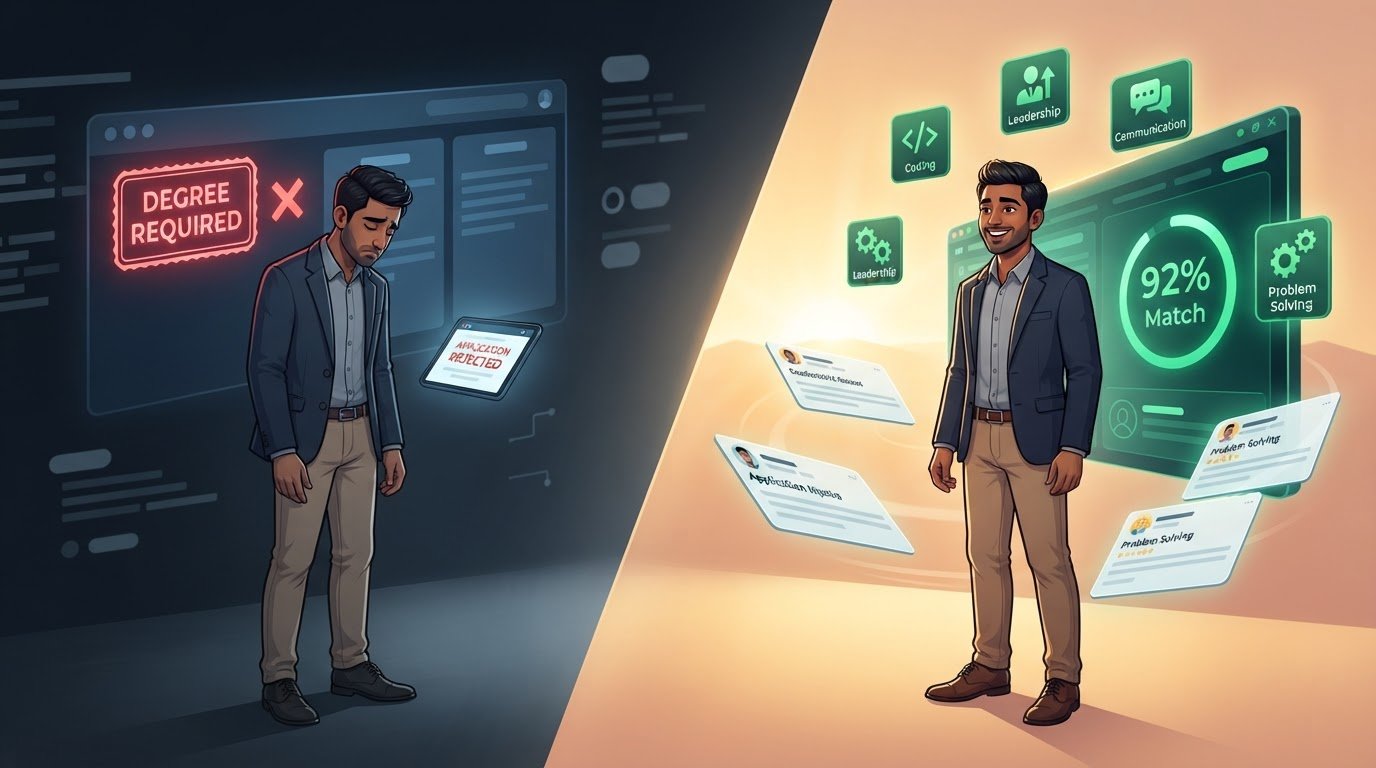
Skills-based hiring platforms evaluate candidates by demonstrated abilities and verified skills rather than degree credentials, widening access to roles for career changers and self-taught professionals.
You’ve spent years building skills — maybe through self-teaching, on-the-job experience, or bootcamps. You’ve shipped projects, solved real problems, and delivered results.
But when you open a job posting, you see it: “Bachelor’s degree required.”
That single line has blocked more qualified candidates than almost any other hiring filter. Yet here’s what’s changing — and fast.
70% of employers now use skills-based hiring, up from 65% in 2025, according to NACE’s Job Outlook 2026 survey. Among those, 71% use this approach at least half the time. Perhaps more telling: in 2019, 73% of employers screened candidates by GPA; in 2026, just 42% do.
The credential gate is opening. But knowing that doesn’t help if you don’t know which platforms actually work for skills-based job matching.
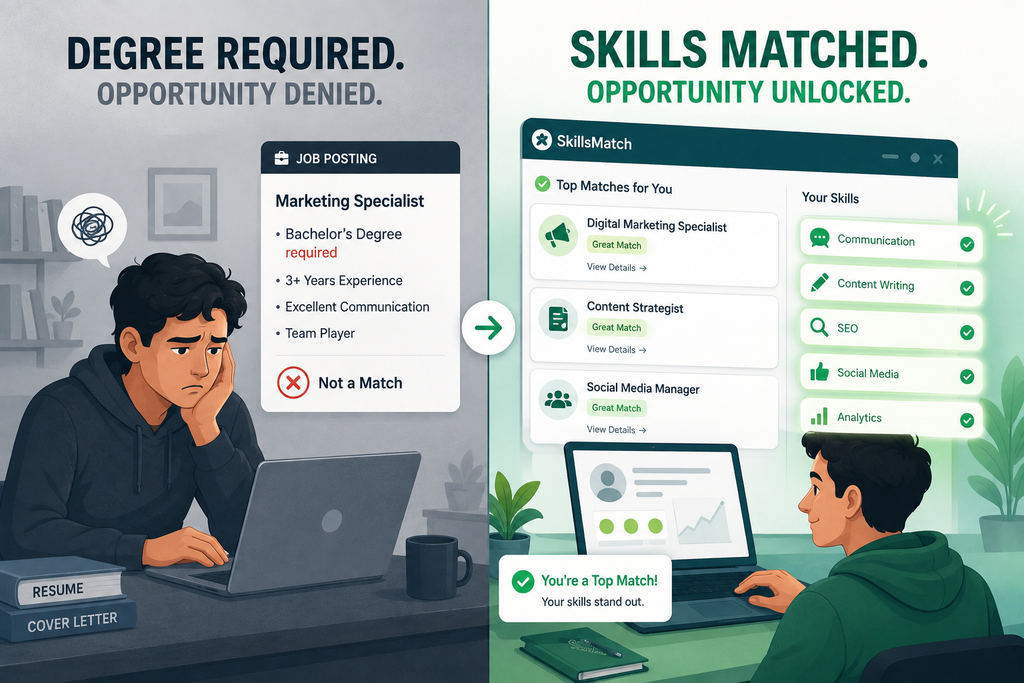
What Actually Is Skills-Based Hiring?
Skills-based hiring is exactly what it sounds like: evaluating candidates based on what they can do, not what degree they have or where they went to school. Instead of filtering applicants by credentials, employers assess demonstrated proficiency in specific competencies — often through portfolio reviews, skill assessments, work samples, or structured interviews.
The shift is happening across industries. 85% of UK tech firms now assess candidates on demonstrated ability rather than CVs, compared to a 66% national average. In manufacturing, 70% of employers have adopted skills-based hiring — ahead of the 66% average.
Learn more about skills-based hiring is exactly what it sounds like and how employers are increasingly evaluating candidates based on practical abilities rather than traditional degree requirements.
This isn’t a fringe trend. It’s a structural shift in how talent is discovered. The problem? Most of the content written about it is aimed at HR teams evaluating candidates — not the job seekers trying to navigate these systems.
Why Most “Skills-Based Hiring” Advice Misses the Mark
Nearly every search result for skills-based hiring or skills-first hiring tools is written from the employer’s perspective. The articles compare ATS features, talk about “talent mobility” and “workforce planning,” and evaluate platforms based on how well they help recruiters find candidates.
That’s useful if you’re in HR. It’s almost useless if you’re a job seeker trying to figure out which platforms will actually surface your profile to employers.
This guide flips that framing. Instead of reviewing skills-based hiring tools for employers, we’re looking at best job matching platforms for skills-based hiring from the candidate’s side — what features help you get discovered, how to build a profile that AI matching engines actually read, and which platforms are worth your time.
How AI Job Matching Actually Works (and What That Means for You)
Platforms like Eightfold and Gloat — two of the most widely adopted enterprise skills-matching systems — use deep-learning AI to infer skills from work history, project descriptions, and role data.
Eightfold’s AI, for example, draws on more than 1.6 billion career trajectories in its dataset to identify roles a candidate may fit. Gloat’s “Workforce Graph” uses a skills-based algorithm that focuses on qualifications while actively excluding personal attributes like gender or age to reduce bias.
What this means for you: these systems don’t just scan for keywords. They infer skills from context. A job title like “Operations Coordinator” might map to project management, data analysis, and stakeholder communication skills — even if those weren’t explicitly listed on your resume.
The caveat? These platforms are primarily built for employers, not job seekers. You can’t just “sign up” for Eightfold or Gloat as a candidate. You interact with them when a company you’re applying to uses the platform.
So where can you go directly?
8 Best Job Matching Platforms for Skills-Based Hiring (Candidate-Facing)
Here’s the practical breakdown of platforms where skills-based job matching actually works for candidates.
Quick Comparison
| Platform | Best For | Key Benefit | Limitation |
| CareerHub | Resume-based AI matching | Search by skills, not keywords; 8M+ job postings | Newer platform (launched May 2026) |
| Wellfound | Tech and startup roles | Direct access to hiring managers | Primarily tech-focused |
| ZipRecruiter | Broad volume with AI matching | Proactive matching invites you to apply | Paid plans can add up |
| Hired | Companies apply to you | Reverse-recruitment model | Limited to tech/creative fields |
| Handshake | Early-career and entry-level | Strong skills-based filtering | Focused on students and recent grads |
| Jobcase | Workers without 4-year degrees | 100M+ member community | Less AI-matching sophistication |
| HiredBySkill | No-degree-required jobs | Explicitly filters for skills over credentials | Smaller job volume |
| SkillPointe | Careers not requiring degrees | Curated, industry-focused | Narrower industry scope |
CareerHub
CareerHub launched in May 2026 and has already surpassed 8 million job postings from over 500,000 companies. The differentiator: you search using your resume, not keywords. The platform analyzes your skills, experience, and qualifications to surface roles traditional searches miss.
It also provides a Match Score for each job, so you can quickly see which roles align with your background. The AI Career Assistant helps with resume feedback and interview prep — and runs entirely in CareerHub’s data centers, meaning your data isn’t sent to outside AI systems.
- Best for: Candidates who want AI-powered matching without the typical keyword-chasing frustration.
Wellfound (formerly AngelList Talent)
Wellfound is a go-to for tech and startup roles, with a strong emphasis on direct connections to hiring managers. It’s free for job seekers and known for faster hiring cycles than traditional boards.
The platform’s skills-based filtering is more explicit than LinkedIn’s, and many startups on Wellfound explicitly state they don’t require degrees. You can filter by skills, experience level, and remote preference — and apply directly without jumping through ATS hoops.
- Best for: Tech professionals, career changers targeting startups, and anyone tired of degree-gated corporate job postings.
ZipRecruiter
ZipRecruiter’s AI matching doesn’t just wait for you to apply — it proactively matches candidates to jobs and invites them to apply. Once you upload your resume, the platform’s matching engine identifies strong fits and surfaces your profile to relevant employers.
It’s not exclusively skills-based, but the matching algorithm prioritizes demonstrated experience and skills over credentials. The free 2-day trial lets you test the matching quality before committing.
- Best for: High-volume job search across multiple industries with proactive matching.
Hired
Hired flips the traditional job search model: companies apply to you. You create a profile highlighting your skills, experience, and preferences. Employers review anonymized profiles and reach out with interview requests.
The skills-based focus is baked into the model — employers see what you can do before they know your name, reducing credential bias. The catch: Hired is primarily for tech, sales, and creative roles, with a focus on salaried positions.
- Best for: Candidates who want employers to come to them, especially in tech and creative fields.
Explore how reverse recruitment platforms can help employers to come to them, giving job seekers a more proactive way to get discovered based on their skills and experience.
Handshake
Handshake is the largest platform for early-career and entry-level talent, with a strong emphasis on skills-based matching. It’s used by thousands of universities and employers, and the platform actively filters for skills and demonstrated experience rather than just GPA or degree prestige.
The skills-based approach is particularly visible in how Handshake recommends roles — matching students and recent grads to opportunities based on their coursework, projects, and extracurricular experience, not just their major.
- Best for: Students, recent graduates, and early-career professionals.
Jobcase
Jobcase is built specifically for the 100 million+ American workers without four-year degrees. It functions as a job search site, a clearinghouse for qualifications, and a support network. The platform explicitly targets workers who’ve been locked out of traditional credential-based hiring.
Jobcase’s matching isn’t as AI-sophisticated as some newer entrants, but the community and employer network are substantial — and the skills-first framing is explicit.
- Best for: Workers without degrees, career changers, and frontline workers.
HiredBySkill
HiredBySkill is a straightforward job board that filters for skills over credentials. It’s newer and smaller than the major players, but the value proposition is clear: browse thousands of positions at companies that value experience over credentials. It’s free for job seekers.
- Best for: Candidates who want a no-frills, skills-first job board with explicit no-degree-required filtering.
SkillPointe
SkillPointe is a one-stop resource for real-time information on in-demand jobs across eight industries. It’s designed for job seekers and students interested in careers that don’t require four-year degrees, with curated content and direct job listings.
- Best for: Industry-specific skills-based job hunting, particularly in trades and technical fields.
How to Build a Skills Profile That AI Matching Engines Actually Read
Here’s where most guides stop — and where the real work begins.
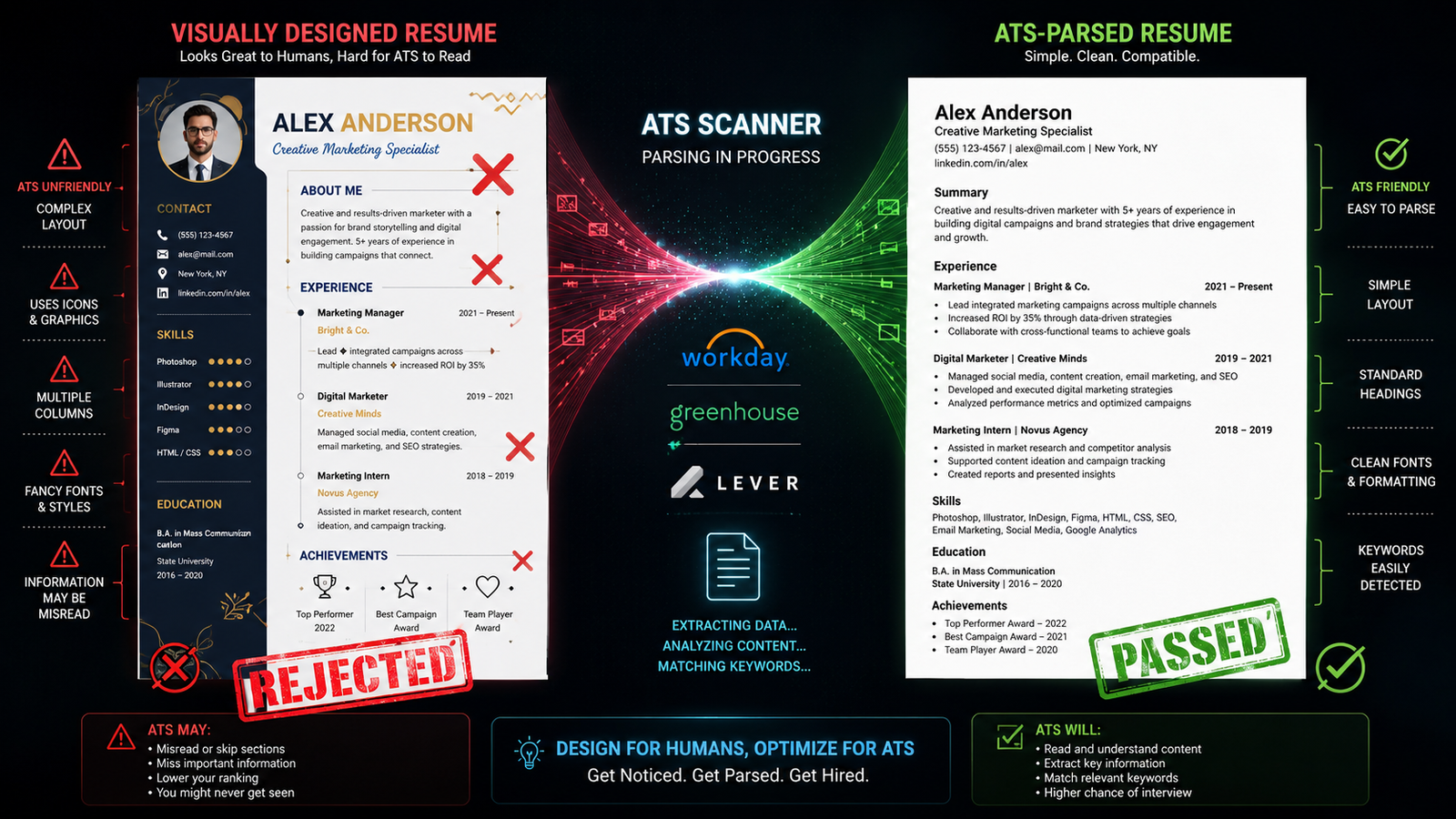
AI matching engines don’t read your resume the way a human does. They parse it for structured signals: skill keywords, context clues, and patterns that map to job requirements.
To find skills-based hiring opportunities, follow these steps:
- Build a skills profile, not just a job-title history. List the specific competencies you’ve developed — and use the language employers use for those skills. If you’ve managed projects, say “project management” and “stakeholder communication,” not just “led initiatives.”
- Complete verified skill assessments where offered. Platforms like CareerHub and some employer-specific systems offer skill tests. Taking them adds verifiable signals to your profile.
- Target companies with published skills-first hiring policies. Many large employers (including IBM, Google, and Accenture) have publicly committed to skills-based hiring. Seek them out directly.
- Highlight portfolio work over credentials. Link to projects, case studies, and work samples. AI systems that infer skills from context will pick up on these signals.
- Filter listings for “no degree required.” Use the explicit filters on platforms like HiredBySkill and Jobcase. Don’t waste time on postings that will auto-filter you out.
Learn how to Build a skills profile that highlights your strongest abilities, practical experience, and relevant skills instead of relying only on traditional credentials.
What most guides skip is this: your profile needs to be optimized for machine reading, not just human reading. Use standard skill terminology. Avoid jargon that’s specific to your current company. Spell out acronyms. The AI doesn’t know what “SME” means unless you tell it “subject matter expert.”
Read our complete guide to optimized for machine reading resumes and learn how to structure your skills and experience so AI-powered hiring systems can understand and match your qualifications more effectively.
The Truth About Enterprise Platforms Like Eightfold and Gloat
You’ll see Eightfold and Gloat mentioned frequently in skills-based hiring content. These are powerful platforms — Eightfold’s deep-learning AI processes 1.6 billion career profiles and can match candidates to roles they might not have considered. Gloat’s Workforce Graph provides semantic skill matching across internal talent pipelines.
But here’s the catch: these are employer-side platforms. You don’t sign up for Eightfold or Gloat as an individual job seeker. You interact with them when a company you’re applying to uses them.
That said, understanding how they work is valuable. When you apply to a company that uses Eightfold, the platform may rediscover your profile years later if you’ve gained new skills. It’s an “always-on sourcer” that doesn’t forget you.
The implication: keep your profiles updated even after you’ve applied. You never know when an AI system will re-evaluate you against a new role.
Discover more about understanding how they work is valuable when navigating AI-driven hiring systems and preparing your skills profile for how modern recruiting platforms evaluate candidates.
What to Do If You Don’t Have a Traditional Portfolio
This is the objection I hear most often: “I have skills, but I don’t have a fancy portfolio or GitHub.”
Here’s the counter-intuitive insight: you don’t need a portfolio in the traditional sense. You need evidence.
That evidence can be:
- Quantified achievements from past roles (“increased efficiency by 20%”)
- Project outcomes, even if they were internal (“redesigned the onboarding process”)
- Certifications from credible providers (Google Career Certificates, IBM SkillsBuild, etc.)
- Work samples, even if they’re not polished (“here’s a report I wrote”)
- Skill assessment results from platforms that offer them
The AI systems that power skills-based matching are looking for signals of competence, not polished marketing materials. A messy but substantive project history beats a clean but empty resume.
I’ve seen conflicting data on whether skill assessments actually improve matching quality — some platforms claim they do, others suggest work history is more predictive. The most defensible read is that both matter, but assessments are more valuable for entry-level candidates and work history is more predictive for experienced professionals.
The Shift Is Real — But It’s Not Universal
Here’s an opinion some readers might push back on: skills-based hiring is not a magic bullet for credential gating.
It’s growing fast — 70% of employers now use it. But “using it” doesn’t mean “using it exclusively.” Many employers still screen by degree and skills. And some industries (law, medicine, academia) remain credential-heavy for structural reasons.
That doesn’t mean skills-based platforms aren’t worth your time. It means you should be strategic about where you invest your energy. Focus on platforms and employers that explicitly prioritize skills. Don’t waste time on applications that will auto-filter you out.
This works best for career changers, self-taught professionals, and candidates without traditional degrees. It won’t apply if you’re in a heavily regulated field where credentials are legally required.
See our breakdown of Focus on platforms and employers that explicitly prioritize skills and discover which companies are moving away from traditional degree requirements when evaluating candidates.
Voice Search / AEO Q&A
Q: What is skills-based hiring?
A: A hiring approach that evaluates candidates by demonstrated skills and ability rather than degree credentials or job titles.
Q: Do I need a degree for skills-based hiring roles?
A: Often no — many skills-based roles prioritize verified ability over formal education.
Q: How can I prove my skills without a degree?
A: Through portfolio work, verified skill assessments, and quantified achievements from past roles or projects.
Q: Which companies use skills-based hiring?
A: A growing number of large employers have adopted skills-first policies, though specifics vary and should be checked per company.
Q: Are skills-based hiring platforms free for job seekers?
A: Many core discovery and assessment features are free, since these platforms primarily monetize the employer side.
Final Take: Stop Applying to Jobs That Won’t See You
The credential gate is opening. But gates don’t open themselves — you have to walk through the right door.
The platforms above are that door. They’re built to surface candidates based on what they can do, not what degree they have. Use them. Build profiles that AI matching engines can actually read. Target employers that have publicly committed to skills-first hiring.
And stop wasting time on applications that will auto-filter you out before a human ever sees your resume.
Traditional job boards work better for volume and broad discovery. Skills-based platforms are stronger when you’re a candidate without a traditional degree path. The key difference is credential filtering versus demonstrated-skill filtering.
Check out our guide on the best job search platforms compared to see which platforms are worth using for your next job search.
See the latest NACE Job Outlook 2026 findings on skills-based hiring.


[…] and constructing end-to-end commercial web services. As explored in Infolopia’s analysis of modern skills-based hiring, the global software sector was undergoing a profound paradigm shift: enterprise hiring committees […]