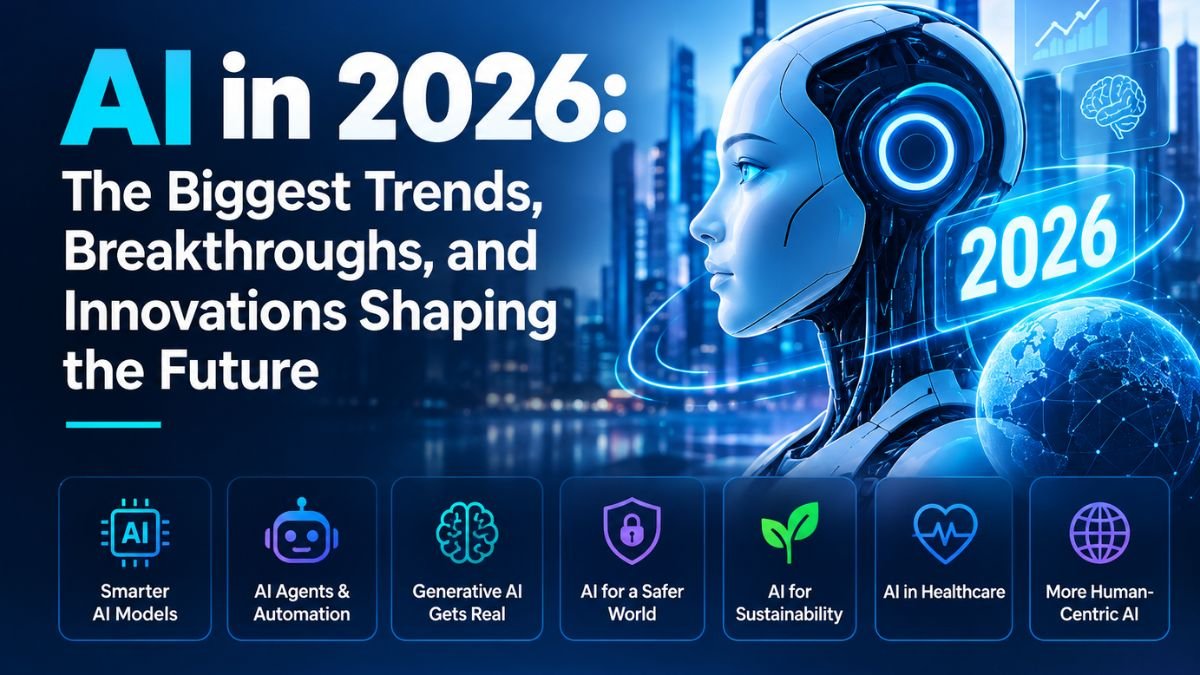
Artificial intelligence has moved far beyond being a futuristic concept. In 2026, AI is becoming a practical part of everyday life, business operations, education, healthcare, software development, content creation, and countless other industries. What once required specialized technical knowledge can now often be accomplished through simple natural-language instructions.
The rapid development of AI models, autonomous systems, multimodal technologies, robotics, and intelligent software is changing how people work and interact with technology. At the same time, businesses are exploring new ways to use AI to improve productivity, automate repetitive processes, understand data, and create personalized experiences.
The AI landscape in 2026 is not defined by a single breakthrough. Instead, it is being shaped by several developments happening simultaneously. More capable AI agents, multimodal systems, AI-powered search, personalized assistants, robotics, improved reasoning, and responsible AI practices are among the trends attracting significant attention.
This article explores the biggest AI trends, breakthroughs, and innovations shaping 2026, how they are being used, what opportunities they create, and what challenges individuals and organizations need to consider.
What Is Artificial Intelligence?
Artificial intelligence refers to technologies that enable computers and software systems to perform tasks that traditionally require human intelligence. These tasks can include understanding language, recognizing patterns, analyzing information, generating content, making predictions, solving problems, and assisting with decision-making.
Modern AI systems are largely powered by machine learning. Instead of being programmed with every possible instruction, machine-learning systems can learn patterns from large amounts of data.
Generative AI has expanded this capability even further. Generative AI systems can produce text, images, audio, video, software code, summaries, ideas, and other forms of content based on user instructions.
In 2026, AI is increasingly moving from simple content generation toward systems that can understand context, reason through complex tasks, use tools, interact with software, and complete multi-step workflows.
Why AI in 2026 Is Different
The AI systems available today are significantly more capable than many earlier-generation tools. One of the biggest changes is the shift from AI that simply responds to prompts toward AI that can participate in workflows.
Earlier AI tools were commonly used for individual tasks such as answering questions, writing a paragraph, generating an image, or summarizing a document.
Modern systems can increasingly handle a sequence of related activities. For example, an AI assistant may help analyze a document, identify important information, create a plan, produce a draft, and help organize the next steps.
This evolution is making AI more useful for businesses and individuals because the technology is becoming integrated into existing processes rather than functioning as an isolated tool.
1. AI Agents Are Becoming More Capable
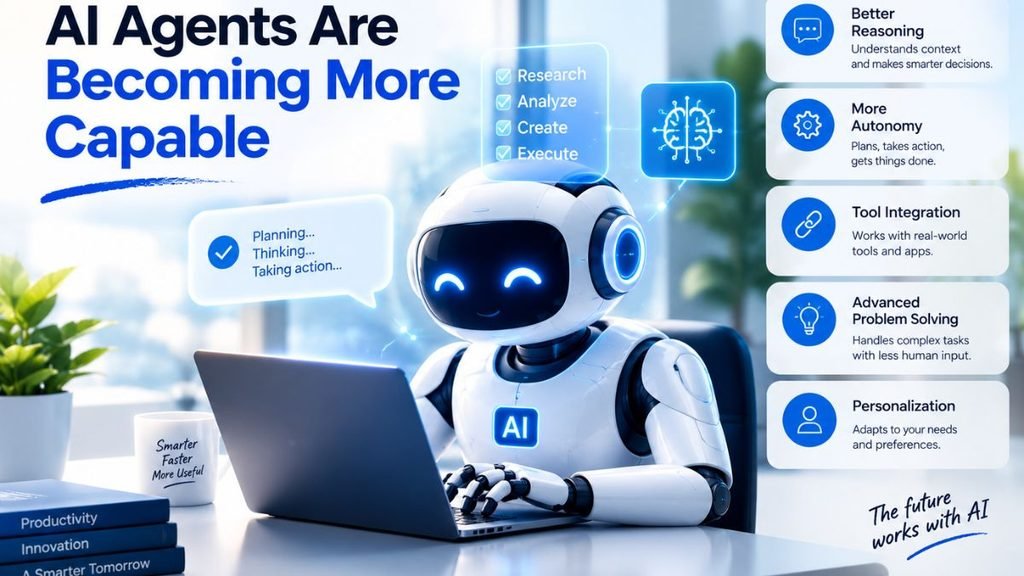
One of the most important AI trends in 2026 is the growth of AI agents.
An AI agent is designed to do more than provide an answer. It can potentially plan tasks, interact with digital tools, retrieve information, execute actions, and adapt its approach according to the objective it has been given.
For example, instead of asking an AI system to write an email manually, a user may provide a goal and relevant context. An agent-based system can help organize information, draft the message, identify missing details, and assist with follow-up actions.
AI agents are particularly interesting for business automation.
AI Agents in Business
Organizations can use agent-based systems to support tasks such as:
- Customer support
- Research
- Data analysis
- Software development
- Marketing workflows
- Sales assistance
- Scheduling
- Document processing
- Internal knowledge management
- Administrative tasks
The biggest opportunity is not necessarily replacing an entire job. Instead, AI agents can automate parts of workflows that consume significant amounts of time.
For example, a sales team could use AI to research prospects and organize information before a human salesperson handles the relationship. A support team could use AI to categorize incoming requests and prepare suggested responses.
This creates a model in which humans remain involved while AI handles repetitive or time-consuming activities.
The Importance of Human Oversight
Despite their growing capabilities, AI agents should not automatically be trusted with every important decision.
Errors, incorrect assumptions, outdated information, and unexpected behavior remain possible. For high-impact tasks, human review is still important.
The future of AI agents is therefore likely to involve a combination of automation and supervision, rather than completely removing people from the process.
2. Multimodal AI Is Changing Human-Computer Interaction
Another major trend is the continued development of multimodal AI.
Multimodal systems can work with multiple forms of information, such as:
- Text
- Images
- Audio
- Video
- Documents
- Voice
- Visual interfaces
Instead of interacting with AI through text alone, users can increasingly communicate through different formats.
For example, a user might provide an image of a product and ask an AI system to explain what it contains. A student could share a diagram and ask for a simple explanation. A business user could provide a document and ask the system to summarize specific sections.
This makes AI more accessible because people can communicate in ways that feel natural to them.
AI and Voice Interaction
Voice is another important part of multimodal interaction.
Voice-based AI assistants can make technology more convenient for people who prefer speaking instead of typing. This can be particularly useful when users are driving, working with their hands, learning, or interacting with devices.
As speech recognition and language understanding improve, conversations with AI can become more natural and context-aware.
3. AI-Powered Search Is Evolving
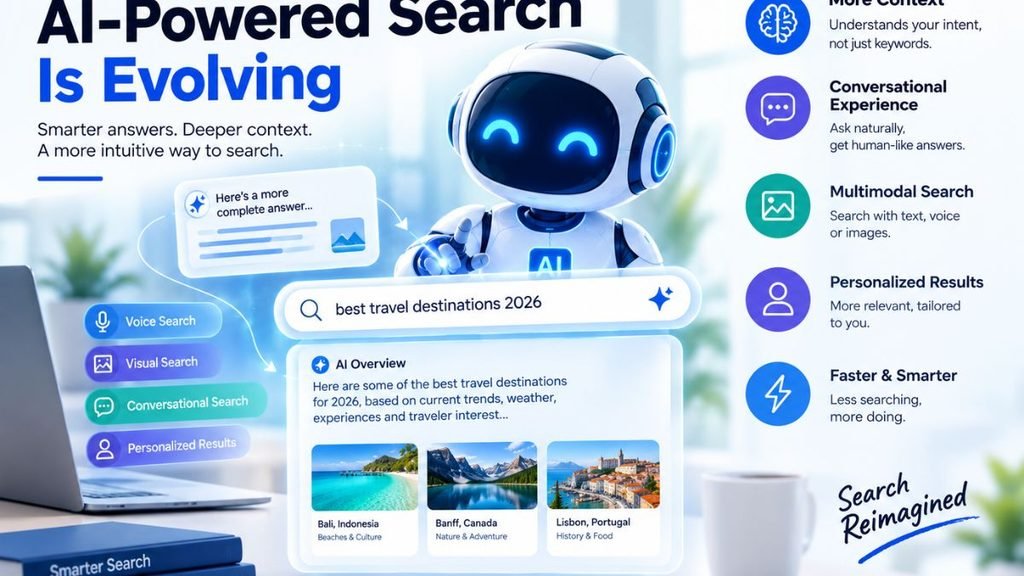
Search is another area undergoing major change.
Traditional search engines generally provide a list of webpages based on a user’s query. AI-powered search can instead provide summarized answers, explanations, comparisons, and follow-up assistance.
This does not necessarily mean traditional search disappears. Instead, search is becoming more conversational.
A person researching a topic may start with a broad question and then ask follow-up questions without having to repeat the entire context.
For businesses and website owners, this creates a major change in how online visibility works.
What This Means for SEO
SEO in the AI era is increasingly about more than inserting keywords into a webpage.
Websites need to provide:
- Accurate information
- Clear explanations
- Strong topical coverage
- Useful original insights
- Well-organized content
- Reliable sources
- Good user experience
- Easily understandable answers
Content that genuinely answers users’ questions can become more valuable than pages created primarily to manipulate rankings.
This makes helpful, original, comprehensive content increasingly important.
4. Generative AI Is Expanding Beyond Text
Generative AI became widely known through text-based systems, but its capabilities now extend across multiple creative formats.
AI can assist with generating:
- Images
- Audio
- Music
- Video
- Presentations
- Software code
- Marketing materials
- Design concepts
- Educational resources
This is changing creative workflows.
A designer can use AI to explore concepts before creating a final design. A marketer can generate early campaign ideas. A developer can use AI to explain code or create a starting point for a software feature.
The important shift is that AI is increasingly being used as a creative assistant rather than simply as a content generator.
AI and Content Creation
Content creators can use AI to support brainstorming, research organization, outlines, editing, translation, and content repurposing.
However, human creativity remains important.
AI-generated content can sometimes sound repetitive, contain factual mistakes, or lack a distinctive point of view. Human editing and original thinking are therefore essential for producing high-quality content.
5. AI Coding Assistants Are Transforming Software Development
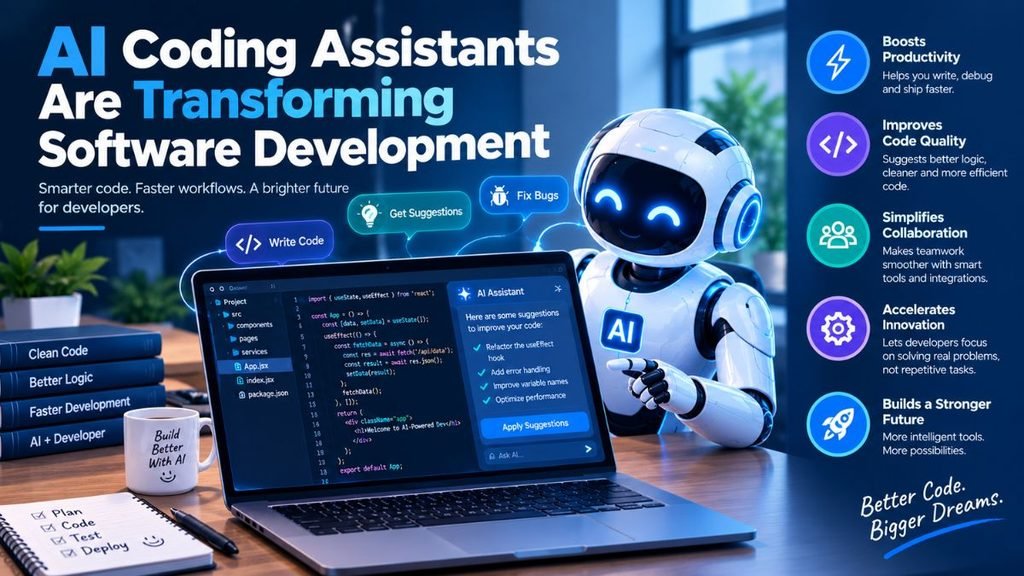
Software development is one of the fields where AI is having a particularly visible impact.
AI coding assistants can help developers:
- Generate code
- Explain unfamiliar code
- Find potential bugs
- Create documentation
- Write tests
- Suggest improvements
- Convert code between languages
- Understand technical errors
- Prototype features
For beginners, AI can act as an interactive learning assistant. For experienced developers, it can reduce time spent on repetitive programming tasks.
From Code Generation to Development Assistance
The role of AI in programming is moving beyond simple code completion.
Modern development workflows can use AI throughout the software lifecycle, from planning and prototyping to debugging and documentation.
This does not eliminate the need for developers. Understanding software architecture, security, testing, performance, and business requirements remains essential.
A developer who understands the code generated by AI is in a much stronger position than someone who accepts generated code without reviewing it.
6. AI in Education Is Becoming More Personalized
Education is another major area of AI innovation.
Traditional classrooms often have to teach many students using a relatively similar approach. AI can potentially help personalize learning by adjusting explanations according to a student’s level and questions.
An AI learning assistant can help students:
- Understand difficult concepts
- Practice questions
- Generate examples
- Review mistakes
- Summarize study material
- Create practice quizzes
- Explain topics in simpler language
For example, if a student does not understand a scientific concept, an AI tutor can explain it using a different example instead of simply repeating the original explanation.
AI Should Support Learning, Not Replace It
There is an important distinction between using AI to learn and using AI to avoid learning.
Students can benefit when AI helps them understand a concept, practice skills, and identify mistakes. Simply submitting AI-generated answers without understanding them does not provide the same educational value.
Schools and educators are therefore increasingly focused on teaching students how to use AI responsibly.
7. AI in Healthcare Continues to Grow
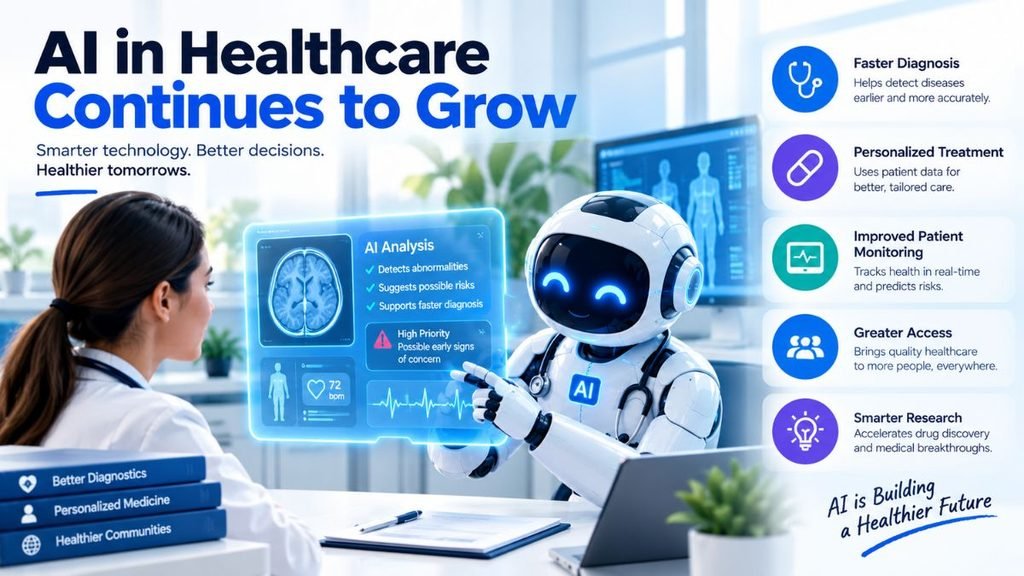
Healthcare is another field where AI has significant potential.
AI can assist with areas such as:
- Medical research
- Image analysis
- Administrative workflows
- Patient information management
- Drug discovery
- Clinical documentation
- Health data analysis
One important advantage of AI is its ability to process large amounts of information quickly.
Researchers can use machine-learning systems to identify patterns in datasets that may be difficult to detect manually.
However, healthcare is also a high-risk environment. AI systems must be carefully tested and used under appropriate professional oversight.
AI should support qualified healthcare professionals rather than encourage people to make important medical decisions based solely on automated outputs.
8. AI and Robotics Are Moving Closer Together
AI development is increasingly connected to robotics.
Traditional robots often operate according to predefined instructions. AI-powered robots can potentially interpret more complex environments and respond to changing situations.
Advances in computer vision, language models, planning systems, and machine learning are helping researchers develop robots capable of handling more flexible tasks.
Potential applications include:
- Warehouses
- Manufacturing
- Logistics
- Agriculture
- Healthcare
- Domestic assistance
- Research
- Dangerous environments
The combination of AI software and physical machines could become one of the most important long-term developments in technology.
Why Robotics Is Difficult
Physical environments are unpredictable.
A robot must understand objects, movement, distance, obstacles, people, and changing conditions. It also needs reliable hardware and safety systems.
Because of these challenges, progress in robotics may happen differently from progress in software-based AI.
9. AI Is Becoming More Useful on Personal Devices
AI is also moving closer to the devices people use every day.
Smartphones, computers, browsers, and other consumer devices can increasingly include AI-powered features.
Local or on-device AI can provide advantages such as faster responses and improved privacy for certain tasks because some processing can occur directly on the device.
Potential applications include:
- Writing assistance
- Photo organization
- Voice features
- Translation
- Accessibility
- Personal productivity
- Summarization
- Device automation
The development of smaller and more efficient AI models is helping make these experiences possible across a wider range of hardware.
10. Smaller AI Models Are Becoming Important
AI progress is not only about building larger models.
Smaller, specialized models are also becoming increasingly useful.
A compact model can sometimes be more practical for a specific task because it may require fewer computing resources and can potentially operate more efficiently.
This is important for organizations that do not have unlimited infrastructure budgets.
Businesses may choose different AI models depending on the task. A large general-purpose model may be useful for complex reasoning, while a smaller specialized model may be sufficient for a narrow workflow.
This creates a more diverse AI ecosystem rather than a world where one model is used for everything.
11. AI Is Becoming More Personalized
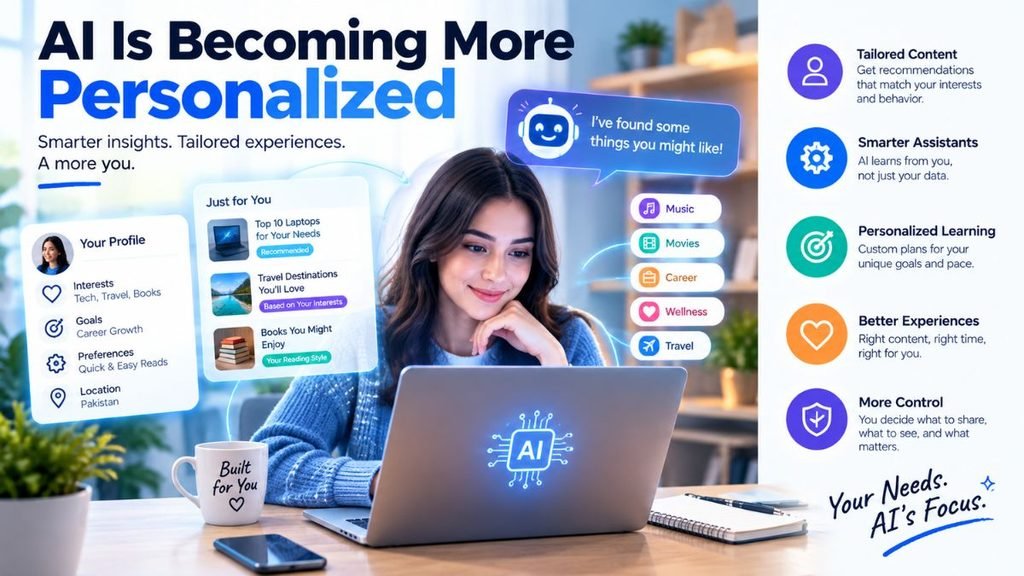
Personalization is another major trend.
AI systems can increasingly adapt responses according to a user’s preferences, previous interactions, goals, or working style.
For example, a productivity assistant may help organize information in a preferred format. A learning assistant may adapt explanations according to a student’s level. A professional writing tool may learn the type of communication a user commonly needs.
Personalization can make AI more useful because users spend less time explaining the same context repeatedly.
At the same time, personalization raises important questions about privacy and data control.
Users should understand what information an AI service stores, how it is used, and what options are available for managing their data.
12. AI in Business Automation
Businesses are among the biggest adopters of AI because automation can save time and improve operational efficiency.
AI can help automate workflows involving:
- Customer communication
- Data entry
- Report generation
- Document analysis
- Marketing
- Sales research
- Customer support
- Scheduling
- Internal knowledge
For small businesses, AI can be particularly useful because it can provide support across multiple areas without requiring a large team.
However, successful implementation requires more than purchasing an AI tool.
Companies need to identify the specific problem they want to solve and determine whether AI is actually the right solution.
13. AI and Cybersecurity
Cybersecurity is becoming increasingly connected with AI.
Security teams can use AI to analyze large quantities of data, identify unusual patterns, prioritize alerts, and assist with investigations.
At the same time, malicious actors can also use AI to create more sophisticated attacks.
This creates an ongoing technological race.
Organizations therefore need stronger security practices, employee awareness, monitoring, authentication, and responsible use of AI systems.
AI can strengthen cybersecurity, but it is not a complete replacement for security professionals and established security processes.
14. AI Regulation and Responsible AI
As AI becomes more powerful and widely used, responsible development is becoming increasingly important.
Governments, organizations, researchers, and technology companies are paying greater attention to issues such as:
- Privacy
- Bias
- Transparency
- Security
- Copyright
- Accountability
- Safety
- Misinformation
AI systems can produce convincing information that is incorrect. They can also reflect problems present in their training data.
Responsible AI therefore requires testing, monitoring, human oversight, and clear policies.
Why AI Transparency Matters
People should ideally understand when they are interacting with an AI system and how important decisions involving AI are made.
For sensitive applications, organizations may need stronger documentation and evaluation procedures.
Trust in AI will depend not only on how capable the technology becomes but also on how responsibly it is developed and deployed.
15. AI and the Future of Work
One of the biggest questions surrounding AI is its effect on employment.
AI is likely to automate some tasks that people currently perform manually. At the same time, it can create demand for new skills and new types of work.
Rather than thinking only in terms of jobs disappearing, it is useful to consider how individual tasks within jobs may change.
For example, a marketing professional may spend less time creating first drafts and more time developing strategy. A programmer may spend less time writing repetitive code and more time reviewing architecture and solving complex problems.
AI Skills Are Becoming Valuable
People who understand how to work effectively with AI can gain an advantage in many fields.
Important skills include:
- AI literacy
- Critical thinking
- Problem-solving
- Communication
- Data awareness
- Prompting and instruction
- Fact-checking
- Technical understanding
The ability to evaluate AI-generated information is just as important as the ability to generate it.
16. AI-Powered Customer Experience
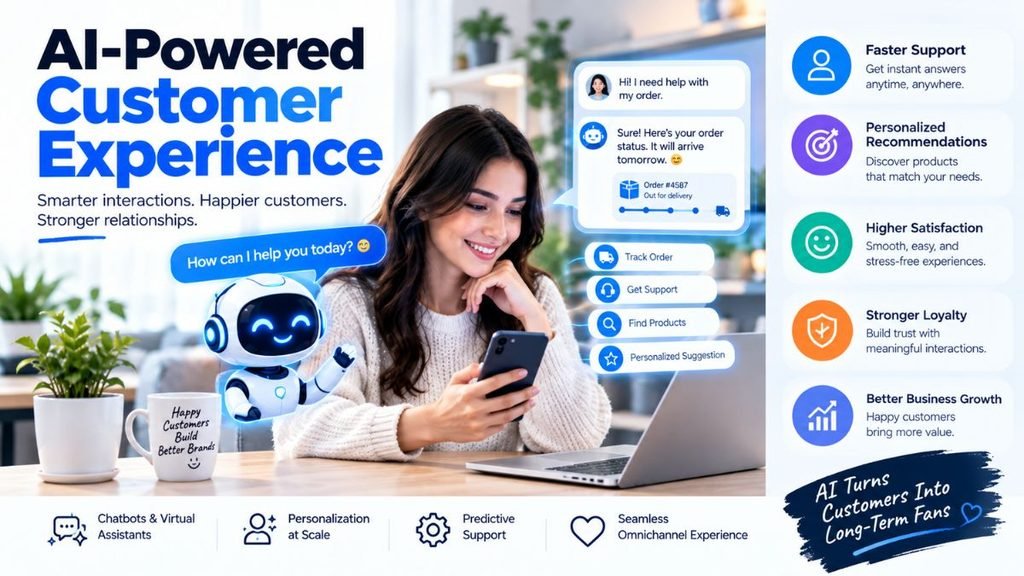
Customer service is another area where AI is changing business operations.
AI-powered assistants can help answer common questions, summarize customer conversations, categorize requests, and provide information quickly.
This can reduce waiting times and allow human representatives to focus on more complicated issues.
The best customer-service systems are likely to combine automation with human support.
Simple questions can be handled quickly by AI, while complex or sensitive problems can be transferred to a human representative.
17. AI in Marketing
Marketing teams are using AI for research, content planning, audience analysis, personalization, and campaign development.
AI can help marketers identify patterns in large datasets and generate multiple ideas quickly.
For example, a marketing team might use AI to brainstorm headlines, organize customer feedback, create campaign variations, or summarize research.
But effective marketing still depends on understanding people.
AI can generate options, but humans need to determine which ideas are appropriate, accurate, ethical, and aligned with the brand.
18. AI for Small Businesses and Entrepreneurs
AI is lowering the barrier to entry for many digital activities.
A small business owner can use AI tools to assist with:
- Website content
- Customer support
- Product descriptions
- Social media ideas
- Market research
- Business planning
- Email drafts
- Data organization
This does not mean AI automatically makes every business successful.
Entrepreneurs still need strong products, customer understanding, marketing strategy, and execution.
The advantage is that AI can help individuals accomplish certain tasks faster and experiment with ideas more efficiently.
19. AI and Scientific Research
Scientific research involves enormous quantities of data, making it another area where AI can be valuable.
Researchers can use machine learning to identify patterns, analyze datasets, generate hypotheses, and accelerate certain stages of discovery.
AI can also assist with simulations and scientific modeling.
The potential impact is significant because faster analysis can allow researchers to explore more possibilities.
However, scientific conclusions still require rigorous validation. An AI-generated hypothesis is not automatically a scientific discovery.
20. AI and Climate Technology
AI can also contribute to environmental and climate-related efforts.
Potential applications include:
- Energy optimization
- Weather and climate modeling
- Agricultural monitoring
- Resource management
- Building efficiency
- Transportation optimization
- Environmental data analysis
For example, AI systems can analyze patterns in energy consumption and help identify opportunities for improved efficiency.
At the same time, AI itself requires significant computing resources. This means the environmental cost of large-scale AI infrastructure also needs to be considered.
21. The Growing Importance of AI Infrastructure
Behind every advanced AI application is a large technological infrastructure.
AI development depends on:
- Computing hardware
- Data centers
- Networking
- Storage
- Specialized processors
- Cloud platforms
- Energy resources
As AI adoption increases, demand for efficient infrastructure also grows.
This means the future of AI is not only about software models. Hardware development, energy efficiency, networking, and data-center technology are equally important parts of the ecosystem.
22. AI Models Are Becoming Better at Reasoning
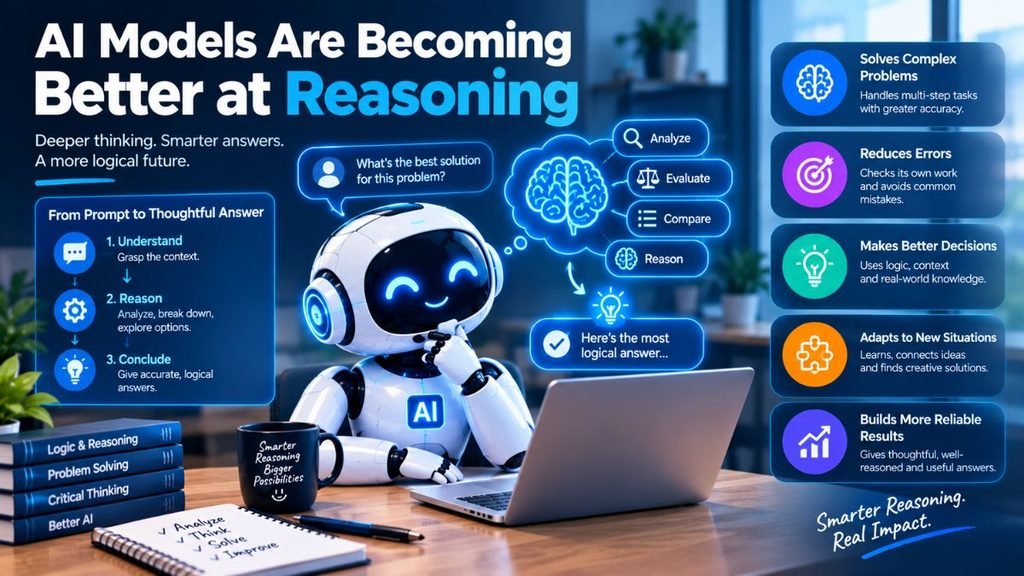
Another major direction in AI development is improved reasoning.
Traditional language models can generate fluent answers, but fluency does not necessarily mean correct reasoning.
Newer approaches increasingly focus on enabling systems to handle complex multi-step problems.
Better reasoning can improve AI performance in areas such as:
- Mathematics
- Programming
- Research
- Planning
- Data analysis
- Technical problem-solving
However, reasoning systems can still make mistakes.
Users should therefore verify important outputs rather than assuming that a confident response is automatically correct.
23. The Rise of AI-Native Applications
Instead of adding a small AI feature to an existing application, developers are increasingly building products around AI from the beginning.
These are often described as AI-native applications.
An AI-native product may use AI as its central interface rather than treating it as an optional feature.
Examples could include intelligent research tools, AI productivity platforms, personalized learning systems, automated design applications, and specialized professional assistants.
This approach is creating opportunities for startups and developers to rethink traditional software products.
24. AI and Data Privacy
As AI becomes more personalized, data privacy becomes increasingly important.
Users may provide AI systems with documents, conversations, work information, personal preferences, and other sensitive data.
Before using an AI service, it is sensible to understand:
- What information is collected?
- How is it stored?
- Is it used for model improvement?
- Who can access it?
- How long is it retained?
- What privacy controls are available?
Organizations also need clear policies for employees using AI tools.
A convenient AI application is not necessarily appropriate for every type of information.
25. Challenges Facing AI in 2026
Despite its rapid development, AI still has significant limitations.
Accuracy
AI systems can generate incorrect information. This is one of the most important limitations because generated content can sometimes appear highly convincing.
Bias
AI systems can reflect biases present in the data used to train them.
Privacy
AI applications may process large quantities of user information, creating privacy concerns.
Security
AI systems can introduce new security risks while also helping defend against existing ones.
Cost
Advanced AI systems can require significant computing resources.
Dependence
Overreliance on AI can weaken human judgment if people stop reviewing outputs critically.
Copyright and Ownership
AI-generated content raises ongoing questions about training data, intellectual property, and ownership.
These challenges demonstrate why AI advancement needs to happen alongside responsible development.
26. How People Can Prepare for an AI-Driven Future
The best way to prepare for AI is not necessarily to become an AI engineer.
People in many careers can benefit from developing basic AI literacy.
Start by understanding what AI can and cannot do.
Then learn how to use AI tools for practical tasks relevant to your field.
For example:
- Writers can use AI for brainstorming and editing.
- Developers can use AI for coding assistance.
- Students can use AI for explanations and practice.
- Marketers can use AI for research and content planning.
- Business owners can use AI for automation.
- Researchers can use AI for organizing information.
The key is to combine AI capabilities with human expertise.
27. What Businesses Should Consider Before Adopting AI
Businesses should avoid adopting AI simply because it is a trend.
A better approach is to identify a specific problem.
Ask:
- What task takes too much time?
- Can AI realistically improve it?
- What information will the AI need?
- What risks are involved?
- Who will review the output?
- How will success be measured?
A small pilot project can often be more useful than attempting to automate an entire organization immediately.
Businesses should also train employees so they understand how to use AI responsibly.
28. The Future of Human-AI Collaboration
The most interesting future may not be humans versus AI.
It may be humans working with AI.
AI is particularly good at processing large quantities of information, generating possibilities, recognizing patterns, and automating repetitive tasks.
Humans remain important for judgment, empathy, creativity, leadership, context, ethics, and responsibility.
When these strengths are combined, AI can become a powerful productivity tool.
The goal should not simply be to automate everything. The goal should be to use technology where it creates meaningful value.
29. What Could AI Look Like Beyond 2026?
The developments taking place in 2026 may represent another step toward more integrated intelligent systems.
Future AI could become increasingly capable of:
- Managing complex workflows
- Understanding longer-term context
- Interacting with software independently
- Working across different media
- Controlling physical devices
- Personalizing experiences
- Supporting scientific discovery
- Assisting professionals in specialized fields
However, predicting the exact future of AI is difficult.
Technology can develop in unexpected directions, and practical adoption depends on economics, regulation, safety, infrastructure, and public acceptance.
30. Final Thoughts on AI in 2026
Artificial intelligence in 2026 is becoming more capable, more accessible, and more deeply integrated into everyday technology.
The biggest developments are not limited to chatbots or text generation. AI agents, multimodal systems, intelligent search, coding assistants, robotics, personalized applications, AI-powered business automation, and specialized models are all contributing to a broader transformation.
At the same time, AI comes with real challenges. Accuracy, privacy, security, bias, copyright, employment changes, and responsible use all require serious attention.
For individuals and businesses, the most useful approach is to treat AI as a powerful tool rather than an unquestionable authority.
People who learn how to combine AI with human judgment, creativity, expertise, and critical thinking will be better positioned to benefit from the technology.
The AI revolution is therefore not simply about machines becoming smarter. It is about how humans choose to use increasingly capable technology.
As 2026 continues, the most important developments may come not only from larger and more advanced AI models, but from the ways these systems become part of real-world products, workplaces, education, research, and everyday life.
Frequently Asked Questions About AI in 2026
What are the biggest AI trends in 2026?
Major AI trends include AI agents, multimodal systems, AI-powered search, generative AI, coding assistants, personalized AI, robotics, business automation, and the development of more efficient specialized models.
Is AI becoming more powerful in 2026?
AI capabilities continue to develop rapidly, particularly in areas such as reasoning, multimodal interaction, coding, automation, and complex task assistance. However, AI systems still have important limitations and can produce incorrect information.
How is AI changing the workplace?
AI is automating and assisting with many repetitive and information-heavy tasks. It can help with research, writing, coding, customer support, data analysis, marketing, and administrative workflows.
Will AI replace human workers?
AI may automate certain tasks and change the way many jobs are performed, but the impact varies considerably by industry and occupation. Human skills such as judgment, communication, creativity, leadership, and specialized expertise remain important.
What is an AI agent?
An AI agent is a system designed to work toward a goal by planning tasks, using available tools, interacting with software or information, and completing multiple steps instead of simply responding to one prompt.
What is multimodal AI?
Multimodal AI can process or work with multiple types of information, such as text, images, audio, video, and documents.
Is AI useful for small businesses?
Yes. Small businesses can use AI for customer support, content creation, marketing, research, administrative work, data organization, and other tasks. The best results usually come from applying AI to specific business problems rather than using it simply because it is popular.
What are the biggest risks of AI?
Important risks include inaccurate information, privacy problems, security vulnerabilities, bias, misuse, overreliance, copyright concerns, and potential disruption to certain types of work.
How can students use AI responsibly?
Students can use AI to understand difficult concepts, practice questions, brainstorm ideas, summarize material, and receive explanations. They should still develop their own understanding and verify important information.
What is the future of AI?
AI is likely to become increasingly integrated into software, devices, businesses, education, healthcare, research, robotics, and other areas. The exact direction remains uncertain, but human-AI collaboration is likely to become increasingly important.