Artificial intelligence has moved far beyond simple chatbots and text generators. In 2026, one of the biggest developments in AI is the rise of AI agents—systems designed not only to answer questions but also to plan tasks, use digital tools, make decisions, and complete multi-step workflows with limited human intervention.
From managing business processes to helping developers write software, AI agents are becoming an important part of how people interact with technology. Unlike traditional AI tools that usually respond to a single prompt, autonomous AI agents can work toward a broader goal by breaking it into smaller tasks and taking action along the way.
This shift could change how companies operate, how employees complete routine work, and how consumers use digital services.
But what exactly are AI agents? How do they work, and why are they becoming so important in 2026?
What Are AI Agents?
AI agents are software systems that can perceive information, reason about a goal, plan actions, use available tools, and complete tasks with varying levels of human supervision.
A traditional chatbot generally waits for a user to provide a prompt and then generates a response. An AI agent can take a broader objective and determine what steps may be necessary to achieve it.
For example, instead of asking an AI assistant to write a single email, a business could give an AI agent a broader task such as organizing customer inquiries. Depending on its permissions and tools, the agent could:
- Review incoming messages
- Identify the purpose of each inquiry
- Categorize requests
- Retrieve relevant information
- Draft responses
- Escalate complex cases to a human
- Update a customer-management system
The important difference is action.
AI agents are increasingly being designed to move from simply generating information toward completing useful workflows.
How Do AI Agents Work?
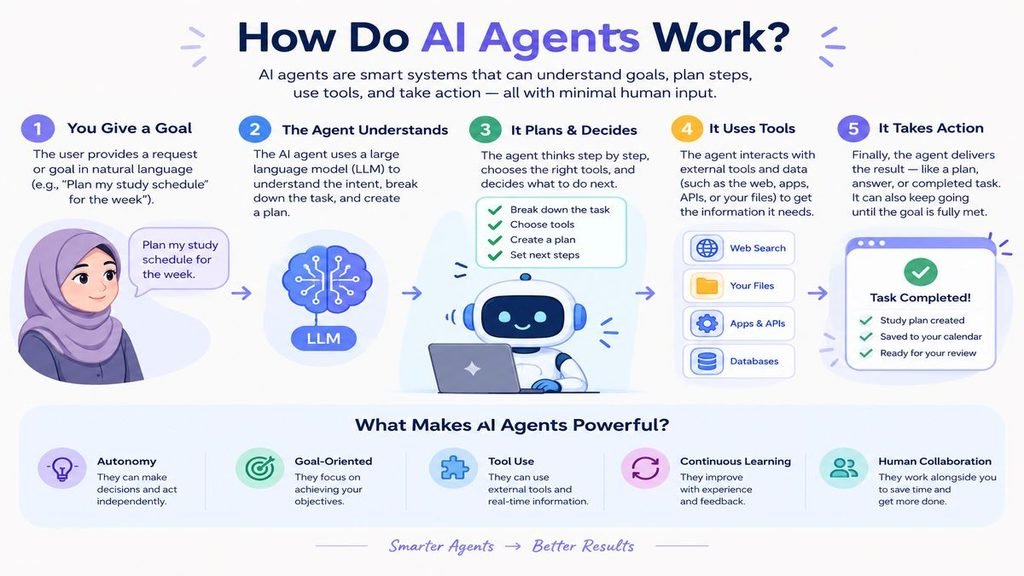
Although implementations vary, most AI agents combine several important components.
1. Understanding the Goal
The first step is understanding what the user or organization wants to accomplish.
A goal might be relatively simple, such as organizing information, or more complex, such as researching potential business opportunities.
The AI system interprets the objective and determines what needs to happen.
2. Planning
An agent may break a large objective into smaller tasks.
For example, a research-oriented agent could determine that it needs to:
- Identify relevant sources.
- Collect information.
- Compare the findings.
- Organize the information.
- Produce a final report.
This planning capability is one of the characteristics that distinguishes agentic systems from basic question-and-answer applications.
3. Using Tools
AI agents can potentially interact with software tools, databases, websites, APIs, spreadsheets, development environments, and other digital systems.
This gives them the ability to do more than generate text.
For example, an AI coding agent may be able to inspect a software project, identify an issue, modify relevant code, and run tests.
4. Taking Action
After deciding what to do, an agent can execute permitted actions.
The exact level of autonomy depends on the system.
Some agents require users to approve important actions, while others can complete predefined workflows automatically.
5. Evaluating Results
A more advanced agent can evaluate whether an action produced the expected result.
If something goes wrong, it may revise its approach and attempt another step.
This creates a basic cycle:
Goal → Plan → Act → Evaluate → Adjust
That cycle is central to many agentic AI systems.
AI Agents vs. Traditional AI Tools
It is easy to confuse AI agents with ordinary AI assistants, but there is an important distinction.
A conventional AI tool might answer:
“How can I improve my website’s SEO?”
An AI agent could potentially be given a broader objective such as improving a website’s technical SEO and then use authorized tools to inspect pages, identify issues, prepare recommendations, and assist with implementation.
The difference is not simply intelligence. It is also about autonomy, tool use, planning, and task execution.
| Traditional AI Tool | AI Agent |
|---|---|
| Usually responds to prompts | Can work toward a broader goal |
| Often performs one interaction at a time | Can perform multiple connected steps |
| Mainly generates information | Can potentially take actions |
| Limited tool interaction | Can use multiple tools |
| Usually requires frequent instructions | Can operate with greater autonomy |
However, not every AI agent is fully autonomous. Many systems still require human approval for sensitive or high-impact decisions.
Why AI Agents Matter in 2026
AI agents are gaining attention because businesses and individuals increasingly want AI to do more than generate content.
Generative AI demonstrated that machines can produce text, images, code, audio, and other forms of content. Agentic AI takes that foundation and focuses more heavily on getting tasks done.
This could have significant implications for productivity.
Instead of spending hours moving information between different applications, a worker could potentially delegate parts of the workflow to an AI agent.
For businesses, that could mean automating repetitive processes while allowing employees to focus on tasks requiring judgment, creativity, communication, and domain expertise.
AI Agents in the Workplace
One of the biggest areas of development is workplace automation.
Businesses perform countless repetitive digital tasks every day. AI agents could assist with some of these processes.
Customer Support
AI agents can help organizations manage customer-service workflows.
They may be used to:
- Sort incoming support requests
- Identify common problems
- Find relevant documentation
- Draft responses
- Summarize conversations
- Route complicated cases to human employees
Human representatives can then focus on unusual or sensitive situations.
Research and Analysis
Research is another area where agents can be useful.
An AI research agent could potentially gather information from authorized sources, organize findings, compare data, and prepare a structured summary.
This doesn’t eliminate the need for human verification. In fact, fact-checking and source evaluation remain important, particularly when research influences business or financial decisions.
Marketing
Marketing teams can use AI systems for various stages of campaigns.
Agents may assist with:
- Market research
- Competitor analysis
- Content planning
- Keyword research
- Campaign organization
- Performance analysis
Human marketers can still provide the strategy, brand direction, and final judgment.
Software Development
AI agents are also changing software development.
Modern coding systems can assist developers with understanding codebases, generating code, debugging problems, writing tests, and explaining technical concepts.
An agentic coding workflow can potentially connect several of these activities.
For developers, this means AI may increasingly function as a software development collaborator rather than merely a code generator.
AI Agents and Small Businesses
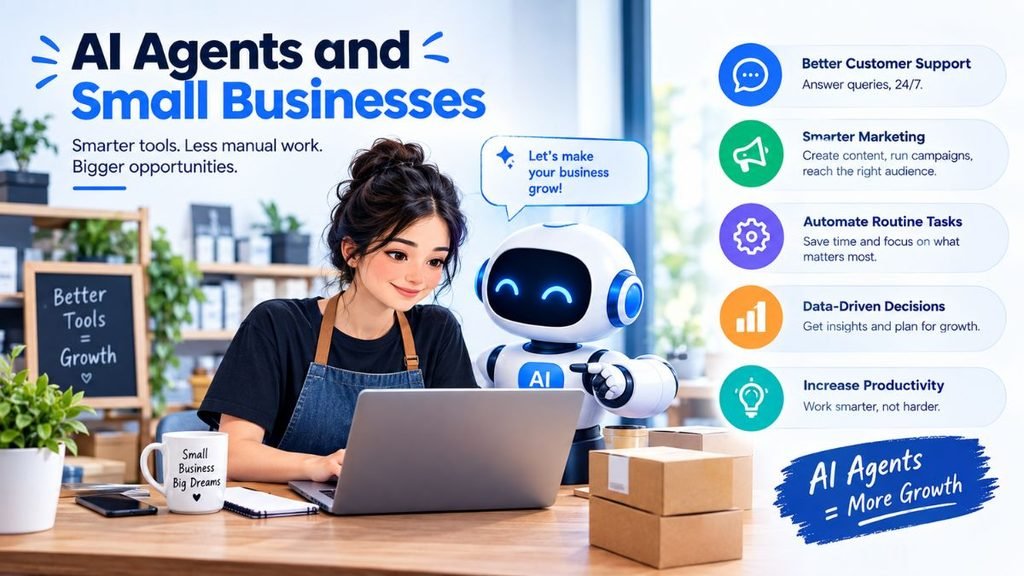
AI agents aren’t only relevant to large corporations.
Small businesses may also benefit from automation because they often have limited staff and resources.
A small online business could potentially use AI-powered workflows to assist with:
- Customer inquiries
- Appointment scheduling
- Inventory-related tasks
- Email organization
- Lead qualification
- Content planning
- Internal documentation
For a small company, automating even a few repetitive processes could free employees to spend more time on customers and business growth.
However, businesses should evaluate the cost, reliability, privacy implications, and risks before allowing an AI system to perform important operations.
AI Agents for Everyday Users
AI agents are also expected to become increasingly visible in consumer technology.
Instead of interacting with dozens of individual applications, users may increasingly communicate with AI systems that help coordinate tasks across multiple services.
For example, a personal AI assistant could potentially help a user organize a schedule, summarize messages, prepare a travel plan, or manage a collection of digital information.
The exact capabilities depend on the tools and permissions available to the system.
The broader idea is simple:
Instead of asking users to learn how every application works, AI could increasingly help users accomplish goals across applications.
AI Agents and Personal Productivity
Productivity is one of the most promising use cases.
People regularly spend time on tasks such as:
- Sorting emails
- Creating meeting summaries
- Organizing documents
- Preparing reports
- Managing calendars
- Researching information
- Creating task lists
AI agents could assist with these workflows by connecting several steps together.
For example, after a meeting, an AI system could potentially summarize the discussion, identify action items, organize them into a task list, and prepare follow-up messages for review.
The user remains responsible for checking important information before anything consequential is sent or changed.
The Rise of Multi-Agent Systems
Another important development is the concept of multi-agent AI systems.
Instead of relying on one AI agent to perform an entire workflow, different agents can potentially specialize in different tasks.
For example:
- One agent researches information.
- Another analyzes the findings.
- Another prepares a report.
- A final system reviews the output.
This resembles a digital team where different AI systems have different responsibilities.
Multi-agent approaches can potentially make complicated workflows easier to organize, although they also introduce additional complexity.
More agents do not automatically mean better results. Coordination, verification, permissions, and error handling become increasingly important as systems become more complicated.
AI Agents and Automation
Automation has existed for decades, but AI agents could make automation more flexible.
Traditional automation generally follows predefined rules.
For example:
If a customer submits a form → send an email.
An AI-powered workflow could potentially interpret less structured information and determine what action should happen next.
For example:
Customer message → understand the request → identify relevant information → determine the appropriate workflow → prepare a response or escalate to a human.
This flexibility is one reason businesses are paying close attention to agentic AI.
What Are the Benefits of AI Agents?
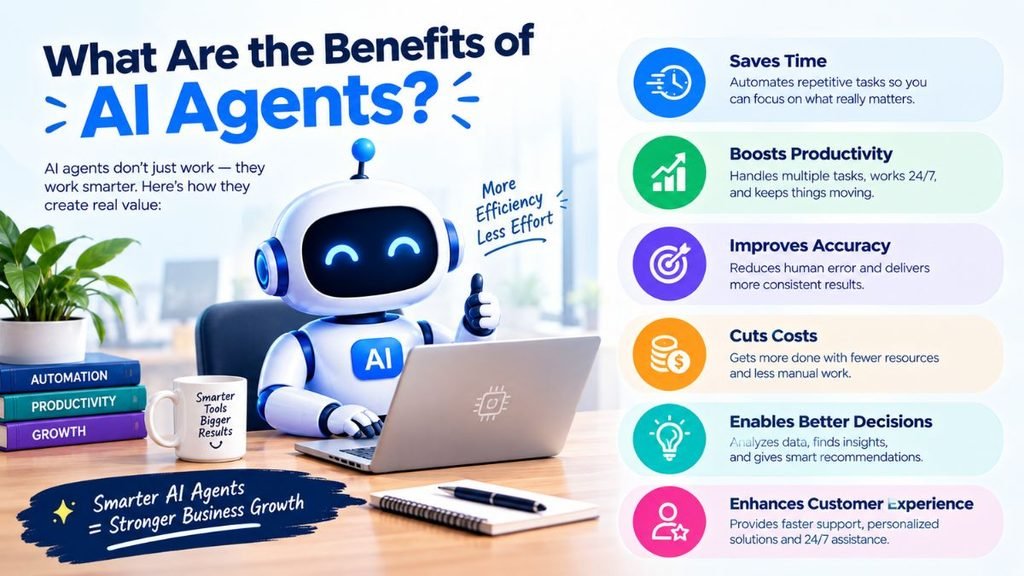
AI agents can offer several potential benefits when they are implemented responsibly.
Increased Productivity
Agents can handle repetitive digital tasks, allowing people to spend more time on higher-value activities.
Faster Workflows
A system that can perform several connected steps may reduce the time required to complete certain processes.
24/7 Availability
Software-based AI systems can operate outside normal working hours, which can be useful for customer service and other continuous workflows.
Better Scalability
Businesses can potentially automate portions of processes as demand increases without increasing every operational task manually.
Personalized Assistance
AI agents can potentially adapt their actions based on user instructions, available information, and context.
The Risks and Limitations of AI Agents
Despite their potential, AI agents are not perfect.
Greater autonomy also creates greater risks.
Incorrect Decisions
An AI agent can misunderstand information or produce an incorrect conclusion.
If the system is allowed to take actions automatically, an error can have consequences beyond an incorrect chatbot response.
Hallucinations
AI systems can sometimes generate information that sounds convincing but is inaccurate.
For this reason, important outputs should be verified.
Privacy Concerns
AI agents may require access to emails, files, calendars, business systems, or other sensitive information.
Organizations need clear rules about what data an agent can access and what actions it is allowed to perform.
Security Risks
An agent with extensive permissions could create security problems if its instructions, tools, or connected systems are compromised.
Security therefore becomes especially important as AI systems gain more ability to act.
Lack of Human Judgment
Some decisions require context, empathy, ethical reasoning, or professional expertise that should not be delegated entirely to an automated system.
Human oversight remains essential for many high-impact situations.
Why Human Oversight Still Matters
The growing capabilities of AI agents do not mean humans become unnecessary.
Instead, the role of humans may change.
People can define objectives, establish boundaries, review important decisions, and intervene when an AI system encounters something unexpected.
A useful approach is:
Let AI handle appropriate repetitive work while humans retain control over important decisions.
For example, an AI agent might prepare a customer response, but a human employee could review it before sending it in sensitive situations.
This type of human-in-the-loop system can provide a balance between automation and accountability.
AI Agents and the Future of Jobs
One of the biggest questions surrounding agentic AI is its impact on employment.
AI agents are likely to automate some tasks within jobs rather than simply replacing entire occupations overnight.
A single profession can contain dozens of different activities. Some may be highly repetitive and suitable for automation, while others require creativity, interpersonal communication, physical work, or complex judgment.
As AI becomes more capable, workers may increasingly need skills such as:
- AI literacy
- Critical thinking
- Problem-solving
- Communication
- Domain expertise
- Data awareness
- Ability to evaluate AI-generated information
The future workplace may therefore involve humans and AI systems working together more closely.
How AI Agents Could Change Business Operations
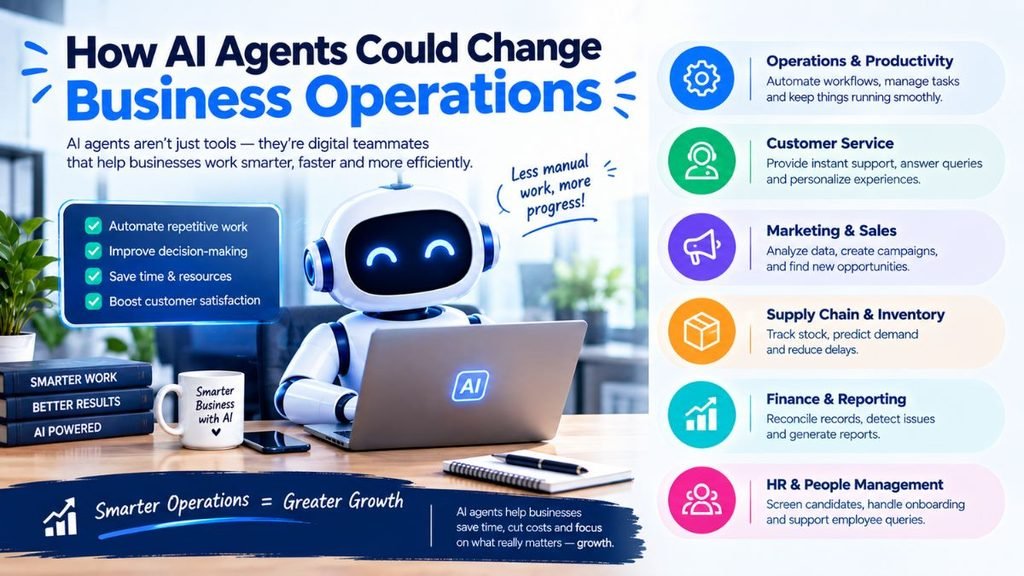
Businesses traditionally organize work around departments and software applications.
AI agents could create another layer between employees and those systems.
Instead of manually moving information from one application to another, an employee might communicate a goal to an AI system that coordinates parts of the process.
For example:
Employee goal → AI planning → multiple tools → completed workflow → human review
This could make business software more conversational and task-oriented.
AI Agents and Education
Education is another area where AI agents could provide assistance.
Students may use AI systems to:
- Organize study plans
- Explain difficult concepts
- Generate practice questions
- Summarize learning materials
- Track assignments
- Practice problem-solving
Teachers could potentially use AI systems to assist with administrative tasks and educational planning.
However, AI should support learning rather than replace the student’s own thinking. Students still need to understand the material and develop independent reasoning skills.
AI Agents and Healthcare
Healthcare could also benefit from agentic systems, but this area requires especially careful safeguards.
AI may assist with administrative workflows, information organization, appointment-related processes, documentation, and other tasks.
However, medical decisions involve significant risks. AI systems should not be treated as a substitute for qualified healthcare professionals.
In high-stakes environments, accuracy, privacy, security, regulation, and human oversight are particularly important.
What Will AI Agents Look Like in the Future?
The future of AI agents may not be one giant system controlling everything.
Instead, we may see specialized agents designed for specific purposes.
Examples could include:
- Personal productivity agents
- Coding agents
- Research agents
- Marketing agents
- Customer-service agents
- Financial administration agents
- Education assistants
- Business workflow agents
These systems may increasingly communicate with software tools and with one another.
The result could be a digital environment where AI is less like a single chatbot and more like an intelligent layer connecting people, information, and software.
How Businesses Can Prepare for AI Agents
Companies interested in agentic AI should not start by giving an AI system unlimited access to everything.
A better approach is to begin with clearly defined, lower-risk workflows.
Step 1: Identify Repetitive Tasks
Find processes that consume significant time but follow predictable patterns.
Step 2: Start Small
Test AI agents on a limited workflow before expanding their permissions.
Step 3: Define Permissions
Clearly establish what an agent can read, change, send, or delete.
Step 4: Add Human Review
Require approval for sensitive or high-impact actions.
Step 5: Monitor Performance
Track errors, unexpected behavior, and overall effectiveness.
Step 6: Improve Gradually
Use real-world feedback to refine workflows and safeguards.
The Difference Between AI Automation and AI Agents
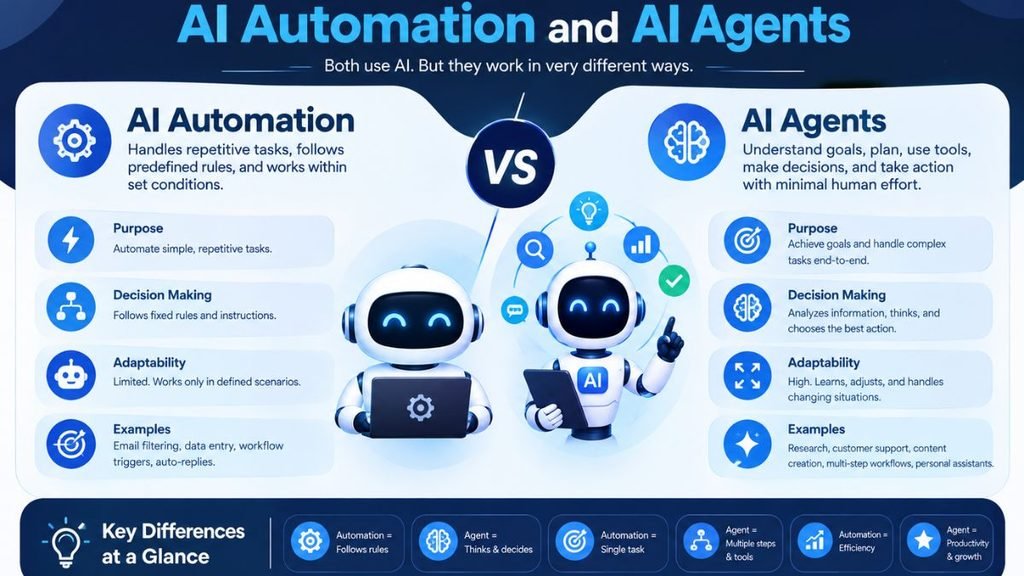
These terms are related but aren’t exactly identical.
AI automation generally refers to using AI to automate tasks or workflows.
AI agents are systems that can use reasoning, planning, tools, and actions to pursue a goal with some degree of autonomy.
An AI agent can therefore be part of an automated workflow, but not every AI automation system needs to be an agent.
Understanding this distinction is useful because businesses should select the simplest technology that solves their actual problem.
Are AI Agents Fully Autonomous?
No.
The word “autonomous” can make AI agents sound more independent than they actually are.
Most real-world systems operate within boundaries defined by developers or organizations.
Their autonomy may be limited by:
- Available tools
- System permissions
- Human approvals
- Security policies
- Business rules
- Technical limitations
In many cases, the best approach isn’t complete autonomy but controlled autonomy.
What Makes an AI Agent Reliable?
Reliability depends on more than the underlying AI model.
A reliable agent also needs:
Clear instructions
The system needs a well-defined objective.
Appropriate tools
It should have access only to tools necessary for its task.
Strong permissions
Sensitive actions should be restricted.
Verification
Important outputs should be checked.
Monitoring
Organizations should be able to identify failures and unusual behavior.
Human oversight
People should remain involved where mistakes could cause significant harm.
The Future of Agentic AI
AI agents are still developing, but their direction is becoming increasingly clear.
AI is moving from systems that primarily generate information toward systems that can increasingly plan and execute tasks.
This does not mean every digital task will soon be handled autonomously. Real-world environments are complicated, and reliable automation requires strong infrastructure, security, evaluation, and governance.
Nevertheless, agentic AI could become one of the defining technological developments of the late 2020s.
As models become more capable and software becomes increasingly connected, the boundary between “asking AI a question” and “asking AI to accomplish something” may continue to disappear.
Final Thoughts
AI agents in 2026 represent an important shift in how artificial intelligence is being used.
Instead of limiting AI to conversations, content generation, or isolated tasks, developers are increasingly building systems that can understand goals, plan multiple steps, interact with tools, and perform actions.
The potential benefits are significant. Businesses could automate repetitive workflows, employees could save time, developers could accelerate software projects, and individuals could receive more capable digital assistance.
At the same time, greater autonomy creates greater responsibility.
Privacy, security, accuracy, human oversight, and carefully designed permissions will be essential as AI agents become more deeply integrated into everyday technology.
The most important question may therefore not be whether AI agents will become more capable. It is how people and organizations will choose to use that capability responsibly.
As 2026 continues, AI agents are likely to become an increasingly important part of the conversation about the future of work, business, and technology.
Frequently Asked Questions
What is an AI agent?
An AI agent is a software system that can understand a goal, plan tasks, use tools, and take actions with some level of autonomy.
Are AI agents the same as chatbots?
No. Chatbots primarily respond to user prompts, while AI agents can potentially plan and execute multiple steps toward a broader objective.
What are AI agents used for?
AI agents can assist with areas such as customer support, research, software development, marketing, productivity, business automation, and information management.
Can AI agents replace human workers?
AI agents may automate some tasks currently performed by humans, but many jobs involve judgment, creativity, communication, and expertise that cannot simply be reduced to automated workflows.
Are AI agents safe?
AI agents can be useful, but their safety depends on how they are designed, what permissions they receive, what information they can access, and how much human oversight is provided.
Why are AI agents important in 2026?
AI agents are important because they represent a shift from AI that primarily generates information toward AI systems that can increasingly plan, use tools, and complete tasks.